
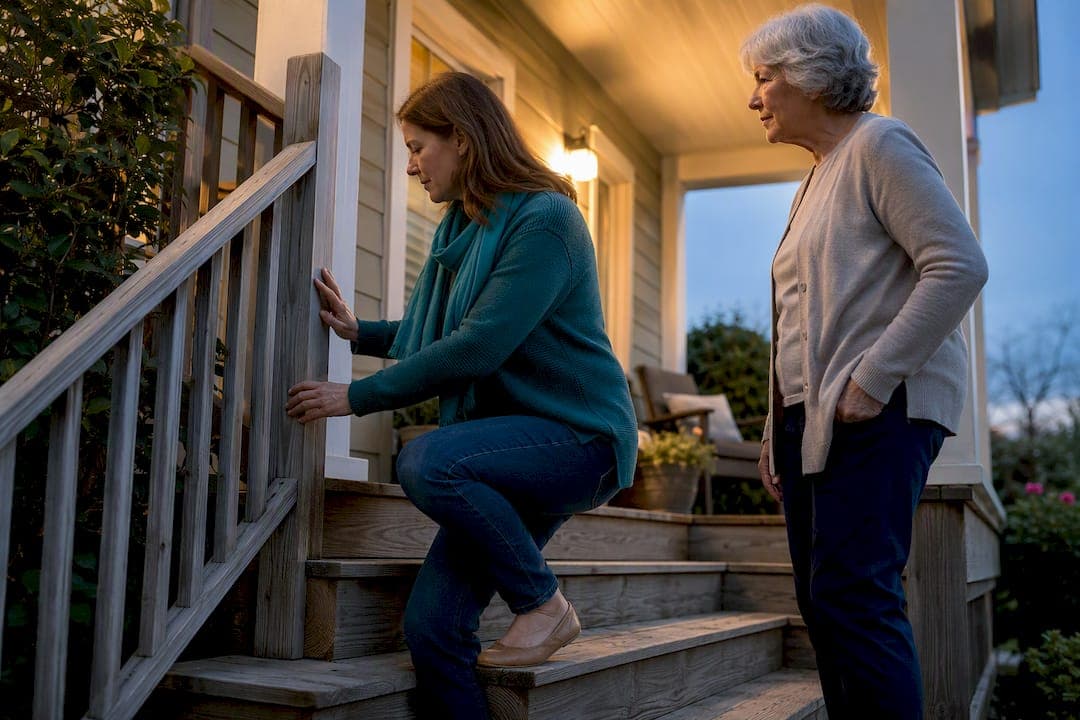
The changes that make the biggest difference at an entryway are also the simplest: clear the path, add real light, secure a handrail, and smooth out any bump or lip at the door. Most falls among high-risk older adults happen inside or right around the home, which makes the entry one of the most important spots to check first. Helping Mom built this guide, along with a printable checklist below, so you can start today without turning the whole project into a renovation.
TL;DR:
- Clear pathways, secure handrails, and eliminate door thresholds or lips to prevent falls, especially where water pooling or uneven surfaces are present.
- Test existing handrails and thresholds with your parent to ensure they feel sturdy and safe before buying or installing new hardware or ramps.
- Install motion-activated lighting, non-slip strips, and secure entry mats to reduce the risk of falls during nighttime or wet conditions.
- Most quick safety upgrades like swapping doorknobs or applying non-slip tape can be completed within a weekend, but structural repairs require professional contractors.
- Keep emergency communication devices and weather protection, such as porch covers or awnings, near the entry to enhance safety during emergencies and adverse weather.
Table of Contents
- A quick checklist for your entry safety walk-through
- Entry-by-entry fixes: porch, steps, threshold, and door
- Getting the lighting and footing right at the door
- Low-cost, high-impact projects to finish in a weekend
- Knowing when to call in a professional
- Emergency communication systems near the entry
- Covering the entry so weather doesn't become a hazard
- Helping seniors with vision or touch changes navigate the entry
- How Helping Mom thinks about entry safety
- Services that help you take the next step
- Where to go for more evidence and local help
- Sources
- FAQ
A quick checklist for your entry safety walk-through
Grab a notepad and walk your parent's entry the way they do, slowly, with your hands full if you can manage it. That's often when you'll notice what a quick glance misses.
- Porch and approach: the path should be clear of hoses, plant pots, and toys, with no cracked or uneven pavement.
- Steps: handrails should feel solid and firmly anchored when gently tested, and every step should be the same height.
- Threshold: there shouldn't be a lip or gap taller than a shoe's sole where the door meets the floor.
- Door hardware: round doorknobs are harder for arthritic hands than lever handles, and locks should turn with one motion.
- Lighting: you should be able to find the keyhole in the dark without your phone's flashlight.
Mark each item as immediate (fix today), low-cost (a weekend project), or pro needed (call someone). The NIA's home safety guidance points to exactly this mix of quick fixes and one or two bigger jobs as the most effective use of a limited budget. For a version you can print and keep on the fridge, Helping Mom's elderly home safety checklist walks through the same categories room by room.
Entry-by-entry fixes: porch, steps, threshold, and door
Once you've walked the entry once, it helps to slow down and look at each piece separately. Small entry problems tend to compound: a slightly cracked path leads to a rushed step onto an uneven stair, which leads to a grab for a railing that isn't there.
Porch and pathway. Check for drainage first. Water that pools near the door freezes in winter and stays slick in the rain, so a slight slope away from the house matters more than it looks. Sweep leaves and debris weekly during fall, and keep a clear, level line of travel from the driveway or car to the door. If pavers have shifted or cracked, patch or replace them rather than hoping your parent will remember to step around them.

Stairs and railings. A handrail should run continuously along the full length of the stairs, not stop halfway. It needs to be anchored into solid framing or a concrete footing rather than surface-mounted into thin decking or fascia board, which is a common point of failure. Test any existing handrail by gently applying pressure at several points to confirm it feels secure and stable. If your parent has balance challenges or uses a cane or walker, having handrails on both sides of the stairs can provide added support
Thresholds and ramps. The NIA recommends ramps with handrails as one of the most effective home modifications for reducing fall risk, and reducing the threshold itself is often the fastest win. A beveled rubber or aluminum trim piece can help smooth a small lip quickly and simply. Choose one with drainage channels built in, since a solid strip can trap water against the door. For higher steps, a temporary ramp can help immediately, with plans to install a permanent ramp with proper slope and landings if needed
Door hardware. Replacing round doorknobs with lever handles makes opening doors easier for those with arthritis or limited hand strength. Choose locks that are easy to operate with a single motion, avoiding more complicated deadbolts when possible. A wide-angle peephole helps, but if your parent uses a wheelchair or has lost height with age, a second peephole mounted lower, or a small door-mounted camera, lets them see who's outside without straining.
A note for renters. If your parent rents, the Fair Housing Act generally requires housing providers to allow reasonable modifications like grab bars or ramps, though the tenant typically covers the cost and may need to request permission in writing first.
Pro Tip: Before you buy anything, test the existing handrail and threshold with your parent standing there. What feels sturdy to you might still feel shaky to someone with less grip strength or balance.
Getting the lighting and footing right at the door
Poor lighting and slick surfaces are two of the quieter causes of entry falls, and both are fixable without a contractor.
For lighting, a motion-activated or dusk-to-dawn fixture at the porch means your parent never has to fumble for a switch in the dark. Adding path lights along the walkway and placing switches at both ends of routes helps create even lighting and ease of use A sudden shift from a bright porch light to a pitch-dark yard is disorienting, so aim for even coverage rather than one strong spot.
Contrast matters as much as brightness. A glossy painted step can throw glare back at exactly the wrong moment, so matte finishes on steps and landings are safer than shiny ones.
For traction, adhesive non-slip strips or rubber stair treads are inexpensive and can go on in an afternoon. Choose a securely anchored mat rather than a loose one at the door, since a mat that slides is its own hazard. In winter, keep ice melt or sand by the door and use it before the first hard freeze, not after someone's already slipped.
A simple way to check your work: walk the entry route at night, in the shoes your parent actually wears, carrying something in both hands the way they'd carry groceries or mail. Bathroom and stairway or entry falls show a higher chance of injury than falls in a living room, which is exactly why this walk-through is worth the ten minutes.

Low-cost, high-impact projects to finish in a weekend
You don't need a full weekend for most of these. Many impactful safety fixes can be completed within a weekend morning
- Install or firmly secure an outdoor handrail to ensure safe support Use lag bolts into wall studs or a concrete anchor, never just wood screws into siding, and test it under real weight before calling it done.
- Swap a round doorknob for a lever handle. This is usually a 15 to 30 minute job with a screwdriver and a new hardware set from any home improvement store.
- Apply non-slip tape to steps and entry flooring. Textured outdoor-rated tape costs relatively little and holds up for a year or more if you clean the surface well before applying it.
- Install a plug-in motion light and a secure entry mat. No wiring needed, and both can go up in under an hour.
For new electrical work, major structural changes to stairs or porches, or permanent ramps, hire a licensed professional Those jobs need a licensed contractor, both for safety and because a mistake there is expensive to undo.
Knowing when to call in a professional
Some fixes are weekend projects. Others aren't, and it's worth knowing the difference before you start.
- Uneven or crumbling steps usually mean a structural repair, not a patch job.
- A permanent ramp involves footings, drainage, and slope calculations that are easy to get wrong.
- New electrical work, like wiring a hardwired porch light, should go to a licensed electrician.
- A stairlift or major remodel is a bigger investment worth getting quoted by more than one contractor.
A professional home safety assessment typically involves a walk-through of the entry, stairs, and interior, followed by a written list of recommendations you can act on in stages. Before the visit, jot down specific concerns (a step that wobbles, a door that sticks) so the time is used well. When you're hiring anyone, ask about licensing, insurance, references, and whether they're familiar with accessible design standards. If cost is a concern, your local Area Agency on Aging may know about home modification funding programs in your area.
Emergency communication systems near the entry
Keep a phone or communication device within easy reach near the entry to quickly call for help if needed. A simple wall-mounted intercom near the entry lets your parent talk to whoever's outside without walking to answer it, which matters if their balance is already shaky. Video doorbells serve a similar purpose and let them see a visitor before opening the door at all.
For emergencies, a wearable medical alert pendant or wristband with a panic button covers more ground than any fixed intercom, since falls don't wait until someone's standing at the door. Some systems also include a small base station or key box near the entry so first responders can get in without breaking a lock, which is worth discussing with your parent ahead of time rather than after an emergency. None of this needs to feel like surveillance. Framed well, it's closer to a spare key for peace of mind: something that sits quietly in the background until it's needed. A comprehensive guide to home safety devices walks through options in more detail if you want to compare a few before choosing.
Covering the entry so weather doesn't become a hazard
Weather can quickly make entry areas slippery; adding a porch roof, awning, or small cover helps keep the area dry and safer. A porch roof, awning, or even a retractable canopy keeps the landing dry during a storm, which matters most right at the door where your parent slows down to find their keys.
If a full porch cover isn't practical, a smaller overhang just above the door goes a long way, and it's a much smaller project. Pair any weather cover with a boot tray or absorbent mat just inside the door so wet shoes don't turn the entry hallway into its own hazard. In colder climates, keep a stocked bin of ice melt or sand right by the door, not in the garage, so it's used before the first freeze rather than after a fall.
Helping seniors with vision or touch changes navigate the entry
Aging eyes see contrast and depth differently, so a step edge that's obvious to you might be invisible to your parent. Painting the edge of each step a contrasting color, using bright tape on a threshold, or choosing a doormat in a color that stands out from the porch floor all help someone judge where one surface ends and another begins.
Texture works the same way for touch. A textured strip at the top and bottom step, or a slightly rougher material on a ramp surface, gives a tactile cue underfoot that a flat, uniform surface doesn't provide. These small visual and tactile signals cost very little to add and make a real difference for anyone whose eyesight or sensation has started to change with age.
How Helping Mom thinks about entry safety
I've spent enough time walking through parents' homes with their adult children to know that fear rarely gets anyone to actually fix anything. What works is starting small: one handrail, one light, one weekend project that makes the next visit feel a little less worrying.
Entry safety is best framed around dignity first. We look for the lowest-cost, least disruptive change that solves the real problem, and we treat a home safety review as something to revisit every year or two, not a one-time checklist. Our aging in place guide walks through how to stage bigger changes over time so nothing feels like an overhaul.
— Mike C.
Services that help you take the next step
If walking through this alone feels like a lot, services are available. Virtual Home Safety Consultations provide guided reviews of photos and a prioritized plan without a home visit. In-Home Age-Safe Home Safety Assessments offer hands-on evaluations to flag what photos might miss. A Caregiving Clarity Session can help you decide what to tackle first; current pricing is available on the service website.
Before any session, jot down your specific worries and snap a few photos of the entry, steps, and door. You can book a consultation or start with our home safety assessment page whenever you're ready.
Where to go for more evidence and local help
- NIA's home safety tips: room-by-room modification guidance.
- CDC STEADI compendium: evidence on combined fall-prevention approaches.
- HUD's reasonable modifications guide: legal guidance for renters.
- Your local Area Agency on Aging: home modification funding and referrals.
Sources
- Home safety tips for older adults (NIA)
- What works for community-dwelling older adults (CDC STEADI compendium)
- Circumstances and outcomes of falls among high risk community-dwelling older adults (SAFE study)
- Reasonable modifications under the Fair Housing Act (HUD)
FAQ
What are the most effective home safety devices for seniors?
Motion-activated lighting, wearable medical alert pendants, and secured entry handrails cover the most common risks with the least cost and effort. A video doorbell or wall intercom adds a layer of communication at the door without requiring your parent to answer it in person. Pairing a device with a simple habit, like keeping ice melt by the door in winter, tends to work better than any single gadget alone.
What is the best way for elderly people to safely go up stairs?
The safest approach uses a continuous, securely anchored handrail on at least one side, with a second rail added if balance is a concern. Steps should have uniform heights and non-slip treads, since uneven risers and slick surfaces are common causes of stair falls. Taking one step at a time, keeping both hands free, and pausing at landings rather than rushing helps as much as any equipment.
What is the 40 70 rule for aging parents?
This informal guideline suggests that adult children and their aging parents should start having open conversations about safety, finances, and care preferences before a crisis forces the issue. It's not a strict rule so much as a reminder that these conversations go better early and calmly than late and rushed.
How often should an 82 year old shower or bathe safely?
This is a personal and often medical question that depends on an individual's health, mobility, and preferences, so it's best discussed with their doctor. What matters most for home safety is making sure the bathroom itself, grab bars, non-slip mats, adequate lighting, supports whatever routine they and their care team decide on.
When should I hire a professional instead of doing entry fixes myself?
Bring in a licensed contractor for anything involving new electrical wiring, structural stair repair, or a permanent ramp with footings, since mistakes there are both costly and unsafe to leave unresolved. Simpler jobs, like adding a motion light, non-slip tape, or a lever door handle, are usually safe to handle yourself over a weekend.