
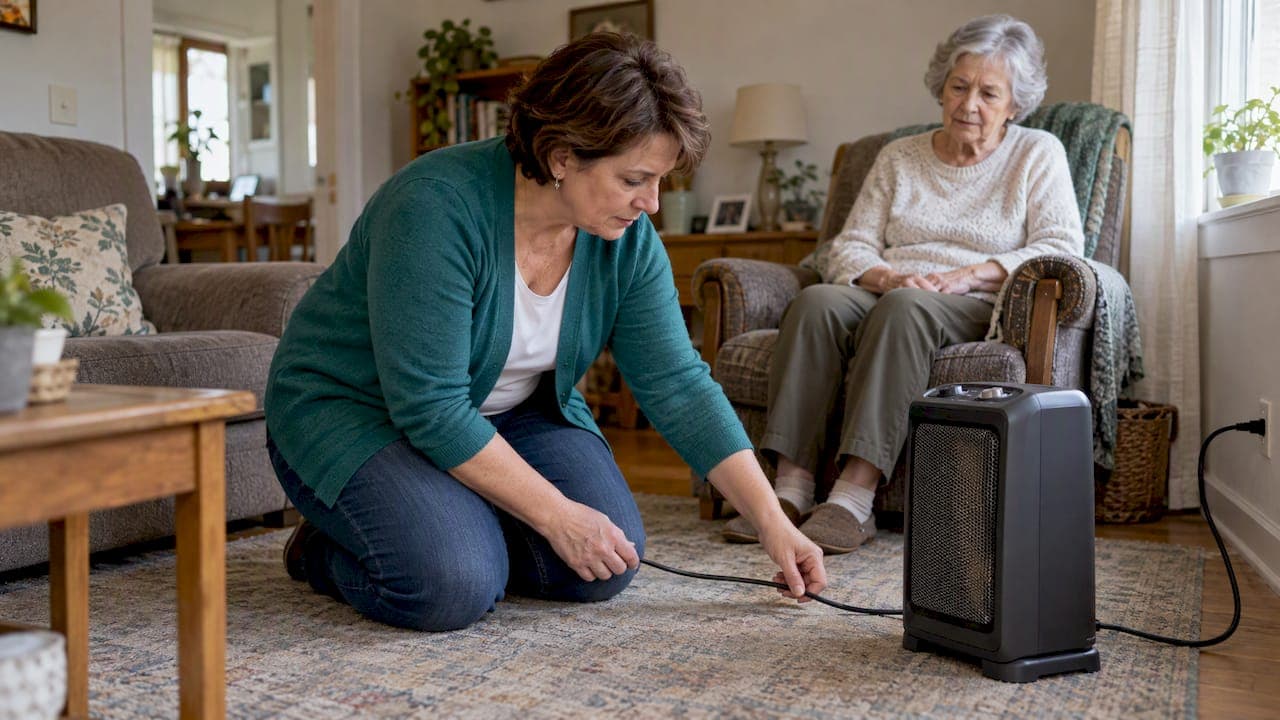
Yes, seniors can use space heaters safely, but only with strict safeguards in place. Choose a listed heater with tip-over and overheat shutoffs, keep it three feet from anything flammable, plug it directly into a wall outlet, and never leave it running unattended. We walk through a full checklist below so you can check your parent's setup today, not someday.
TL;DR:
- Space heaters should be listed by recognized safety labs, with tip-over and overheat protection, and used on a stable, nonflammable surface.
- Keep heaters at least three feet from anything flammable, avoid extension cords, and turn them off when unattended or going to sleep.
- Daily checks should include inspecting cords, testing alarms, and ensuring the heater sits on a flat surface to prevent fire hazards.
- Seniors are vulnerable to hyperthermia and burns, so temperature monitoring, shorter use sessions, and physical checks are essential for safety.
- Long-term solutions like better insulation, programmable thermostats, and professional safety assessments can reduce reliance on portable heaters.
Table of Contents
- Quick caregiver checklist: 8 immediate safety actions
- How to pick a safer space heater
- Setup and daily use: what to check each day
- Hidden risks for older adults: hyperthermia, burns, and sensory limits
- Safer alternatives and longer-term fixes
- Emergency steps, escape planning, and alarms for seniors
- A calm, practical way to think about heater safety
- How we can help with heater safety and the rest of the home
- FAQ
- Sources
Quick caregiver checklist: 8 immediate safety actions
If you only have ten minutes before you leave your parent's house today, use them here. These eight steps address most of the risk you'll find with any space heater in an older adult's home.
- Keep the heater at least three feet from bedding, curtains, furniture, or anything else that can burn, as fire safety agencies recommend.
- Confirm it carries a UL or ETL listing and has both tip-over and overheat shutoff features.
- Plug it straight into a wall outlet. Never route it through an extension cord or power strip.
- Turn it off whenever your parent leaves the room or goes to sleep, and use a simple kitchen timer as a backup reminder.
- Check the cord and plug for fraying, cracks, or heat damage before every use.
- Keep it out of bathrooms and away from anywhere it could get wet.
- Test the smoke and carbon monoxide alarms nearby and make sure the exit path is clear.
- Name one family member who checks the heater daily, even if it's just a quick glance and a touch of the cord.
Pro Tip: Put a sticky note on the heater itself that says "Off before bed" so it catches your parent's eye at the moment that matters most.
How to pick a safer space heater
Not all space heaters carry the same risk, and the differences matter more for an older adult than they do for the rest of the household. A model with the right safety features does a lot of the protective work automatically, which matters on the days you can't be there to double-check.
- Choose a unit listed by UL, ETL, or another nationally recognized testing laboratory, which means it has passed independent safety testing.
- Look for a tip-over switch, an overheat thermal cutoff, and a thermostat that actually holds a set temperature rather than cycling wildly.
- Favor oil-filled or ceramic heaters with enclosed heating elements over models with exposed coils that glow red.
- Skip kerosene, propane, or any fuel-burning heater indoors. These introduce fire and carbon monoxide risks that electric units avoid.
- Match wattage to the room. A heater sized for a large den will overheat a small bedroom fast.
- Pick a model with a numeric temperature display and a built-in timer so settings are easy to read and easy to limit.
Setup and daily use: what to check each day
The heater itself is only part of the equation. How it's placed and watched day to day determines whether those safety features ever get tested.
- Set the heater on a hard, flat, nonflammable surface, never on carpet, a rug, or a bed.
- Plug it into its own wall outlet, away from any extension cord or power strip.
- Do a thirty-second visual check each day: look at the cord, confirm the feet are stable, and sniff for any burning smell.
- Turn it off before naps and before bedtime. A visual timer or a phone reminder works better than relying on memory alone.
- Think through how your parent actually moves through the room. If a walker or wheelchair passes close to the heater, consider balance training for seniors to improve mobility and move the heater, not the furniture.
- If you notice flickering lights or a tripped breaker when the heater runs, call an electrician before using it again. Aging wiring can turn even a well-made heater into a hazard.
Pro Tip: Spend one evening watching how your parent moves around the room before deciding where the heater goes. The safest spot is often different from the obvious one.
For more on reducing everyday hazards around the house, our guide on making a home safer for an elderly parent covers the broader picture beyond heating.
Hidden risks for older adults: hyperthermia, burns, and sensory limits

Some of the biggest heater risks for seniors aren't obvious at first glance. A CPSC preliminary analysis found that room heaters can raise indoor temperatures to dangerous levels and linked hyperthermia deaths to heater use, with older adults among the most vulnerable. Heaters can quietly push a room past a safe temperature long before anyone notices, which is part of why supervision matters as much as the equipment itself.
Reduced skin sensation and neuropathy, common with age and certain conditions, can keep a parent from feeling a burn forming until it's serious. Loose robes or nightgowns add to that risk by brushing against heating elements unnoticed.
- Remember that "unattended" includes napping. A heater left on while your parent dozes off is no safer than one left on in an empty room.
- Use a simple room thermometer so you're relying on a number, not a feeling.
- Keep sessions shorter and settings lower than you might for a younger adult.
- Check in physically, not just by asking if they're warm enough.
Safer alternatives and longer-term fixes
Space heaters work best as a short-term supplement, not a long-term heating plan. A few changes to the whole home often reduce how much your parent needs one at all.
- Schedule an HVAC tune-up and consider a programmable or smart thermostat that keeps temperatures steady without manual adjustment.
- Add layered clothing, a properly used heated mattress pad, draft-proofing around windows and doors, and thermal curtains.
- If a space heater is still needed, limit it to short, supervised sessions rather than all-day use.
- Book a professional home safety assessment if you notice drafts, inconsistent heating, or wiring issues you can't diagnose yourself.
UAB burn specialists recommend treating space heaters as a temporary measure and leaning on whole-home warmth strategies first, partly because seniors face a higher risk of burns from backing into heaters while wearing loose robes or gowns. For a broader look at aging-in-place improvements, our home safety guide for aging parents covers more ground than heating alone.
Emergency steps, escape planning, and alarms for seniors
A heater-related emergency moves fast, so the plan needs to be simple enough to follow without thinking.
- If you see smoke or flame, get everyone out immediately and call 911 from outside the home.
- Walk through the escape plan with your parent in a way that matches their actual mobility and hearing. A plan built for someone who moves quickly won't work for someone who doesn't.
- Assign roles ahead of time, including a nearby neighbor who can check in if you're not there.
- Test smoke and carbon monoxide alarms monthly and replace batteries on a set schedule, placing extra alarms near bedrooms where portable heaters are most often used.
- If safety can't be reliably maintained, even with these steps, it may be time to consider a different living arrangement.
Our article on fire safety priorities for seniors walks through a focused two-step plan you can put in place this week.
A calm, practical way to think about heater safety
Most of the risk here comes down to a handful of habits, not a long list of rules to memorize. Once the heater is listed, plugged in correctly, and someone has agreed to check it daily, you've handled the bulk of the danger. The goal isn't a perfect setup. It's a few consistent habits that hold up on an ordinary Tuesday, not just the day you happen to be watching.
— Mike C.
How we can help with heater safety and the rest of the home
A walkthrough from someone who knows what to look for often catches things a quick glance misses, outlets that run hot, a cord tucked under a rug, a heater sitting too close to a curtain that moves more than you'd think. That's the kind of detail we help you spot.
- A Caregiving Clarity Session gives you a focused conversation to sort out what matters most right now, heater safety included.
- Our Virtual Home Safety Consultations walk through your parent's home with you over a video call, flagging placement and wiring concerns room by room.
- Our In-Home Age-Safe Home Safety Assessments bring that same review in person, with a practical checklist and fixes you can act on right away.
If you're not sure where to start, booking a Virtual Home Safety Consultation is a low-pressure way to get specific answers for your parent's actual home instead of general advice.
FAQ
What percentage of house fires are started by space heaters?
Space heaters caused about 33% of home heating equipment fires between 2016 and 2020, despite making up a much smaller share of heating equipment overall.
Are space heaters safe to use unattended?
No. Safety guidance consistently advises turning heaters off whenever a room is empty or a person falls asleep, since napping and sleeping count as unattended use. A heater running while your parent dozes carries the same risk as one left on in an empty room.
What is the safest heater to use indoors?
An electric model listed by UL or ETL, with a tip-over switch, an overheat thermal cutoff, and an enclosed heating element, is the safest category available. Oil-filled and ceramic heaters with these features are generally preferable to exposed-coil units, and fuel-burning heaters should be avoided indoors entirely.
What are the odds of a space heater catching fire?
There's no single published odds figure, but the risk concentrates around specific factors: placing a heater too close to something flammable, using an extension cord, or leaving it running unattended. USFA analysis found that placing a heat source too close to combustibles is a leading factor in portable heater fires, which is why the three-foot rule matters so much.
Sources
- NFPA: Home heating equipment fire statistics (heating equipment report)
- CPSC: A preliminary analysis of hyperthermia deaths associated with electric room and space heaters
- UAB: Cold weather safety — is your space heater more harmful than helpful?
- ESFI: Home heating safety tips for older adults