
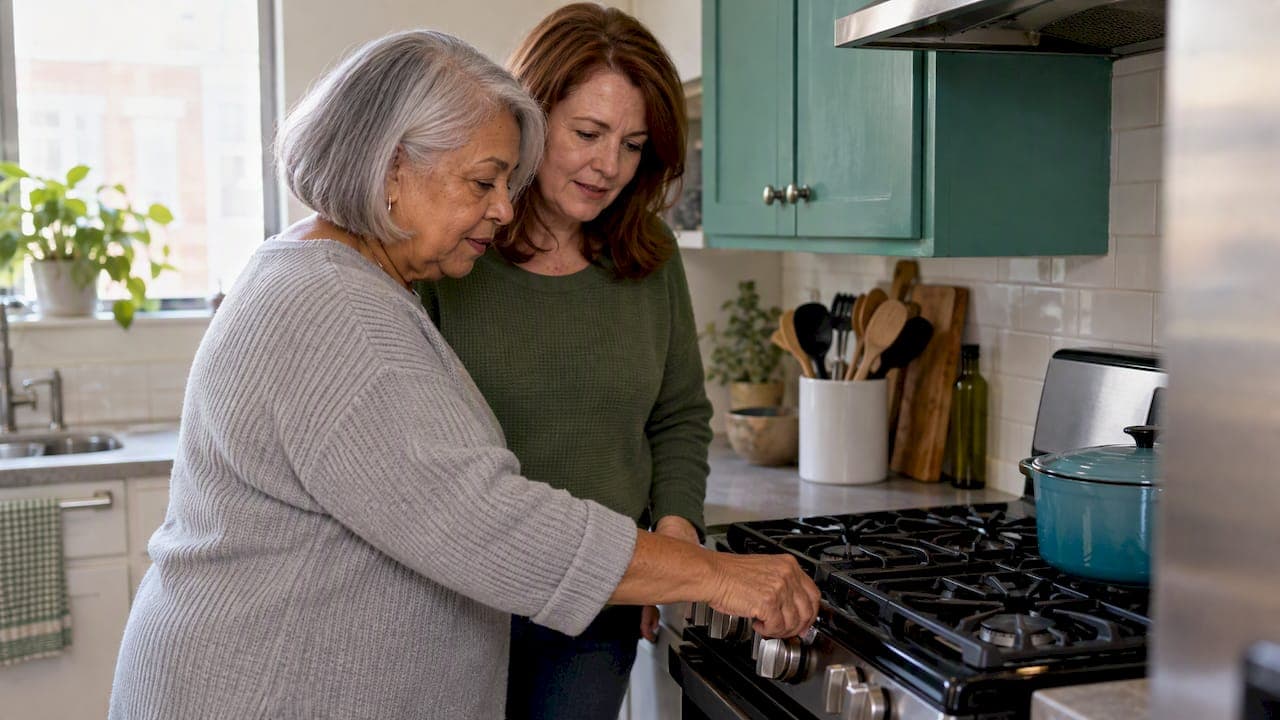
Most stove safety comes down to three things: staying with the cooking, setting up the kitchen so the stove is easy and predictable to use, and adding a safety device if remembering to turn it off has become unreliable. You rarely have to take the stove away. This guide walks through each step in the order most families need them, with examples you can try this week.
If you are reading this because you noticed a scorched pan at your mom's house, take a breath. One burnt pot is a prompt to look closer, not a verdict.
TL;DR
- Cooking is the number one cause of home fires, and older adults face a higher risk of injury from them, so the stove deserves attention early. Attention does not have to mean alarm.
- Start with habits: stay in the kitchen, use a timer, wear close-fitting sleeves, and keep towels and packaging away from the burners.
- Then adjust the space: front or side controls, even lighting, and a clear path between the fridge, counter, and stove.
- If forgetting is the concern, a stove auto shut-off (electric) or a lockable gas valve can protect your parent and let them keep cooking.
- Watch for patterns, not one-off mistakes, and talk about the kitchen as a shared project.
Table of Contents
- Why the stove is the first place to look
- Everyday habits that prevent most stove fires
- Setting up the kitchen so the stove is easier to use
- Gas or electric: what makes each safer
- Choosing a safety device without taking over
- Signs your parent may need more help with cooking
- Food safety belongs in the same conversation
- Our perspective: walking alongside, not taking control
- Want a second pair of eyes on the kitchen?
- A one-weekend stove safety plan
- FAQ
- Sources
Why the stove is the first place to look
The U.S. Fire Administration reports that cooking fires are the number one cause of home fires. The American Burn Association adds that adults over 65 face a much higher risk of injury or death from kitchen fires, because changes in vision, hearing, or movement can slow a quick response, and thinner skin burns faster and deeper.
That is useful to know, but it is not a reason to panic. Most of the risk comes from a few predictable moments: walking away from a pan, reaching across a hot burner, a loose sleeve, or a stove that stays on after the meal. Each of those has a simple fix.
The kitchen is also where independence lives. Making a cup of tea or a grilled cheese is often how your parent feels like themselves. Our goal is to keep that going safely, not to take it over.
Everyday habits that prevent most stove fires
The USFA's guidance for older adults is refreshingly plain. These are the habits worth building, with how they look in a real kitchen:
- Stay in the kitchen while you cook. If the phone rings or someone comes to the door, turn the burner off first. Moving a pan off the heat takes two seconds and removes the risk.
- Use a timer for food that needs checking. A simple kitchen timer worn on a lanyard or placed in the next room works better than memory. The USFA suggests this for anything that needs regular checking.
- Wear short or close-fitting sleeves. Cardigans and bathrobes with loose cuffs are the usual culprits, especially in cooler months.
- Keep things that burn away from the stove. Oven mitts, paper towels, dish towels, and cereal boxes tend to drift toward the burners over time. Give them a home a few feet away.
- Wipe the stove top after it cools. Grease and crumbs build up, and a clean surface is one less thing to ignite.
- Turn pot handles toward the back. It prevents bumped pans and spills. Use the back burners for hot or heavy pots when you can.
- Keep a lid within reach. If a pan catches fire, sliding a lid over it and turning off the heat is the usual first step. Water and grease do not mix, so skip the sink. Call 911 if a fire spreads or you are unsure.
If you are not sure how to bring up changes like these, our guide to kitchen safety for seniors has gentle ways to start.
Outlets and small appliances count too
The stove is not the only heat source in the kitchen. Mass.gov's fire safety guidance for older adults recommends avoiding overloaded outlets and power strips, repairing or discarding frayed cords, and using one appliance per outlet, especially for heat-producing appliances such as toasters and kettles. A quick look behind the counter during a visit can catch problems before they matter.
Setting up the kitchen so the stove is easier to use
A safe stove is often one that is simply easier to use. Small layout changes reduce reaching, bending, and guessing.
Controls and reach
University of Arkansas extension guidance on aging in place recommends cooktops with front or side controls. Alaska's state health department makes the same point from a safety angle: front controls can reduce the need to reach across hot burners, pots, or pans.
If replacing a stove is not realistic, try these low-cost options:
- Use the front burners for everyday cooking and reserve the back for slow, large pots.
- Move frequently used pots and pans to a shelf between hip and shoulder height, so your parent never reaches over a burner to get one.
- Keep a stable, heat-safe landing spot next to the stove for hot dishes.
- Mark the "off" position on dials with a bright sticker if the labels are hard to read.
Light and vision
Dim kitchens make it harder to see flames, knobs, and what is in the pan. The Arkansas extension guide recommends mixing ambient, task, and accent lighting, with task lighting providing shadow-free light for food preparation. In practice, an under-cabinet light strip above the counter and a brighter bulb over the stove often make the biggest difference for the least money. If your parent's eyesight has been changing, our guide to vision changes in older adults goes through the rest of the house.

A seated option
The same extension guidance suggests universal design features such as single-lever faucets and counters at different heights, including a seated-cook height. A sturdy chair or stool near the stove lets a parent with tired legs or balance concerns keep cooking without standing for the whole meal. Make sure it is stable and not positioned where it blocks the path to the door.

Gas or electric: what makes each safer
The two types of stoves carry different worries, so the fixes differ.
| Gas range | Electric range | |
|---|---|---|
| Main worry | Forgotten flame, gas supply, carbon monoxide | Burner stays hot with no visible sign |
| Everyday fix | Check knobs before bed and leaving the house | Use burners with indicator lights; wipe up spills quickly |
| Device type | Lockable gas valve, knob covers | Auto shut-off linked to a smoke alarm or motion sensor, stove guard |
| Maintenance | Annual service by a qualified technician | Check cords and outlets, repair worn elements |
Making a gas stove safer
The CDC notes that gas ranges can produce carbon monoxide and recommends having gas appliances serviced every year by a qualified technician and properly vented. Ask for that visit before anything else, and make sure there is a working carbon monoxide alarm nearby.
For a parent who forgets, one option is a lockable valve on the gas supply. Greater Manchester Fire and Rescue Service in the UK describes a locking cooker valve fitted to existing gas pipework that stops the gas when locked, so a caregiver with the key controls when it can be used. Since that guidance comes from the UK, ask a licensed U.S. gas fitter or your gas utility what is approved and safe for your parent's stove. Do not try to modify gas lines yourself.
Making an electric stove safer
Alaska's guidance notes that an electric stove auto shut-off can turn off the stove once a smoke alarm is activated. Devices in this family work in a few ways: by hearing the smoke alarm, by sensing that no one is in the room, or by cutting power after a set time. The Manchester guidance also recommends investigating the different options and having a stove guard fitted by a qualified specialist.
Choosing a safety device without taking over
If your parent has started forgetting the stove, a device can be the middle path between "nothing" and "no more cooking." Manchester's fire service notes these devices can help people stay independent and reassure the people who care for them. Here is what we suggest weighing:
- Match the fuel. Gas and electric ranges need different devices. Confirm which your parent has, and whether it is a freestanding range or a cooktop built into the counter.
- Ask who installs it. Some products plug in, while others are wired in. Anything that touches the wiring or gas line needs a qualified installer.
- Think about how it triggers. A device that shuts off when the room is empty suits a parent who wanders away. One that responds to smoke alarms is a backstop for when something has already gone wrong.
- Make sure your parent can restart it. A shut-off that is hard to reset will be bypassed or resented. Practice together.
- Check the warranty and return policy, and ask whether alerts come to your phone or only sound locally.
- Keep the smoke alarm basics in place. A device is never a replacement for working smoke and carbon monoxide alarms and a clear way out.
For a wider look at the options beyond the kitchen, see our overview of home safety devices for aging parents.
How to present it
How you introduce the idea matters as much as the device. "I worry about you" can land as criticism. Something like "I'd feel better if the stove had a backup, the way a car has a seat belt" tends to go over more easily. Offer to set it up together, and let your parent choose where the timer goes or which dial gets the sticker. If the conversation is hard, our guide to talking with aging parents about care can help.
Signs your parent may need more help with cooking
No single sign means something is wrong. Look for patterns over a few weeks, and keep notes of what you see, not what you fear. Things families often mention:
- Scorched pots or pans tucked away, or a lingering smell of burnt food.
- Food in the fridge that is expired, or very little fresh food at all.
- Meals becoming noticeably simpler, with more cereal, crackers, or takeout than before.
- Burners left on after the meal, or knobs set to unexpected settings.
- New burns, small scalds, or singed sleeves.
- Confusion about how to use appliances that used to be familiar.
- Unusual stress or frustration around cooking that your parent used to enjoy.
There are many reasons for these changes, including tiredness, grief, vision, medication, or the plain fact that cooking for one is less fun. Please do not try to diagnose. If you notice memory-related patterns, mention what you have seen to your parent's doctor and let them take it from there. In the meantime, safety steps like a timer or shut-off device are sensible whatever the cause.
A gentle way to check in: cook a meal together, or have lunch at their house on a Tuesday rather than a holiday. You will see how the kitchen works on an ordinary day.
Food safety belongs in the same conversation
A safe stove only helps if the food on it is safe too. The CDC notes that adults 65 and older are more likely to get sick from certain germs, including Listeria and Salmonella, and recommends four steps: clean, separate, cook, and chill. The USDA explains that immunity to infection naturally weakens with age, so safe handling is worth making a lifelong habit.
A few things to set up in the kitchen:
- A food thermometer. The USDA's food safety guidance lists safe internal temperatures: 165°F for poultry and reheated leftovers, 160°F for ground meats and egg dishes, and 145°F for steaks, roasts, and chops. Tape the numbers inside a cabinet door.
- A fridge thermometer. Keep the refrigerator at 40°F or below and the freezer at 0°F or below, per the same USDA guide.
- The two-hour rule. Refrigerate perishable food within two hours, or one hour when it is above 90°F, as the USDA advises.
- Riskier foods. The CDC lists unpasteurized milk and dairy, soft cheese made from unpasteurized milk, raw or undercooked sprouts, and unheated deli meat among the riskier choices for adults 65 and older.
A simple routine for a visit: check the fridge together, toss anything past its date, and label leftovers with the day they were made. Frame it as helping with a chore, not an inspection.
Our perspective: walking alongside, not taking control
We have seen how quickly families jump from "Mom left the burner on" to "Mom can't cook anymore." In our experience, that jump is rarely necessary. Our approach to home safety comes from personal caregiving experience and professional crisis management, and our assessments are done with Age Safe® America certification behind them. What we keep coming back to is that a safe kitchen is almost always one small adjustment away.
This journey isn't about taking control. It's about walking alongside your parents. So we start with what is working, such as the meals your parent loves to make, and we add a timer, a light, a better layout, or a device only where there is a real gap. Dignity and simplicity guide every step. When your parent feels part of the plan, the plan holds.
One more thing: you do not need to fix the whole kitchen in one weekend. Pick one change, try it for two weeks, and see how it feels.
— Mike C.
Want a second pair of eyes on the kitchen?
If you would like help deciding what to change first, we offer a few ways to get it. A Caregiving Clarity Session is a one-time 1:1 call at $97 where we talk through your parent's situation and map out next steps. If you want the kitchen and the rest of the house reviewed, you can request a virtual home safety consultation, or, if your parent lives in Central Florida, an in-home safety assessment. Prefer to start on your own? Our elderly home safety checklist is free.
A one-weekend stove safety plan
If you would like a simple order of operations, this one works for most families:
- Observe. On your next visit, watch how your parent uses the stove. Note what feels easy and what feels awkward.
- Check the basics. Test smoke and carbon monoxide alarms, and clear flammable items away from the burners. Our fire safety priorities for seniors article covers the two fixes to make first.
- Improve the light. Add task lighting above the counter and stove.
- Add a timer. Pick one your parent likes and put it where they will see it.
- Decide on a device. If there have been forgotten-burner moments, talk about a shut-off device or gas valve, and plan for qualified installation.
- Revisit in a month. Ask what is working. Adjust.
The rest of the house deserves the same patient approach. Our guide to making the home safer for an elderly parent shows how to phase the work over time.
FAQ
How do you make a gas stove safe for an elderly person?
Start with an annual service by a qualified technician, proper ventilation, and a working carbon monoxide alarm, as the CDC recommends. If forgetting is a concern, ask a licensed gas fitter about a lockable valve or other approved shut-off options for your parent's stove. Do not modify gas lines yourself.
How do you keep an elderly person from using the stove?
Before removing access, ask whether a middle path would work: a timer, an auto shut-off on an electric stove, or a lockable gas valve. These can let your parent keep cooking while giving you peace of mind. If you do need to limit use, make it a shared decision and offer alternatives, such as a microwave, an induction hot plate with an auto-off feature, or prepared meals.
What is the safest type of stove for an older adult?
Look for a cooktop with front or side controls, so there is no reaching over hot burners, plus clear markings and good lighting. Extension and state health guidance both point to these features. The best choice also depends on your parent's vision, balance, and memory, so try to let them test the controls before buying.
What are signs that someone needs help in the kitchen?
Look for repeated patterns: burnt pans, a burner left on, spoiled food in the fridge, simpler and simpler meals, or new small burns. One incident is not a verdict. If the pattern continues, mention it to your parent's doctor and add safety supports in the meantime.
Sources
- Fire Safety for Older Adults, U.S. Fire Administration
- Cooking Safety for Older Adults, American Burn Association
- Fire and Burn Safety for Older Adults, Mass.gov
- Aging in Place: Kitchens and Meal Preparation, University of Arkansas Extension
- Stove Access and Safety, Alaska Department of Health
- Carbon Monoxide Poisoning Basics, CDC
- Cooking fire safety devices, Greater Manchester Fire and Rescue Service
- Safer Food Choices for Adults 65 and Older, CDC
- Adults 65 and Older: An At-Risk Population, USDA FSIS
- Food Safety Counts!, USDA FSIS