

The safest transfer techniques for seniors generally include stand-pivot with a gait belt, sliding with a transfer board, sit-to-stand lifts, full mechanical lifts, and two-person manual assists. The rule that decides which one to use is simple: match the method to how much weight your parent can safely bear on their legs and how well they can follow a spoken cue. If dizziness, new weakness, pain, or resistance shows up mid transfer, stop, ease them back down, and get help before trying again.
TL;DR:
- Use a stand-pivot transfer only if the senior can bear weight on both legs and follow instructions reliably.
- Opt for a sliding transfer board when the person has upper-body strength but cannot stand safely on their legs.
- Employ full-body lifts for individuals who cannot bear any weight or follow cues, to minimize caregiver injury risk.
- Practice transfer cues and pivot steps regularly without full weight to build confidence and reduce the risk of accidents.
- Always prioritize proper space setup, clear communication, and body mechanics to ensure safe, effective transfers and avoid injuries.
Table of Contents
- Your Quick Transfer Techniques Checklist for Seniors
- How Do You Perform a Stand-Pivot Transfer Safely?
- When Should You Use a Sliding Transfer Board?
- How Do Two Caregivers Perform a Manual Dependent Transfer?
- Are Mechanical Lifts Worth Using at Home?
- What Equipment Do You Actually Need for Transfers?
- How Do You Protect Your Own Back During Transfers?
- How Do You Set Up the Space and Talk Your Parent Through a Transfer?
- When Should You Stop and Call for Professional Help?
- Helping Mom's Take on Building Transfer Confidence
- What Most Advice Gets Wrong About Transfers
- A Practical Next Step From Helping Mom
- Sources
- FAQ
Your Quick Transfer Techniques Checklist for Seniors
Before you move anyone, run through a 30 second check. It takes less time than deciding what to make for dinner, and it prevents most of the falls and near misses that happen during transfers at home.
Assess first:
- Is your parent alert and able to follow a two-step instruction right now?
- Can they bear weight on both legs, one leg, or neither?
- Have they mentioned dizziness, or has anything changed since yesterday (new medication, a rough night, low appetite)?
Then match the method:
- Can bear weight on both legs and follow instructions → stand-pivot transfer.
- Has limited leg strength but good upper-body strength and trunk control → sliding transfer board.
- Can bear partial weight but needs real assistance getting upright → sit-to-stand mechanical lift.
- Cannot bear weight at all, or cannot reliably follow cues → full-body mechanical lift or two-person assist.
Before any of it, lock the wheelchair brakes, clear the path of rugs and cords, make sure shoes or nonslip socks are on, and have your gait belt, board, or lift within arm's reach. This kind of safe lifting approach protects both of you, every single time.
How Do You Perform a Stand-Pivot Transfer Safely?
A stand-pivot works when your parent can bear at least partial weight and understands what you're asking them to do. It's the most common transfer technique in home care, and it's also the one people rush the most, which is where mistakes happen.
Start by having your parent scoot forward until their feet are flat on the floor, about hip-width apart. If they've been lying down, have them sit at the edge of the bed for a minute or two first. This "dangling" step matters more than it looks. It gives blood pressure time to adjust and reduces the risk of a dizzy spell the moment they stand.
- Put the gait belt around their waist, snug but not tight, and get a firm grip with both hands.
- Stand close, facing them, with your feet shoulder-width apart and your knees slightly bent.
- Give a clear count. "On three, we're standing up together. One, two, three."
- Let them push up through their legs while you guide, not lift, using the belt.
- Pivot together using small steps. Never twist your spine while your feet stay planted.
- Guide them down slowly into the new seat, bending your knees as you go.
Pro Tip: Practice the count and the pivot steps once or twice without actually completing the transfer. Rehearsing the sequence, even in slow motion, builds muscle memory for both of you and cuts down on hesitation when it counts.
A Cochrane review of mobility training found that frail older adults who practiced functional movements like sit-to-stand experienced improvements in mobility that could last for several months. Short, regular practice genuinely pays off.
When Should You Use a Sliding Transfer Board?
A transfer board makes sense when your parent has decent upper-body strength and can hold their trunk steady, but their legs won't reliably support standing. Think of someone recovering from a hip fracture or living with advanced arthritis in the knees. If they lean or slump easily, or can't follow a simple cue, a board isn't the right tool and you should consider a lift instead.
- Remove the wheelchair armrest and footrest on the transfer side before you start.
- Bridge the board between the two seats, angled slightly downward toward the destination.
- Have your parent place their hands flat on the board, not gripping the edge.
- Guide them through small scoot-and-slide movements, pausing between each one.
- Support their knees with your own leg or hand to keep them from buckling sideways.
Pro Tip: A light dusting of talc-free slide powder or a smooth pillowcase over the board reduces friction and makes each scoot easier on their skin, especially for someone with thin or fragile skin.
Skip the board entirely if your parent has recently fallen off one, seems confused about the steps, or their trunk sags to one side without support.
How Do Two Caregivers Perform a Manual Dependent Transfer?
Two-person transfers make sense when someone can't bear enough weight for a stand-pivot but a mechanical lift isn't set up yet, or the move is short, like scooting someone higher in bed. If your parent needs this kind of help for every transfer, it's worth asking a physical therapist whether a lift would be safer long term.
- Assign roles clearly before you start: one caregiver supports the upper body and head, the other manages the hips and legs.
- Agree on a count together, out loud, so both of you move on the same beat.
- For a draw-sheet transfer, grip the sheet rolled close to the body on both sides, never pulling directly on an arm or catheter line.
- Lift with your legs, not your back, and keep the person's body as close to yours as possible during the move by following proven safe lifting guidelines for heavy furniture.
- Reassess after: check skin, tubing, and comfort, and stop immediately if either caregiver feels a strain.
If one of you can't maintain a steady grip or the person is heavier than both of you can safely manage, that's the signal to switch to a mechanical lift.
Are Mechanical Lifts Worth Using at Home?
Mechanical lifts exist because manual lifting is one of the biggest causes of caregiver back injuries, and OSHA and NIOSH guidance specifically recommends assistive devices over manual lifting whenever possible. There's no shame in using one. A lift protects your parent's dignity as much as your spine.
A sit-to-stand lift assists someone who can bear some weight but needs support getting fully upright, essentially a powered boost for a stand-pivot. A full-body lift, used with a sling, supports someone who can't bear any weight at all, cradling them through the entire move.
- Confirm the lift's weight capacity matches your parent's weight with margin to spare.
- Ask a physical or occupational therapist which sling type fits their body and condition.
- Clear a wide, obstacle-free rotation space before you begin.
- Check the straps and hooks for wear every time, not just occasionally.
- Test the lift empty first, and never leave someone unattended while suspended in a sling.
Pro Tip: Home health agencies and equipment rental companies often include a training session with the lift. Take it, even if you feel confident. Ten minutes of hands-on instruction prevents most of the fumbling that happens the first few real uses.
What Equipment Do You Actually Need for Transfers?
You don't need every gadget on the market. You need the right two or three tools for your specific situation, chosen with a little care.
- Gait belt: a simple fabric belt that gives you something secure to hold during a stand-pivot.
- Transfer board: a smooth, rigid board that bridges two surfaces for a sliding transfer.
- Swivel cushion: helpful for car transfers, letting someone rotate without twisting their spine.
- Mechanical lift: sit-to-stand or full-body, for anyone who needs more support than a person alone can safely give.
- Nonslip footwear: closed-back shoes or grip socks, worn every single time, no exceptions.
Before buying anything, walk through a short checklist: your parent's current ability level, how often transfers happen each day, your own physical capacity, the layout of your home (narrow hallways change everything), and the weight rating on any equipment you're considering. Renting a lift for a few weeks after surgery often makes more sense than buying one outright, and either way, inspect straps and wheels before every use.
How Do You Protect Your Own Back During Transfers?
Caregiver injuries happen quietly, one imperfect transfer at a time, until suddenly your back gives out on what felt like a routine Tuesday. The fix is a handful of body-mechanics habits you can build into muscle memory.
- Plant your feet shoulder-width apart before you move anyone.
- Bend at your knees, not your waist, and keep your back straight.
- Keep the person's weight as close to your body as possible.
- Pivot by stepping your feet, never by twisting your spine.
- Rotate transfer duties with another family member when you can.
Proper body mechanics built around a stable base and a straight spine are what separate a manageable routine from a chronic injury. If you're doing more than a handful of manual transfers a day without help, that's a warning sign worth taking seriously, not pushing through. And if you feel sharp pain, numbness, or your back "catches" after a transfer, see a doctor before you try again. The OSHA safe patient handling guidance exists precisely because caregiver injuries are common and largely preventable.
How Do You Set Up the Space and Talk Your Parent Through a Transfer?
Most transfer problems start before anyone even moves. A cluttered path, a wobbly chair, or a rushed instruction causes more falls than weak legs ever do.
Clear the route of rugs, cords, and clutter. Lock every wheel brake in sight. Choose a chair that's firm and roughly hip height rather than a soft armchair that swallows someone on the way down. Dry any wet flooring completely.
- Give short, one-step cues: "Feet flat. Hands on the belt. Now stand."
- Count out loud together so the movement happens on a shared beat.
- Use a calm, steady voice, especially if your parent seems hesitant or scared.
For a parent living with dementia, shorten the cues even further and demonstrate the movement yourself first. If they seem confused or start pulling away, pause and try again in a few minutes rather than pushing through. Small, gentle exercises done daily also make each transfer a little easier over time.
Pro Tip: Say the same three cues every single time, in the same order. Predictability lowers anxiety more than almost anything else you can do during a transfer.
When Should You Stop and Call for Professional Help?
Certain signs mean it's time to stop the transfer and bring in outside support, not push through on your own.
- New weakness on one side of the body, especially in the face, arm, or leg.
- Chest pain, fainting, or a fall during or right after a transfer.
- Repeated falls over a short period, even minor ones.
- A caregiver injury or persistent pain after lifting.
- An inability to complete the transfer safely no matter how you approach it.
New weakness, chest pain, or fainting call for a doctor or 911 right away. Repeated falls or a transfer that keeps feeling unsafe are reasons to ask a physical or occupational therapist for a home visit, where they'll assess strength, balance, and recommend the exact equipment your parent needs.
Helping Mom's Take on Building Transfer Confidence
Transfers get safer with repetition, not bravado. Helping Mom was built around exactly this kind of practical guidance, and Mike C. has spent years helping families turn overwhelming caregiving tasks into manageable routines. A short daily rehearsal, practicing the stand-pivot cues without a full transfer, or trying a few gentle bed exercises, builds real confidence. Go slow, protect your parent's dignity, and ask a PT for hands-on training whenever you're unsure.
What Most Advice Gets Wrong About Transfers
Most guidance on senior transfers treats the topic like a medical procedure with rigid steps to memorize once and never revisit. That framing misses the point. A transfer is closer to a golf swing than a checklist: it's a physical skill that improves with short, repeated practice, not a single lesson you master and forget.
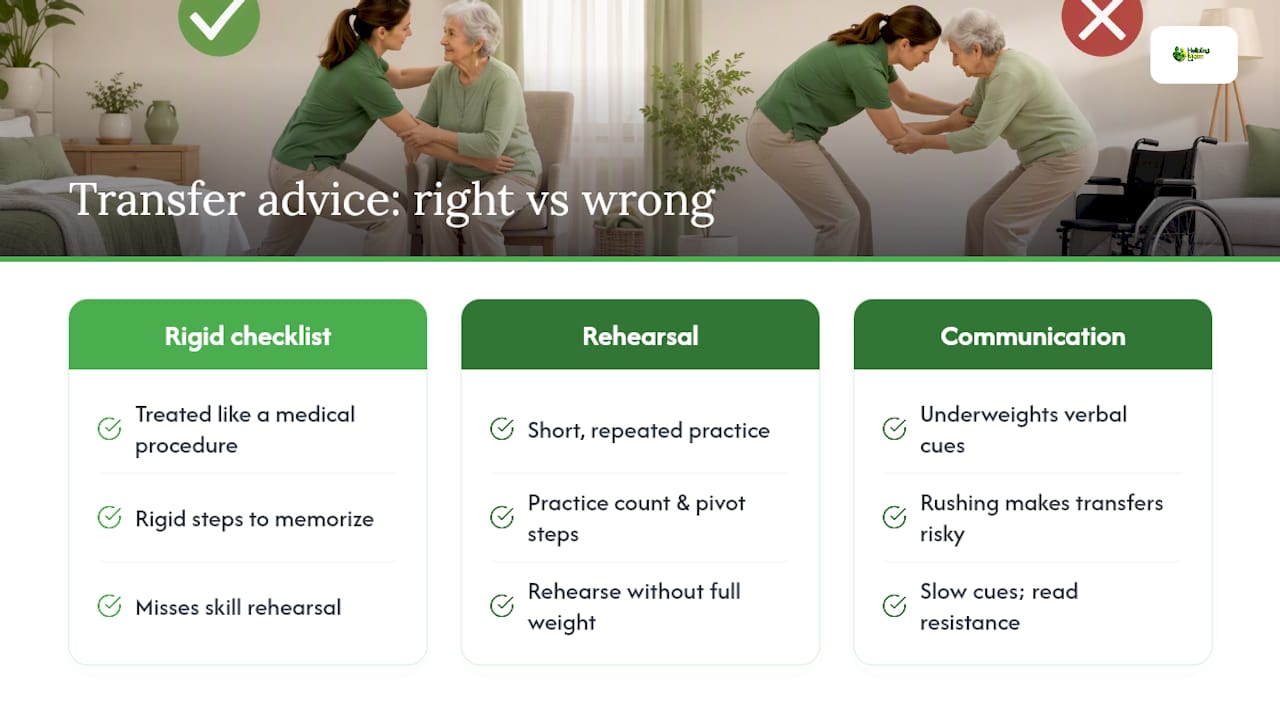
The conventional advice also underweights communication. Caregivers get trained on hand placement and body mechanics, but the moment a senior feels rushed, confused, or unheard, even a technically perfect stand-pivot turns risky. Slowing down the verbal cues, counting out loud, and reading resistance as information rather than stubbornness matters as much as any grip technique.
If there's one thing to prioritize first, it's this: rehearse the sequence without the full weight of the transfer riding on it. Practice the count. Practice the pivot steps. Get your parent comfortable with the routine when nothing is on the line. That's how families avoid the moment where fear meets an unfamiliar movement and something goes wrong. Equipment matters, technique matters, but rehearsal is what turns both into instinct.
— Mike C.
A Practical Next Step From Helping Mom
This kind of resource is available for families who need how-to knowledge from this article paired with a hands-on look at their own home. Our Practical Guide to making a home safer for seniors walks you through the checklists and setup changes that make transfers safer, room by room, without needing a background in home care. If you want eyes on your specific situation, a paid Zoom consultation lets you walk through your parent's actual bedroom, bathroom, and chair setup with someone who's talked through this exact worry with dozens of families. And if you're weighing equipment like a lift or transfer board, our home safety assessment resources can point you toward a rental referral so you're not guessing on fit or weight ratings. Start with the guide, then book a consult when you're ready for a closer look.
Sources
- Patient transfers (classification by weight-bearing)
- Transferring tips for caregivers — caregiver body mechanics
- Mobility training for increasing mobility and functioning in older people with frailty (Cochrane review)
- OSHA — Safe patient handling
FAQ
What Are Safe Transfer Techniques for Elderly People?
The safest options are the stand-pivot with a gait belt, a sliding transfer board, sit-to-stand and full-body mechanical lifts, and two-person manual assists, chosen based on how much weight the person can bear.
What Is the Best Transfer Board for Elderly People?
There's no single best board for everyone. The right one is smooth, rigid, sized to bridge the specific gap between your parent's two surfaces, and used only when they have solid upper-body strength and trunk control.
What Is the Best Way to Transfer a Patient Who Cannot Walk?
If someone can't bear weight at all, a full-body mechanical lift with a properly fitted sling is generally the safest method, since it removes manual lifting entirely and follows the assistive-device approach OSHA and NIOSH recommend.
What Are the Different Types of Patient Transfer Techniques?
The main categories are stand-pivot transfers, sliding board transfers, sit-to-stand mechanical lifts, full-body mechanical lifts, and two-person manual assists, each matched to the person's weight-bearing ability.
How Often Should Caregivers Practice Transfer Techniques?
Short, regular practice, even just rehearsing the cues and pivot steps without completing a full transfer, builds confidence and reduces hesitation, and research on mobility training shows benefits that can last for months.