
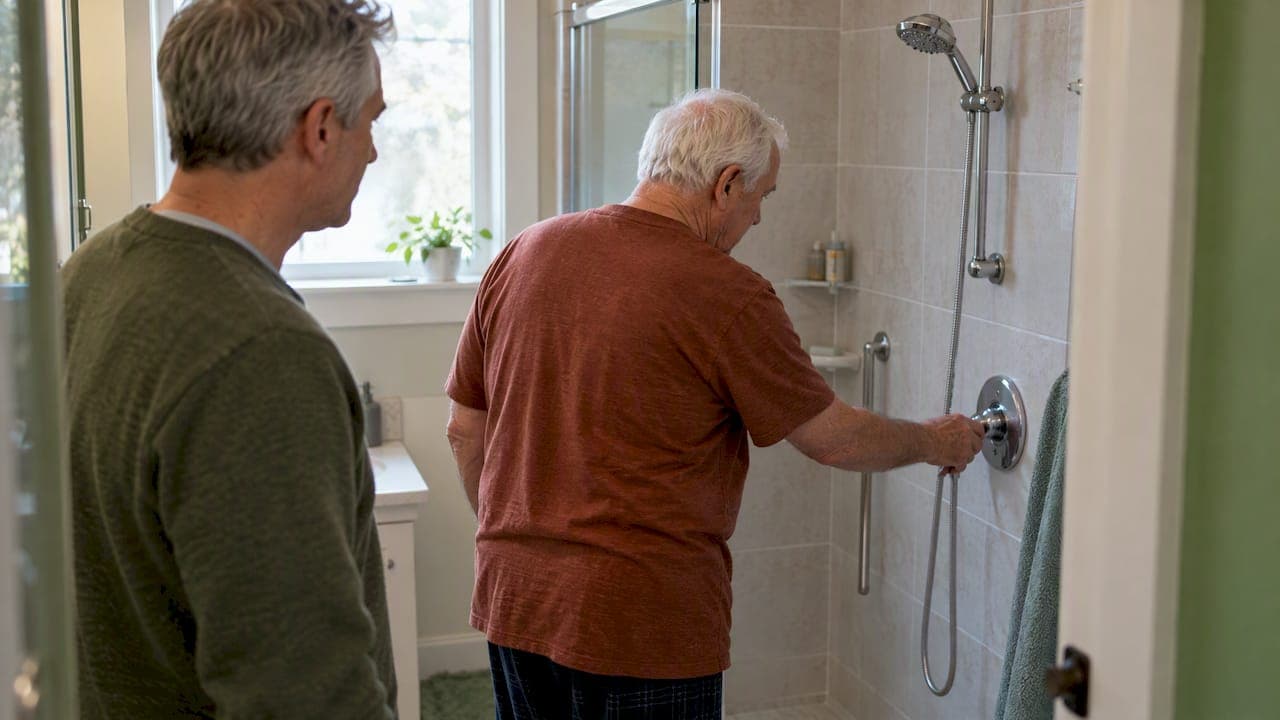
An anti-scald valve keeps the hottest water from reaching your parent's skin. For an older adult, the best setup is usually a layered one: a water heater set to a safe temperature, a properly adjusted pressure-balancing or thermostatic valve at the shower, and, if your parent is especially vulnerable, a small shut-off device as a backup. None of it is complicated. It does help to know which piece does which job before you call a plumber.
If you are reading this because you stepped into your mom's shower and the water felt hotter than it should, you are in the right place. This is a fixable, one-afternoon kind of problem, and we will walk through it together.
TL;DR
- Anti-scald protection works best in layers: a lower water heater setting, a valve at the shower, and an optional high-temperature shut-off as a backup.
- A "stop" on the shower handle is not the same thing as an anti-scald valve. It does not respond to pressure changes elsewhere in the house.
- Even a good valve has to be set correctly at installation. Ask the plumber to test and tell you the maximum temperature at the showerhead.
- A small add-on that cuts the flow when water gets too hot costs around $60 and can often be installed without opening a wall.
- Hardware protects better than reminders. Your parent should not have to remember to test the water.
Table of Contents
- Why hot water is a real concern for older parents
- What an anti-scald valve actually does
- Which one is right for your parent's bathroom?
- Why a handle stop is not enough
- The water heater setting: a quiet trade-off
- A layered plan that does not overwhelm anyone
- Talking with your parent about it
- Our perspective
- Questions to ask the plumber
- Where this fits in the bigger home safety picture
- If you would like a second pair of eyes
- FAQ
- Sources
Why hot water is a real concern for older parents
Most of us think of scalding as something that happens to toddlers. The Consumer Product Safety Commission says the majority of tap water scald injuries and deaths involve older adults and children under five.
The reasons are ordinary. A parent may have slower reflexes, reduced feeling in the hands or feet, or a medical condition that delays the reaction when water suddenly turns hot. InterNACHI points out a second risk that families often miss: the fall that happens when someone jerks away from a stream of scalding water, in a wet tub, on a slippery floor.
So a hot spike is not only a burn risk. It is a fall risk too, and falls are the thing most of us are already working to prevent.
How fast water can burn
The CPSC publishes a simple timeline of how long it takes for tap water to cause serious burns:
| Water temperature | Time to a serious burn |
|---|---|
| 140°F | About 6 seconds |
| 130°F | About 30 seconds |
| 127°F | About 1 minute |
| 120°F | 5 to 10 minutes |
Those figures come from CPSC Publication 5098. The takeaway is not to be afraid of your parent's bathroom. It is that a few degrees make a large difference, which is why a device that holds the temperature steady is worth having.
What an anti-scald valve actually does
An anti-scald valve, also called a tempering or mixing valve, blends cold water into the hot water so that what leaves the fixture is not hot enough to scald. That is the whole idea. The differences are in how it does the blending and where it sits.
Three terms come up again and again when you shop or talk to a plumber.
Pressure-balancing valves
This is the type found in many newer showers. It reacts when pressure changes, for example when someone flushes a toilet or starts the dishwasher, so the shower does not suddenly turn scalding or freezing. Plumbing guidance notes that codes call for an ASSE 1016 shower valve to limit shower water to 120°F and guard against thermal shock, rather than treating the water heater setting alone as enough.
There is one catch, and it matters for families. These valves rely on a temperature limit that the installer has to set. The CPSC has warned about shower systems where the installer did not set the limit stop screw, which can leave the valve able to deliver hotter water than intended. A valve can be the right product and still be set wrong.

Thermostatic mixing valves
A thermostatic valve senses the actual water temperature and holds it where you set it. These can be installed at a single fixture or at the water heater, where they serve the whole house. They tend to cost more and often involve opening the wall, so they make the most sense during a bathroom remodel or when a plumber is already there.
Temperature-actuated flow reducers
This is the small, inexpensive option. A temperature-actuated flow reducer (often shortened to TAFR) attaches at the shower arm and cuts the flow to a trickle if the water goes past a set point. One common model, the HydroGuard HT115, reduces flow to under a quarter gallon per minute at 115°F and resumes full flow when the water cools. A typical retail listing shows these running roughly $60, and describes them as usable on new or existing installations.
Because it screws on between the shower arm and the showerhead, this is often the quickest way to add protection for a parent who lives in an older home with an older valve.
Which one is right for your parent's bathroom?
There is no single correct answer. This table is a starting point for the conversation with a licensed plumber.
| Situation | A reasonable first option | Why |
|---|---|---|
| Older home, original shower valve, tight budget | Shower-arm flow reducer | Quick add-on, no wall work |
| Newer home with a pressure-balancing valve | Have the valve's limit setting checked and adjusted | Often the valve is fine but was never tested |
| Bathroom remodel already planned | Thermostatic or pressure-balancing valve, set and tested at install | Wall is open, the best time to do it right |
| Parent has memory loss or reduced feeling in hands and feet | Layered approach with a shut-off backup | Your parent cannot be the safety check |
| Several bathrooms and sinks to cover | Mixing valve at the water heater, plus point-of-use protection | Covers the whole house |
Costs vary a lot by region, valve brand and whether a wall must be opened, so get a written quote before you commit.
Why a handle stop is not enough
Many showers have a small adjustable stop that limits how far the handle can turn toward hot. It is a good habit to set it, but it is not a true anti-scald device. InterNACHI explains that it only limits the handle's travel and does not respond to pressure changes. If someone uses water elsewhere in the house, the temperature at the showerhead can still jump, wherever the handle is set.
Think of it as a helpful reminder, not a safety net. If your parent's shower only has a handle stop, it is worth asking a plumber what valve is behind the wall.
The water heater setting: a quiet trade-off
The CPSC recommends setting water heaters to 120°F to reduce scalding. That is sensible advice, and it is the base layer. But there is a trade-off worth knowing. The Wisconsin Department of Health Services notes that Legionella bacteria can grow in water systems kept below 140°F, which is one reason practitioners suggest keeping the heater hotter and adding mixing valves at the fixtures instead. Public health guidance in Canada takes the same approach, advising a 140°F heater setting together with automatic mixing valves at the tap.
So you have two reasonable paths, and the right one depends on your parent's health and home. If your parent has a weakened immune system or a chronic lung condition, ask their doctor or pharmacist about water temperature before you change the heater. That is a medical question, and we cannot answer it for you.
A practical middle path for many families: talk with a plumber about a valve at the point of use so the water hitting the skin is safe, whatever the heater is set to.

A layered plan that does not overwhelm anyone
Safety guidance from Wisconsin's health department describes a defense-in-depth approach: set the heater thoughtfully as the base, add mixing valves at the fixtures, and consider a secondary high-temperature shut-off for the most vulnerable. The reasoning is that no single device is perfect. A standard mixing valve can keep letting water flow if it malfunctions, while a shut-off device is built to cut flow when it senses dangerous heat.
Here is how that might look in a real house.
- Check what you have. Find out what valve is in the shower and when it was installed. A photo of the faucet handle and trim is often enough for a plumber to tell you what is likely behind it.
- Measure the water. With a simple kitchen or bath thermometer, run the shower until it is as hot as it gets and read the temperature at the showerhead. Do it carefully, with a cup, not your hand.
- Call a licensed plumber. Ask for the valve type, the maximum temperature it will deliver once set, and whether a shut-off backup makes sense for your parent.
- Test after the work. Always verify the maximum output after any new installation or plumbing repair. Do the same check once or twice a year.
- Pair it with the rest of the bathroom. A scald valve works best alongside grab bars, a non-slip surface and a shower seat.
The research on this is fairly clear about one thing: educational efforts alone have shown limited success in preventing home scalds, while passive fixes like correctly installed mixing valves protect people who cannot test the water themselves. In plain terms, do not count on your mom remembering to check the temperature. Build it into the plumbing.
Talking with your parent about it
This part is often harder than the plumbing. Many parents hear "anti-scald valve" and think "you believe I can't take care of myself." A few approaches tend to land more gently:
- Frame it as the house, not the person. "Newer showers are built with this, and ours is overdue for an update" is easier to hear than "it's not safe for you."
- Bundle it. Pair it with something your parent wants, such as a better showerhead or a handheld sprayer.
- Let them choose the plumber or the date. Choice keeps dignity intact.
- Keep it short. One calm conversation, then a quote on the kitchen table, works better than repeated reminders.
If you want more help with this kind of conversation, we wrote about talking with aging parents about care.
Our perspective
When we walk through a home with a family, the hot water question almost never comes up first. People mention the stairs, the rugs, the bathtub. Then, near the end, someone says, "Oh, and the shower gets really hot sometimes." That sentence is worth stopping for.
We hold a few views, and we try to keep them simple.
Fix the thing, not the person. Caregiving already asks a lot of you and your parent. A valve that is set correctly does its job every morning without a reminder, and that is a quiet kind of relief.
Do not let one device carry the whole load. We are cautious about the idea that a single purchase "solves" bathroom safety. A lower heater temperature, a properly set valve and sensible bathroom layout each cover a gap the others leave.
Move at your parent's pace. This journey is not about taking control. It is about walking alongside your parents. Often the smoothest path is to phase the work, starting with the cheapest and least intrusive fix. We lay that out in our guide to aging-in-place bathroom upgrades you can phase.
We are not medical professionals. We give non-medical, safety-based guidance. For anything about your parent's health, skin sensation, medications or immune system, their doctor is the right person.
— Mike C.
Questions to ask the plumber
Bring a short list. It makes the visit faster and gives you something to compare between quotes.
- What type of valve is in this shower now, and is it working as designed?
- Was the temperature limit set at installation, and can you test it today?
- What is the highest temperature the shower can deliver after your adjustment?
- Would a high-temperature shut-off at the shower arm add a useful second layer here?
- Do the other bathrooms and the kitchen sink need attention, too?
- Can you put the test result and the setting in writing?
A good plumber will be glad you asked. If one brushes the questions off, that is useful information too.
Where this fits in the bigger home safety picture
Scald protection is one small piece. Bathrooms are where many of the risks overlap: wet floors, hard surfaces, and hot water. Our bathroom safety guide for your parents covers the rest of the room, and the home safety devices guide shows where a valve fits among other low-effort additions. If you would like a room-by-room list to carry through the house, start with our elderly home safety checklist.
For a broader view of staying at home safely, the aging in place and home safety guide puts these steps in order so you do not try to do everything at once.
If you would like a second pair of eyes
It can be hard to judge a bathroom you walk through every holiday. If you would rather not guess, we offer virtual home safety consultations where we go through your parent's home by video, and in-home safety assessments for families in Central Florida. If you are not sure where to begin, the Caregiving Clarity Session is $97 one time, and it is a calm place to sort out what to do first.
FAQ
Do all showers have an anti-scald device?
No. Newer showers are commonly built with a pressure-balancing or thermostatic valve, but older homes often have a plain mixing valve or none at all. Look at the faucet's trim or ask a plumber to identify what is behind the wall. If you cannot tell, treat it as unprotected until it has been checked.
Can a mixing valve act as an anti-scald device?
Yes. Anti-scald valves are also called tempering or mixing valves because they blend cold water into the hot. What matters is that the valve is the right type for the location and that its maximum temperature was set and tested when it was installed.
Where is the anti-scald valve located in a shower?
Usually behind the wall, inside the faucet body that your handle connects to. A thermostatic mixing valve may also sit near the water heater, and a small flow reducer, if there is one, screws on at the shower arm where the showerhead attaches. A plumber can confirm quickly.
Can I add an anti-scald device to a shower myself?
A shower-arm flow reducer is designed for new or existing installations and often screws on like a showerhead, so many people handle it themselves. Anything inside the wall, including valve replacement and adjusting a limit stop, is a job for a licensed plumber. Test the water afterward either way.
Is a lower water heater setting enough?
It helps, but it is only one layer, and it comes with the Legionella trade-off noted above. A valve at the shower gives protection where the water meets your parent's skin. For anyone with health questions about water temperature, check with their doctor.
Sources
- CPSC Publication 5098: Tap Water Scalds
- Anti-Scald Valves, InterNACHI
- ASSE 1016 Shower Valves
- Symmons Industries notice, CPSC.gov
- HydroGuard HT115, Powers
- Anti-Scald Shutoff Shower Arm Attachment listing, The Home Depot
- Hot Water Temperatures in Adult Family Homes, P-01942, Wisconsin DHS
- Water temperature and burns/scalds, Canada.ca
- Preventable Burns from Domestic Tap Water, PMC