

Original Medicare almost never pays for permanent home modifications like grab bars, ramps, or walk-in showers. It sometimes covers durable medical equipment when a doctor documents medical necessity. Your better shots at funding usually come from Medicare Advantage supplemental benefits, Medicaid HCBS waivers, VA grants, or PACE. The checklist below walks you through each path.
TL;DR:
- Medicare Advantage plans frequently include home safety benefits such as assessments, vendor installations, or stipends, but coverage varies widely by region and plan type.
- Medicaid HCBS waivers are the primary source for funding extensive renovations, with eligibility criteria, waitlists, and coverage limits differing significantly across states.
- Original Medicare generally excludes home modifications like ramps and grab bars unless they qualify as durable medical equipment, which is rare for structural changes.
- Securing funding requires comprehensive documentation, including an occupational therapy assessment and a physician’s letter of medical necessity, before applying for benefits.
- Costs for modifications range from a few hundred dollars for simple items to several thousand for complex renovations, with approval timelines extending from weeks to months.
Table of Contents
- Medicare Home Modification Coverage: Why Original Medicare Falls Short
- Medicare Advantage Supplemental Benefits: The Path Worth Checking First
- Medicaid HCBS Waivers: Where Bigger Renovations Usually Get Funded
- VA Benefits and PACE: Two Paths Families Often Miss
- How to Pursue Coverage: A Step-by-Step Checklist
- What Home Modifications Actually Cost and How Long Approval Takes
- Why Your State's Medicaid Waiver Looks Nothing Like Your Neighbor's
- Helping Mom Perspective: What Families Actually Find Helpful First
- How Helping-mom Helps You Skip the Guesswork
- Sources
- FAQ
Medicare Home Modification Coverage: Why Original Medicare Falls Short
Original Medicare (Parts A and B) is built to cover medical treatment, not house repairs. That distinction shapes everything about medicare home modifications coverage, and it explains why so many families get a denial letter after assuming a grab bar would be treated like a hospital visit.
Medicare's durable medical equipment (DME) rules set five conditions an item must meet: it has to serve a medical purpose, be usable in the home, last at least three years, be reusable rather than disposable, and be something a person without an illness or injury wouldn't ordinarily need. A wheelchair clears all five. A grab bar screwed into a shower wall usually does not, because Medicare treats it as a permanent fixture and a home improvement rather than equipment.
That's why coverage splits so sharply between categories:
- Often covered as DME: hospital beds, wheelchairs, walkers, and in narrow, well-documented cases, bedside commodes.
- Almost always excluded: installed grab bars, wheelchair ramps, widened doorways, and walk-in tubs.
According to Medicare, Part B pays for medically necessary equipment and supplies your doctor prescribes for home use, but structural changes to the house itself fall outside that definition entirely.
Two things affect how a specific claim gets decided. National Coverage Determinations (NCDs) set the rule everywhere, but when an NCD doesn't address something specifically, your regional Medicare Administrative Contractor (MAC) has discretion through Local Coverage Determinations. Your doctor will also typically need to submit a Certificate of Medical Necessity or a written order tying the equipment to your specific condition. Skip that paperwork, and even a legitimately covered item can get denied.
Medicare Advantage Supplemental Benefits: The Path Worth Checking First
If you're going to find real home safety help through Medicare, Medicare Advantage (Part C) is usually where it lives. Since 2020, CMS has allowed MA plans to offer Special Supplemental Benefits for the Chronically Ill (SSBCI), and many carriers now bundle in home safety items as part of that allowance or as a general supplemental benefit.
These benefits show up in a few common formats:
- Assessment-based installs — a plan sends an occupational therapist or contracted vendor to your parent's home, then installs approved items like grab bars or a raised toilet seat at no cost.
- Vendor-network installations — you choose from a list of approved contractors the plan already works with.
- Flex cards or OTC allowances — a prepaid card, often in a modest to moderate dollar range depending on the plan, that covers safety products purchased through an approved catalog.
- Annual stipends — a fixed dollar amount reimbursed after you submit receipts.
Coverage varies enormously by carrier, by whether the plan is a Special Needs Plan (SNP) versus standard MA, and even by county, since benefits are filed and approved region by region.
Pro Tip: Call your parent's plan and ask specifically for "special supplemental benefits for the chronically ill" or the "home safety benefit," not just "home modifications." Front-line representatives often don't recognize the general term, and you'll get a faster, more accurate answer by naming the benefit category directly. Always ask them to send the benefit rules in writing before you schedule any work.
Medicaid HCBS Waivers: Where Bigger Renovations Usually Get Funded
For anything beyond a grab bar, Medicaid is typically the program that actually pays. Specifically, it's the Home and Community-Based Services (HCBS) waiver authorized under section 1915(c) of the Social Security Act. These waivers exist for one core reason: it's cheaper for states to keep someone safely at home than to pay for nursing home placement, and a $4,000 roll-in shower is a bargain next to a year of institutional care.
Here's what families should expect going in:
- Means-testing applies. Eligibility depends on income and asset limits that vary by state, and these limits are often stricter than regular Medicaid.
- Waitlists are common. Some states process HCBS waiver applications in weeks; others have multi-year waitlists depending on funding and demand.
- Approval requires documentation. Most states need a functional needs assessment, a cost estimate from a licensed contractor, and proof the modification directly addresses a safety or independence need.
- Coverage caps exist. Many states set a dollar limit per project or per year rather than covering renovations without limit.
Start by contacting your state Medicaid office and your local Area Agency on Aging, which can tell you which waiver programs exist in your state and help with the waitlist application. Getting your occupational therapy report and contractor quotes ready before you apply shaves real time off the process.
VA Benefits and PACE: Two Paths Families Often Miss
If your parent is a veteran, don't overlook the VA's Home Improvements and Structural Alterations (HISA) grant. It can pay significant amounts for veterans with a qualifying service-connected disability, and smaller amounts for certain non-service-connected conditions. A VA physician has to certify the medical need before the grant is approved, so that certification step is worth starting early.
Two other options are worth a phone call:
- PACE (Program of All-Inclusive Care for the Elderly) covers home modifications for enrolled participants when a modification helps someone avoid nursing home placement, since PACE providers are financially responsible for all of a participant's care and have a direct incentive to keep people safely at home.
- Long-term-care insurance and VA Aid & Attendance can also reimburse or offset modification costs, depending on the policy and eligibility.
If your parent already receives VA disability compensation or pension benefits, ask their VA caseworker about HISA directly. Many families never hear about it unless they ask by name.
How to Pursue Coverage: A Step-by-Step Checklist
Getting any of these programs to say yes comes down to sequencing. Skip a step, and you'll likely get a denial that could have been avoided.
- Book an occupational therapy home-safety assessment. This is the single most important step. An OT evaluates your parent's specific limitations and produces a written report connecting them to concrete recommendations, like "requires grab bars at tub entry due to fall risk from lower-extremity weakness."
- Get a Letter of Medical Necessity from the treating physician. This letter should reference the OT report directly and state why the modification is medically necessary, not just convenient.
- Collect contractor quotes and contact the payer. Whether it's the Medicare Advantage plan, a Medicaid caseworker, or the VA, ask for the benefit rules in writing before work begins.
- Submit the pre-authorization or waiver application. Keep copies of everything you send, note submission dates, and ask about appeals timelines upfront in case you need them.
Pro Tip: If a claim gets denied, ask for the denial reason in writing and compare it line by line against the documentation you submitted. Most denials come down to a missing connection between the diagnosis and the specific modification, not a blanket refusal, and a resubmission with a stronger letter of medical necessity often succeeds.
What Home Modifications Actually Cost and How Long Approval Takes
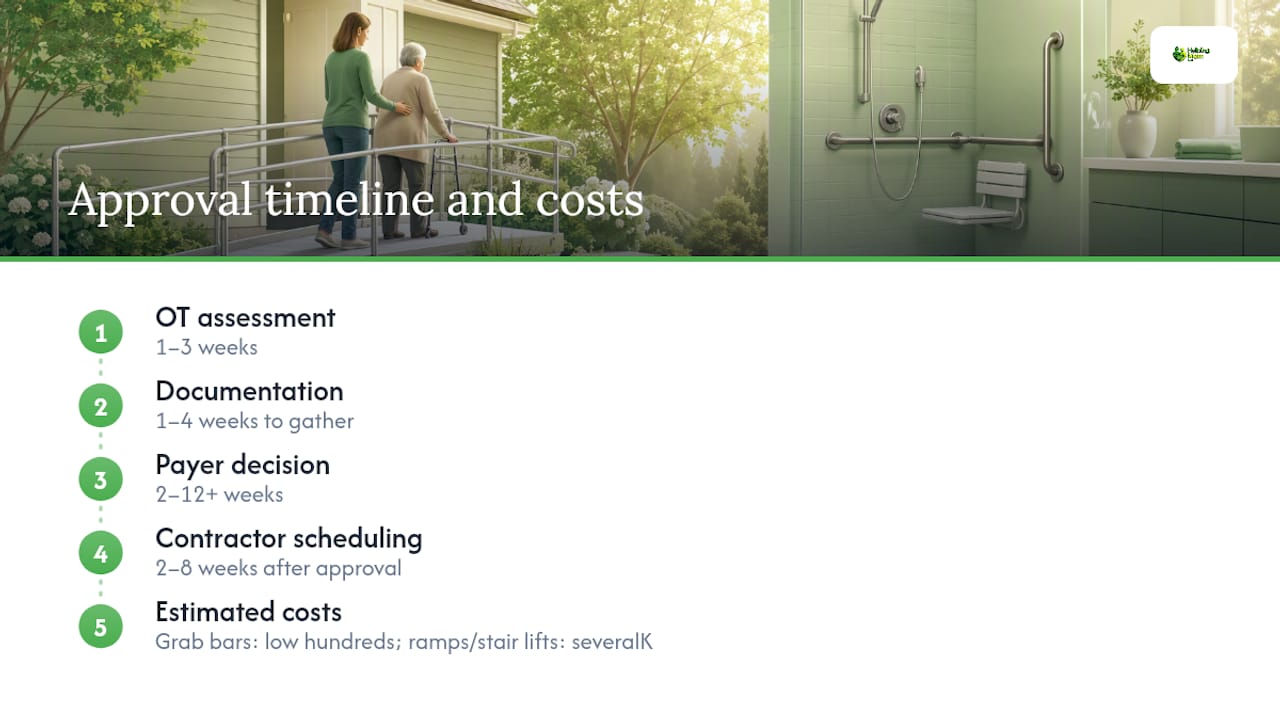
Costs vary by region and contractor, and can range from low hundreds for simpler items like grab bars to several thousands for more complex modifications like ramps or stair lifts.
Timelines stretch out more than most families expect. Budget one to three weeks for the OT assessment, another one to four weeks to gather documentation, then two to twelve or more weeks for the payer's decision depending on the program. Contractor scheduling adds another two to eight weeks once funding is approved.
Layering funding sources is often the realistic path: an MA stipend covers the grab bars, a VA HISA grant pays for the ramp, and personal funds cover finishing touches. If you pay out of pocket, IRS Publication 502 allows certain home modifications to be deducted as medical expenses when they're primarily for medical care, which can soften the cost at tax time.
Why Your State's Medicaid Waiver Looks Nothing Like Your Neighbor's
If you've compared notes with a friend in another state about Medicaid coverage for home modifications, you may have walked away confused, and that's not you misunderstanding something. Each state designs its own HCBS waiver programs within federal guidelines, which means coverage scope, income limits, and waitlist length can look completely different across a state line.
California's Medi-Cal HCBS waivers, for example, operate through several distinct waiver programs targeting different populations, each with its own income thresholds and service menu. Texas runs multiple 1915(c) waivers with separate waitlists that can stretch for years depending on the specific waiver and region. Florida, where many Helping-mom families are based, administers home modification benefits through its Statewide Medicaid Managed Care Long-Term Care program, with its own assessment and enrollment process distinct from regular Medicaid.
Some states cap home modification benefits at a set dollar amount per year. Others evaluate each request individually with no published cap, which sounds more flexible but often means longer review times. A few states fold home modifications into a broader "environmental accessibility adaptations" service category, so the exact wording you search for in your state's waiver handbook matters more than you'd think.
The practical takeaway: never assume a rule you read about one state's waiver applies to yours. Call your state Medicaid office or your local Area Agency on Aging and ask specifically what's covered under your state's HCBS waiver, what the income and asset limits are, and whether there's currently a waitlist. That one phone call will tell you more than any general guide, including this one.
Helping Mom Perspective: What Families Actually Find Helpful First
While you're chasing paperwork, don't wait to make the changes that don't need anyone's permission. Better lighting, non-slip strips, and a couple of grab bars installed this weekend often prevent the fall that makes everything else urgent. Pick one family member to own the calls and deadlines. Two siblings calling the same Medicaid office creates confusion, not progress. When you're ready for structured next steps, our aging-in-place home modifications guide is a good place to start, or book a paid assessment to get organized.
— Mike C.
How Helping-mom Helps You Skip the Guesswork
Medicare, Medicaid, and the VA all want documentation before they'll pay for anything, and putting that paperwork together alone, on top of everything else you're managing, is where most families lose momentum. Helping-mom is built specifically for this stage: our home safety guides walk you through what modifications matter most, our paid Zoom consultations help you organize the assessment reports and letters of medical necessity these programs require, and if you're in Central Florida, we offer in-person home safety assessments that give you a written report you can hand straight to a Medicare Advantage plan or Medicaid caseworker. An occupational therapist's report satisfies medical documentation requirements; our assessment is best used alongside that, or as your starting point if you're still deciding whether formal OT involvement is needed. Start with our practical guide to making a home safer for seniors and book a consultation when you're ready to move from research to action.
This article is general information, not a substitute for advice from a qualified financial advisor. Consult a qualified financial professional about your own circumstances before acting on anything here.
Sources
- NCD - Durable Medical Equipment Reference List (280.1) — CMS
- Medicare
- Home modifications factsheet — Eldercare (ACL)
FAQ
Does Medicare pay for home modifications for seniors?
Original Medicare generally does not cover permanent home modifications like grab bars or ramps, but it may cover certain durable medical equipment when a doctor documents medical necessity. Medicare Advantage plans, Medicaid HCBS waivers, and VA grants are more reliable funding sources for actual renovations.
Will Medicare pay for a walk-in shower for seniors?
No. Original Medicare classifies a walk-in shower as a home improvement rather than durable medical equipment, so it's excluded from coverage. Some Medicare Advantage plans offer supplemental benefits that can help with bathroom safety upgrades, and Medicaid HCBS waivers cover roll-in shower conversions in many states.
What home modifications help seniors the most?
Grab bars near the tub and toilet, non-slip flooring, improved lighting on stairs, and a ramp at the main entrance address the most common fall risks in the home. A written occupational therapy assessment can pinpoint which modifications matter most for a specific person's needs.
What are the big changes coming to Medicare in 2026?
CMS updates Medicare Advantage and Part D rules annually, and specific supplemental benefit offerings, including home safety allowances, can shift from year to year by plan and region. Check your parent's plan documents each fall during open enrollment, since benefits like SSBCI are not guaranteed to stay the same from one year to the next.
How do I find out if Medicaid covers home modifications in my state?
Contact your state Medicaid office or your local Area Agency on Aging and ask specifically about HCBS waiver programs and their covered services. Coverage scope, income limits, and waitlists vary significantly by state, so a general answer won't tell you what applies where you live.