
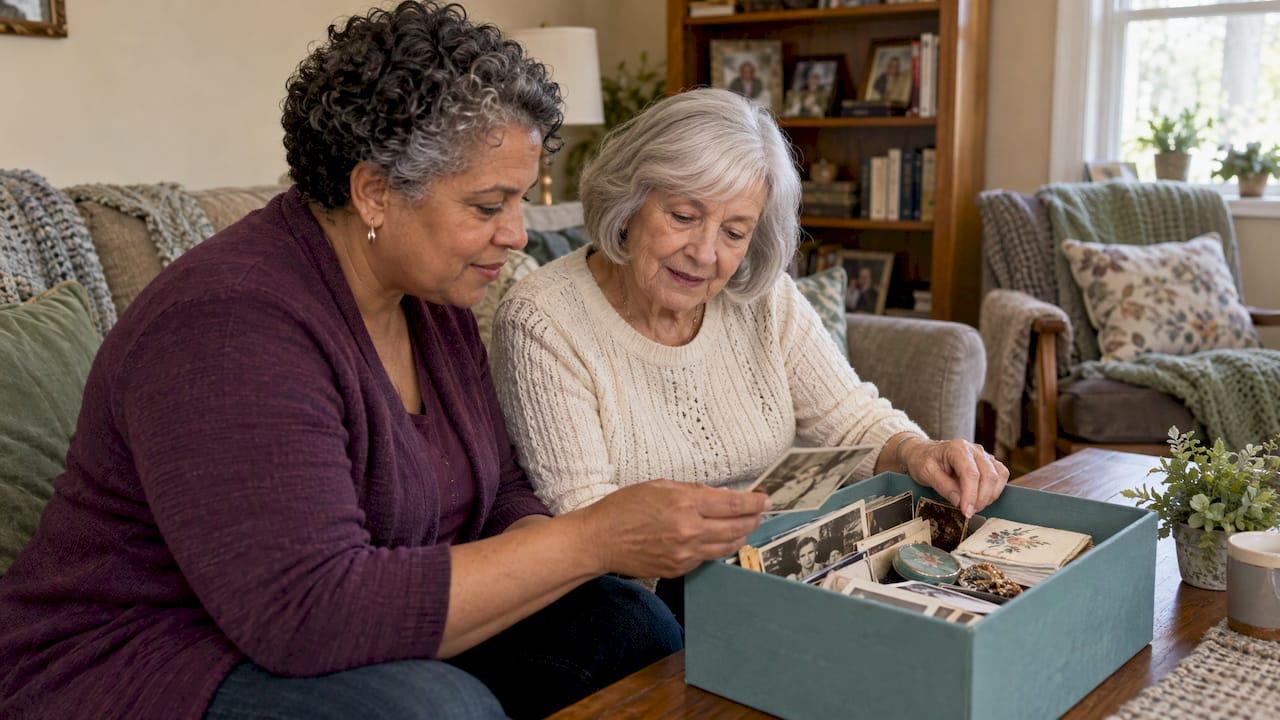
A good memory box for a parent with dementia holds a handful of safe, touchable things that matter to them: a few photos, a favorite scent, a familiar piece of clothing, a song they love. You fill it together, one topic at a time, and you use it to connect, not to quiz. Below you'll find ideas by category, a simple way to build the box, how to use it in a visit, and what to leave out.
If you've been wondering whether a shoebox of old things can really help, you're in good company. It can be one of the gentlest tools you have, and it costs very little.
TL;DR
- A memory box is a hands-on version of a photo album: real objects that can be held, smelled and talked about.
- Start with five to ten items from your parent's own life: photos, music, a familiar scent, a work or hobby item, something soft.
- Let your parent lead. Use their words, take one topic at a time, and drop anything that causes upset.
- Choose objects that are safe to handle alone, with no small pieces that could end up in the mouth.
- The goal is connection and a pleasant half hour together, not testing what they remember.
Table of Contents
- What a memory box is, and why it works
- Memory box ideas by category
- How to personalize a box so it fits your parent
- Making the box together: a simple step-by-step
- Using the box during a visit
- Safety: what to leave out
- Where the box lives
- Support when you want a hand
- FAQ
- Sources
What a memory box is, and why it works
Think of it as a 3-D memory book. Alzheimer's Arkansas describes it as a collection of objects that can be handled and that bring back specific moments. Their suggested containers are plain: plastic storage bins, shoeboxes, jewelry boxes or tackle boxes. You can make a personal box, or themed ones for sports, holidays or hobbies.
The reason it helps comes down to how memory tends to change. The Alzheimer's Association explains that Alzheimer's first affects short-term memory, while older memories often stay reachable much longer. Photos, music and familiar objects can open a door to the past and to the people who care for your parent now.
The same page is clear about the purpose: at home, reminiscing is about connection, not testing memory. Pleasant memories can bring joy, ease anxiety and strengthen emotional bonds, as long as you follow your parent's lead. A 2018 review in The Gerontologist found a moderate evidence base for reminiscence work, with positive effects on mood, and advised care providers to focus on positive memories. If you'd like to read more about the emotional side of looking back on good times, this piece on positive memories is a quiet place to start.
None of this is medical care. It's a way to spend time together that feels warm instead of effortful.
Memory box ideas by category
You don't need all of these. Pick what fits your parent's life. Dementia UK's life story guidance (a UK charity) lists many of the same kinds of items, and notes that boxes are especially useful when someone relies more on touch or smell, including people with sight loss or in later stages of dementia.
Photos and paper keepsakes
- Printed copies of favorite photos, not originals. Choose clear, uncluttered pictures of people your parent knows well.
- Postcards, holiday souvenirs, and theater or ballgame programs and tickets.
- A wedding or graduation program, or a church bulletin from a special day.
- A short caption on the back of each photo, written in your parent's own words if they're willing.
If you're picking from a big pile of family pictures, start with the ones that make your parent smile, and leave out anything tied to loss or hard years. The research points toward positive memories, so let that guide the sorting.
Things to hold and handle
- A smooth stone, a worn wooden spoon or a piece of fabric they used to sew with.
- Work items: a name badge, a ledger, a (safe) tool handle, a pair of reading glasses from their career era.
- Toys from their childhood or their children's, such as a doll, a large wooden block or a stuffed animal.
- Ornaments, a scarf, a hat or costume jewelry.
Scent and touch
Dementia UK mentions toiletries and clothing in its list, and the Illinois Brain Health activity workbook suggests including favorite perfume and an item of clothing. Ideas that fit here:
- A cardigan or flannel shirt that still smells like home.
- A bottle of the perfume or aftershave they always wore, or a sealed sachet of lavender or cedar.
- A soft blanket square or velvet fabric swatch.
- A bar of the soap they used for years, kept in its wrapper.
Music
- A simple playlist or a small speaker with their favorite songs from young adulthood.
- A CD case or album cover they remember.
- A harmonica or a shaker, if they enjoy making sound.
The workbook gives a lovely, simple instruction for music: help your parent discover each item, and sometimes that just means dancing with them to a favorite song.
Hobbies and daily-life themes
Themed boxes work well because they stay focused:
- Gardening: seed packets, a pair of soft gloves, a pressed flower, a seed catalog.
- Baking or cooking: a handwritten recipe card, a wooden spoon, a cookie cutter, a clean apron.
- Sports: a team cap, a ticket stub, a baseball card, a pennant.
- Travel: postcards, a map, a snow globe, photos from a trip.
- Faith and holidays: a small holiday ornament, a favorite hymn card, a greeting card.
How to personalize a box so it fits your parent
The most useful memory box is the one that matches who your parent is now, not just who they were. Alzheimer's Arkansas advises building on well-learned abilities and what the person enjoys, rather than teaching new skills or retraining old hobbies. They also stress focusing on enjoyment over achievement, keeping activities at an adult level, and adjusting expectations to fit remaining ability, since your parent's self-esteem matters more than how well a task gets done.
In practice, that looks like this:
- A retired carpenter might love a box with sandpaper, a smooth block of wood and a folding ruler to hold and run his hands over. He doesn't need to build anything.
- A mom who sewed for decades might enjoy a basket of fabric squares, big buttons sewn onto a card and a measuring tape, sorted by color or feel.
- A dad who loved the radio might do best with a small speaker and three favorite songs, and an old transistor radio to hold.
Keep everything adult. Baby dolls and children's puzzles can feel patronizing to someone who raised a family and ran a household. If you're choosing between a childlike item and a grown-up one with the same texture or feel, go with the grown-up one.
And think about their abilities today. Can they open a lid easily? Can they see small photos? Larger prints, fewer items and a lid that lifts off will serve a parent with stiff hands or low vision far better than a fancy latch.

Making the box together: a simple step-by-step
Building the box can be as meaningful as using it. Dementia UK suggests being led by the person, involving them as much as they want, using their own words as captions because it is their story and not yours, and taking one topic at a time with breaks. It may take days, weeks or months, and you can come back to add more.
- Pick the container. A sturdy shoebox or a lidded bin is plenty. If your parent will explore it alone, the University of Kentucky's CARE Compass guide says it should be easy to open and hold only safe objects.
- Choose one theme. Start with something happy: their wedding, a favorite job, the family dog, summers at the lake.
- Gather together. Bring a few items to the table and see what catches their eye. Skip anything that doesn't.
- Add one or two items at a time. Let them hold each one. Ask a simple, open question, such as "Tell me about this," and give them time.
- Write their words down. Use their phrases as captions on photo backs or on a card in the lid. If they say something that isn't factually right, let it stand. The box is about feeling, not accuracy.
- Decorate if they enjoy it. The Illinois workbook treats decorating the box as its own activity, separate from filling it, which keeps each session short and low pressure.
- Stop while it's still pleasant. End on a good note, and come back another day.
If the whole thing feels like a lot to organize while you're also managing appointments and groceries, you can begin tiny: one photo, one song, one scent. That's already a box.
Using the box during a visit
Open it when your parent is rested and the room is quiet. Turn off the TV. Sit beside them rather than across from them, and let them choose what to pick up.
Some gentle ways to start:
- "This looks soft. Do you want to feel it?"
- "I love this picture of you. Who's with you?"
- "Should we put on that song?"
Avoid "Do you remember...?" That phrase turns a nice moment into a test. The Alzheimer's Association's guidance is to follow the person's lead and keep the focus on connection, so if they don't name the person in the photo, you can say, "She has such a kind smile," and keep going.
If you're finding conversation hard in general, our stage-based communication toolkit walks through what to say as things change, and these calming memory care activities give you more ideas for afternoons together.
Keep sessions short
Alzheimer's Arkansas recommends activities that last no longer than half an hour, since attention spans are shorter than usual. The same source suggests familiar, simple, repetitive activities that don't need much decision-making. A box with five items beats one with thirty.
If an item brings up sadness or agitation
Sometimes a photo of a spouse who has passed, or an item from a stressful job, lands the wrong way. Watch your parent's face and hands. If they seem frustrated, tense or upset, the Arkansas guidance is to step in and help, or shift to another pleasant activity, a break or a snack.
In plain terms:
- Put the item gently aside without comment.
- Offer something comforting: a favorite song, a hand to hold, a cup of tea.
- Make a note, and quietly take that item out of the box before next time.
There's no failure here. You're learning what works for your parent, and that is the whole point.
Safety: what to leave out
A memory box should be something your parent can touch without you worrying. Alzheimer's Arkansas notes that in later stages, a person may put objects in their mouth, so be careful with small pieces in activity kits.
A practical screen for each item:
- Size: If it's small enough to fit in a mouth, leave it out or keep it for supervised visits only. That includes loose buttons, coins, beads and small stones.
- Edges and fragility: Skip glass, sharp tools, razor blades and anything that breaks. Choose a wooden handle, not a blade.
- Liquids and scents: Keep perfume in a sealed bottle or on a cotton ball in a closed sachet during visits, so it can't be swallowed or spilled. Don't include anything edible that looks like candy.
- Medicines and chemicals: Never include pill bottles, cleaning products or cosmetics that look like food.
- Cords and long strings: Leave them out.
If your parent will use the box alone, keep a second, supervised-only box for anything you aren't sure about. If you're thinking about their whole living space, not just the box, our room-by-room dementia-friendly home guide goes through the changes that help most.
If your parent has trouble with swallowing, confusion about objects or behaviors that worry you, mention it to their doctor. This article is not medical advice.
Where the box lives
Keep it somewhere easy to reach, such as on a coffee table or a living-room shelf. For a parent who is moving to a new home or facility, a box with familiar objects can also help the new room feel like theirs. Our guide to labeling a home for dementia pairs well with a box in a parent's room, since both are about helping them feel oriented and at ease.
If you're clearing out a family home to find items, go slowly. Set aside a small "parent's box" pile before anything is donated or sorted, so the best pieces don't get lost in the shuffle.
Our view: start small, and start with them
When we talk with families, the memory box usually isn't the hard part. The hard part is the feeling that you have to do everything perfectly, right now.
We'd gently suggest the opposite. Choose one photo and one song this week. See how your parent responds, and let that tell you what to add. This isn't about taking control. It's about walking alongside your parent, noticing what brings a little light to their day.
The same calm approach applies to the rest of the home. Our guides and assessments are built on personal caregiving experience, and we hold Age Safe® America certification. Many of the families we hear from find that once the home feels safe and familiar, the visits get easier, and a simple box becomes one more comfortable thing to share.
Mike C.
Support when you want a hand
If you'd like a calm second opinion on your parent's home, our Virtual Home Safety Consultations let you walk through it with us by video. If you're in Central Florida, we also offer In-Home Age-Safe Home Safety Assessments. And if you'd simply like to talk through where to begin, the Caregiving Clarity Session is a one-time $97 conversation about your family's situation.
FAQ
How many items should go in a memory box for dementia?
Start with five to ten. A small, focused box is easier to enjoy, and it matches the short, calm sessions that Alzheimer's Arkansas recommends. You can always add more over time or make separate themed boxes.
What should I avoid putting in a memory box?
Leave out small pieces that could be swallowed, sharp or breakable things, medicines, chemicals and anything tied to painful memories. Choose items your parent can safely handle on their own. In later stages, extra care with small objects matters most.
What if my parent doesn't recognize the people in the photos?
That's okay. The goal is connection, not recall. Describe what you see, share a warm comment and follow their lead. If a photo seems to confuse or upset them, set it aside and try a song or a soft item instead.
Can I make a memory box if my parent can't help?
Yes. Use what you know about their life, their favorite songs, their work and their home. Dementia UK notes boxes can be especially helpful for people who rely more on touch or smell. Watch how they respond, and adjust.
Is a memory box the same as a memory book?
Not quite. A memory book is made of pages and photos, while a memory box is a three-dimensional version with objects to hold, smell and feel. Many families make both, so there's something to look at and something to touch.
Sources
- Alzheimer's Association: Reminiscence and Reminiscence Therapy
- Alzheimer's Association: Dementia Care Practice Recommendations, 2018
- Alzheimer's Arkansas: Making the Most of Memories
- Dementia UK: Creating a life story for a person with dementia
- University of Kentucky CARE Compass: Memory Boxes guide
- Illinois Brain Health: Activity Workbook for Individuals Experiencing Memory Loss
- Positive memories and journaling