
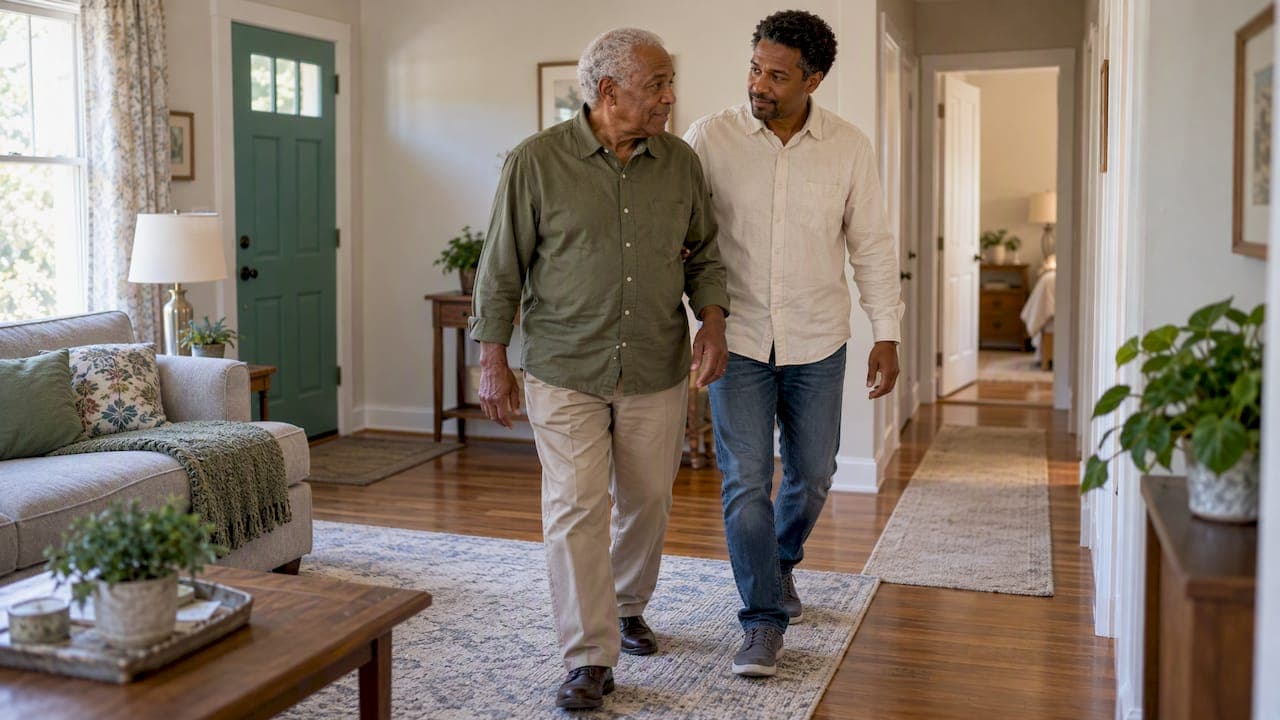
A dementia-friendly home is one that gets simpler, brighter and more predictable as your parent's abilities change, so they can keep moving through familiar rooms with confidence. You don't need a renovation or a long shopping list. Most of the work is small: better light, clear walkways, a few labels, a safer kitchen and bathroom, and a quieter feel overall. The Alzheimer's Association says safety measures can help a person with dementia remain at home, and that the home should still encourage independence and social connection.
If you are reading this with a knot in your stomach, take a breath. You can do this in stages, and you can start this weekend with one room.
TL;DR
- Fix the obvious hazards first: loose rugs, cords, poor lighting, wobbly stair railings. Then work through the rest room by room.
- Even, glare-free light and clear, uncluttered walkways do more for confidence than any single gadget.
- Simple labels, closed cupboards and "everything has a place" habits help your parent find things on their own.
- The kitchen and bathroom need the most attention: stove shut-offs, water temperature, grab bars, locked medications.
- Review the home every so often. Needs change, and the home can change with them, with your parent involved in the decisions.
Table of Contents
- What "dementia-friendly" means inside a home
- Start with what is urgent, then work outward
- Lighting: the quiet change that helps most
- Clear paths, furniture and floors
- Helping your parent find their way
- The kitchen: keep the independence, lower the risk
- Bathroom and bedroom
- Quieting noise and keeping the home familiar
- Adapting as things change, with your parent at the table
- Our perspective
- Getting a second set of eyes on your parent's home
- FAQ
- Sources
What "dementia-friendly" means inside a home
You may have seen the phrase used for whole towns. Dementia Friendly America describes a dementia-friendly community as a place that is informed, safe and respectful of people living with dementia and their families. At home, the idea shrinks down to something very personal: a space that feels familiar, is easy to read, and doesn't ask your parent to solve puzzles.
That last part matters. A cluttered hallway, a shiny floor that looks wet, a patterned rug that looks like a step: none of these are "dangerous" to most of us. When someone's memory, vision processing or judgment is changing, they can become confusing or risky. UCSF's Memory and Aging Center explains that when visual processing is affected, simplicity, consistent placement of objects, reduced glare and unobstructed paths all support recognition and independent movement.
So the goal isn't a "safe room" that feels like a facility. It's your parent's own home, quietly edited.
This guide is non-medical. It covers the physical home and daily routines. Questions about your parent's health, medications or diagnosis belong with their doctor.
Start with what is urgent, then work outward
It is tempting to try to fix everything at once. Please don't. The National Institute on Aging suggests walking through the home room by room, correcting immediate hazards first, such as loose stair railings and poor lighting, and reassessing as needs change. It also notes that not every suggested change will be necessary for every person.
Here is a simple way to sequence it:
| When | Focus | Examples |
|---|---|---|
| This weekend | Immediate hazards | Loose rugs, cords across walkways, burned-out bulbs, shaky handrails |
| Next few weeks | Light, paths and the two high-risk rooms | Night-lights, clearing furniture, kitchen and bathroom changes |
| Over the next months | Cues and routines | Labels, a "memory center," consistent places for keys and glasses |
| Every so often | Review | Walk through again, adjust, remove what's no longer needed |
If you want a printable version of the walk-through, our senior home safety checklist goes room by room and you can work through it at your own pace.
Lighting: the quiet change that helps most
Good light helps your parent see edges, steps and objects, and it helps them feel oriented. The Alzheimer's Association recommends even lighting at entries, landings, between rooms, on stairs and in bathrooms, with night-lights in hallways, bedrooms and bathrooms.
For nighttime, Alzheimers.gov suggests a bedside lamp within easy reach, a night-light in the hallway or bathroom, a flashlight nearby and a phone with emergency numbers. That short list is worth doing this week.
A few practical notes from real homes:
- Walk the path your parent walks at night. Bedroom to bathroom is usually the one. Stand at the bed and look down the route. Is any stretch dark?
- Reduce glare. UCSF recommends consistent lighting and reduced glare. Shiny hardwood or tile with a sunny window can look like a puddle. Sheer curtains, matte finishes or moving a lamp can soften it.
- Keep it consistent. Sudden shifts from a bright room to a dark hallway are harder to adjust to. Leave a hallway light on rather than relying on a switch at the far end.
- Mark glass. Large glass doors or windows can be hard to see. UCSF suggests marking them so they read as a surface, not an opening.
I often hear from families that the lighting fix was the cheapest and the most noticed. A parent who used to hesitate at the top of the hallway starts walking through it again.
Clear paths, furniture and floors
The Alzheimer's Association recommends removing throw rugs, extension cords and clutter, securing large furniture and keeping walkways clear. Alzheimers.gov adds that simplifying furniture and layout and installing sturdy stair handrails help, along with smoke and carbon monoxide detectors in or near the kitchen and in all bedrooms.
UCSF's guidance adds a few useful details: remove clutter and unstable or low-profile furniture, remove loose rugs or secure their edges, and move cords away from high-traffic areas.
In practice, here is how this plays out:
- Do a "shuffle test." Walk through each room slowly, as if you were tired or unsteady. Where do you slow down? That's where something needs to move.
- Thin out, don't strip out. Take away the extra side table and the magazine rack, not the recliner your dad has sat in for twenty years.
- Choose stable over stylish. A sturdy chair with arms is a better seat than a low, soft sofa that is hard to rise from.
- Tame the cords. Lamps and TVs can often be rearranged so cords run along walls rather than across floors.
- Keep doors and drawers closed. UCSF suggests closing cupboard doors and drawers when not in use. It reduces visual noise.
Falls are the worry that sits behind many of these changes. If your parent also lives with bone loss, reading about fall prevention for osteoporosis can help you think about which hazards matter most. And if you'd like a gentler way to look at balance and risk at home, our fall risk screening tests are designed for families to try together.
Helping your parent find their way
When memory slips, a home that explains itself is a gift. The idea is to make the next step obvious.
Labels and signs. UCSF recommends high-contrast labels on doors, drawers and shelves. Large, plain letters on a contrasting background work better than a decorative sign. Some families add a small picture next to the word, such as a cup on the cupboard that holds cups. Use whatever your parent responds to, and drop what they don't.

A memory center. UCSF also suggests a visible spot with a phone, keys, a notepad and a whiteboard. Put it by the door your parent uses most. One example: a mom who kept searching for her keys now has a hook and a tray there, and her daughter's phone number is written on the whiteboard in thick marker.
Same place, every day. UCSF recommends returning items to the same place each day. Glasses on the same shelf, the remote in the same basket. It sounds small. It saves a lot of searching, and a lot of frustration.
Lists and calendars. Alzheimers.gov recommends written lists and calendars, automated bill payments with trusted help when needed, grocery delivery, and pillboxes or medication dispensers to help with changes in memory and thinking. Ask your parent's pharmacist or doctor which pill organizer suits the medications they take.
One more suggestion: avoid big changes to the outside of the home. A familiar front door, a clear house number and an unchanged entry help your parent recognize their own place. Keep the exterior as it is unless something is truly unsafe.
The kitchen: keep the independence, lower the risk
For many parents, the kitchen is where they feel most themselves, so we try to protect that. The Alzheimer's Association suggests automatic shut-offs or stove-knob covers, disconnecting the garbage disposal, removing medicines, toxic plants and decorative fruit that might look edible, and keeping an eye on the temperature of hot water and food.
Alzheimers.gov recommends setting the water heater to 120°F and using an automatic stove shut-off. Both are one-time fixes that don't change how your parent lives day to day.
A few more kitchen habits that families find workable:
- Keep a few easy snacks and drinks at eye level so your parent isn't tempted to cook when they don't need to.
- Store hazardous chemicals out of reach or locked. The Alzheimer's Association also recommends keeping hazardous chemicals inaccessible.
- Clear the counters. Fewer appliances means fewer decisions.
- Let your parent help with safe tasks, such as rinsing vegetables or setting the table.
We've written more on this in kitchen safety for seniors and a calm guide to stove safety.
Bathroom and bedroom
The bathroom is the room where privacy and safety pull in different directions, so go gently. The Alzheimer's Association recommends grab bars, textured stickers on slippery surfaces and considering a walk-in shower. Check that the water heater setting above has been done, since the bathroom is where hot water matters most.
Other things to consider:
- A toilet seat in a contrasting color from the floor and walls can be easier to see than white on white.
- Keep towels, soap and toilet paper in one obvious spot.
- Lock away medications. The Alzheimer's Association recommends locking medications and removing or securely storing firearms. That applies to the whole house, not just the bathroom.
In the bedroom, the night route is the thing to check: a lamp within reach, a night-light, a clear path to the bathroom and a phone with emergency numbers nearby, as Alzheimers.gov suggests. You don't have to do every bathroom upgrade at once. Our guide to phasing bathroom upgrades shows which five to do first.
Quieting noise and keeping the home familiar
A home can be physically safe and still feel overwhelming. Many families notice that a TV on in one room, a radio in another and several people talking at once seems to make a parent more unsettled. You don't need a study to try a gentler approach, and what follows comes from observation rather than medical guidance. If you're worried about your parent's reactions, their doctor is the right person to ask.
- One sound at a time. If the TV is on, turn the radio off. If the TV isn't being watched, turn it off too.
- Soften the room. Rugs are a trip risk, but curtains, upholstered chairs and cushions absorb echo. Fix the floor first, then soften elsewhere.
- Limit visitors at once. Two or three familiar people is usually easier than a crowd. Make introductions simple.
- Keep the meaningful things. Family photos, a favorite quilt, the chair by the window. Keep these where your parent can see them, but avoid crowding every surface. A few well-chosen items beat a wall of frames.
- Give them a calm spot. A comfortable chair in a quiet corner with good light gives your parent a place to retreat to.
- Keep a rhythm. Meals, walks and bedtime at similar times each day make the home feel more predictable.
The idea is to protect what feels like home while taking away what is confusing.
Adapting as things change, with your parent at the table
The NIA advises planning ahead while a person can still take part in important decisions. That might be the most important sentence in this guide. If your parent can still weigh in, ask. "Would the lamp be better here or there?" is a gentler question than "We need to fix the bedroom."
Some ways to keep it collaborative:
- Explain the why in one sentence. "I'm worried about the rug catching your foot" is better than a lecture on falls.
- Change one thing at a time and see how it goes.
- Let them keep what really matters to them, even if it isn't perfect.
- If they resist, try again another day, or have someone they trust suggest it. Our guide on talking with aging parents about care has wording you can borrow.
Review the home periodically. Something you added might no longer be needed, and something new may be. The goal is to match the home to your parent as they are now.
Our perspective
We have seen how much of this comes down to one thing: families don't need more fear, they need a calm place to start. When a parent's memory is changing, adult children often feel they must fix everything at once. That pressure leads to rushed purchases, arguments about "taking over," and homes that feel less like home.
Our approach is built on real family caregiving experience and professional crisis management, and it is non-medical on purpose. We look at the home the way your parent moves through it: where the light drops off, where a rug catches, where the labels are missing, where the kitchen asks too much. Then we help you choose the next two or three changes, not twenty.
We believe this journey isn't about taking control, it's about walking alongside your parents. That's why a second set of eyes can help. A short conversation or a home walk-through often shows what a family has been stepping around for months, and gives you a clear, manageable plan. That's what our Age Safe® America certified approach is for, and it's what our consultations and assessments are designed to provide.
Mike C.
Getting a second set of eyes on your parent's home
If you'd like help setting priorities, there are a few ways to work with us:
- The Caregiving Clarity Session is a one-time Zoom session for $97, where we talk through your situation and decide on next steps.
- Virtual home safety consultations let you walk us through your parent's home by video, wherever you live.
- In-home Age-Safe assessments are available locally in Central Florida.
If you'd rather start on your own, our home safety guide for aging parents is a good first read, and our home safety devices guide can help you sort what's useful from what's not.
FAQ
What is the first thing to change in a dementia-friendly home?
Start with the hazards that could cause a fall or injury right now: loose rugs, cords in walkways, poor lighting and wobbly handrails. The National Institute on Aging recommends correcting these immediate hazards first, then working room by room. After that, move on to the kitchen and bathroom.
Do I need to remodel the house?
Usually not. Most helpful changes are simple: better lighting, clear paths, labels, stove shut-offs, grab bars and locked medications. Larger projects like a walk-in shower can be phased in later, when and if they make sense for your parent.
How can I help my parent find things around the house?
Use large, high-contrast labels on doors, drawers and shelves, keep cupboards closed, and return items to the same place each day. UCSF also suggests a visible memory center with a phone, keys, notepad and whiteboard. Pick a spot near the door your parent uses most.
How often should I review the home?
Periodically, and any time something shifts in your parent's routine or abilities. Walk through each room again, remove what isn't helping, and add only what is needed. Involve your parent in the decisions for as long as they're able.
Is this the same as medical advice?
No. This is practical, home-focused guidance. For questions about your parent's health, medications or diagnosis, speak with their doctor or care team.
Sources
- Home Safety, Alzheimer's Association
- Tips for People With Dementia, Alzheimers.gov
- Home Safety Tips for People with Visual Dysfunction, UCSF Memory and Aging Center
- Aging in Place: Growing Older at Home, National Institute on Aging
- Dementia Friendly America