
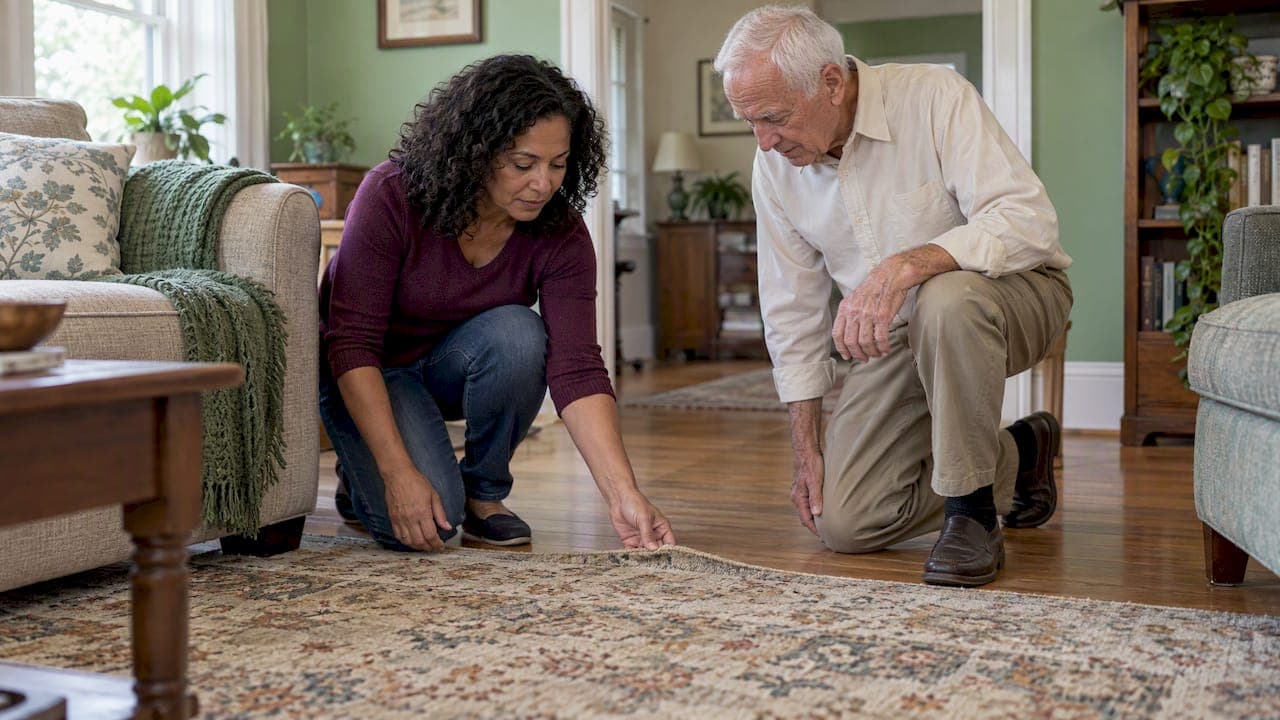
A good senior home safety checklist walks through the house one space at a time and looks for the same few things: poor lighting, trip hazards, slippery surfaces, hard-to-reach items, and no easy way to call for help. You do not need to fix everything in a weekend. You need to see the home the way your parent moves through it, then choose the two or three changes that matter most.
This guide gives you that walkthrough, with a printable-style list for each area, a way to rank what you find, and the extra steps that help when memory changes are part of the picture.
TL;DR
- Walk the home room by room, starting with entrances, stairs, the bathroom and the bedroom, where most trouble begins.
- The biggest everyday fixes are cheap: remove throw rugs, add light, clear walking paths, and add grab bars and nonslip surfaces.
- You do not have to make every change. Pick the top three, talk with your parent first, and review again as needs shift.
- If memory changes are showing up, add locks for medications and cleaning products, stove safeguards, and door alarms.
- After a fall, ask your parent's doctor whether an occupational therapist should visit the home.
Table of Contents
- Why a checklist helps more than a hunch
- Before you walk through: how to set it up
- The room-by-room checklist
- A quick way to rank what you found
- Add these if memory changes are part of the picture
- Perspective: what we have learned from walking through homes
- Staying strong enough to stay safe
- When to bring in a professional
- Where Helping Mom can help
- Keeping the checklist alive
- FAQ
- Sources
Why a checklist helps more than a hunch
Most of us notice small things when we visit: a stack of mail on the stairs, a cord across the hallway, a nightlight that burned out. A checklist turns those passing impressions into a plan, so you are not carrying them in your head.
Falls are the reason this matters. The CDC reports that more than one in four adults 65 and older falls each year, and falling once doubles the chance of falling again. That is not a reason to panic. It is a reason to spend an afternoon on the home, because many of the causes are things you can see and change.
The National Institute on Aging (NIA) also notes that home safety should be reevaluated regularly as an older adult's behavior and needs change. Think of this list as something you return to, not a one-time inspection.
Before you walk through: how to set it up
The checklist is the easy part. The harder part is doing it in a way that leaves your parent feeling respected. A few things help:
- Do it together. Say something like, "I'm going to look at my own house this weekend too. Want to walk through yours with me?" It lands better than arriving with a clipboard.
- Ask how they use each space. Where do they sit when the phone rings? Which route do they take at night? Their habits tell you more than a generic list can.
- Take photos or notes, not action. On the first pass, only observe. Fixing comes after you both agree on priorities.
- Bring a flashlight and a tape measure. Dim corners and narrow doorways show up fast.
If your parent is resistant, our guide on making a home safer for an elderly parent has conversation ideas that keep the focus on independence.
The room-by-room checklist
These items draw on the NIA's home safety worksheets and fall prevention guidance, plus what we see when walking through homes with families. Check what applies and skip what does not.
Entrances, walkways and outdoor areas
The path to the front door is the first place a parent has to be steady, often while carrying groceries or a package.
- Steps are intact, not cracked or crumbling, and walkways are even.
- Handrails are on both sides of any steps, and sturdy when you pull on them.
- Overgrown shrubs are trimmed back from the path.
- The entrance is well lit at night, ideally with a motion-activated or dusk-to-dawn light.
- The house number is visible from the street, so help can find it quickly.
- If steps are a growing problem, consider a ramp with handrails. The NIA lists a ramp with handrails to the front door among its key updates for aging in place.
Living room and hallways
This is where clutter and cords quietly pile up.
- Walking paths are wide and clear of furniture, boxes and stacks of paper.
- Electrical and phone cords run along the wall, not across the floor. The NIA specifically advises keeping cords near walls and away from walking paths.
- Throw rugs are removed or secured. Carpet edges are tacked down, with no curling corners.
- Chairs and sofas are firm enough and high enough to stand up from without a struggle.
- Light switches are reachable from the doorway, so no one crosses a dark room.
- A phone, cordless or cell, is within reach of the favorite chair.
Stairs
- Lighting is bright at the top and the bottom, with switches at both ends.
- Handrails run the full length, ideally on both sides.
- Steps are free of objects, even the "I'll carry that up later" kind.
- Treads are not worn, loose or slippery. Nonslip strips can help on bare wood.
- If your parent can live comfortably on one floor, consider moving the bed, laundry or a half bath so stairs become occasional rather than daily.
Bathroom
Wet surfaces, hard fixtures and getting up from a low seat make this room the one we start with most often.
- Grab bars are installed by the toilet and in the tub or shower, anchored into studs or with proper hardware, never a towel bar standing in for one. Our guide to bathroom grab bars for elderly parents covers what to look for.
- A nonskid mat or adhesive strips are in the tub or shower, and a absorbent rug with a rubber backing, or no rug, sits outside it.
- A shower chair or bench is available if standing for the whole shower is tiring.
- Nightlights light the route from bed to bathroom.
- The water heater is set so water cannot scald. Anti-scald valves are a simple upgrade, and we explain what to install and how.
- A raised toilet seat or a frame is in place if standing up is difficult.
Kitchen
- Everyday items (dishes, food, pots) are stored between waist and shoulder height. Mayo Clinic recommends keeping clothing, dishes, food and other necessities within easy reach.
- A reach stick or a sturdy step stool with a handle is on hand. The NIA suggests a reach stick or a safe step stool used with assistance rather than a chair or a stack of books.
- The floor is dry, with no slick spots near the sink or stove, and with a nonskid mat if needed.
- Smoke and carbon monoxide alarms are working, and a small fire extinguisher is easy to find.
- Expired food is cleared out regularly. Ask permission first and do it together.
- Appliances with automatic shut-off, such as kettles, irons and some stove devices, reduce worry if your parent gets distracted.
Bedroom
- A lamp or switch is within reach of the bed, so no one has to cross the room to turn on a light.
- The bed is a height where feet rest flat on the floor when sitting on the edge.
- A clear path runs from the bed to the bathroom, with a nightlight along it.
- Shoes or nonskid slippers sit where your parent steps out of bed. The NIA's guidance on fall prevention also advises against going barefoot or in loose socks.
- A phone and a flashlight are on the nightstand.
- Closets are arranged so frequently worn clothing is at easy height.
Whole-house safety basics
The NIA's worksheet adds items that apply to the entire home: emergency numbers by the phone, medication labels that are easy to read, alarms, and any firearms locked and unloaded. In practice, that looks like:
- A printed list of emergency numbers, your number, the doctor and the pharmacy near each phone.
- Smoke alarms on every level and outside sleeping areas, tested on a schedule you both remember (many families pick daylight saving changes).
- Bright bulbs in every lamp, and nightlights in halls.
- A spare key with a neighbor or in a lockbox, so help can get in.
- Medications in original, clearly labeled containers. If managing them is getting confusing, see our medication safety guide.
A quick way to rank what you found
A long list of problems feels heavy. Sorting it makes it manageable. We use three buckets:
| Priority | What it looks like | Examples |
|---|---|---|
| Do this week | Cheap, fast, and removes a clear hazard | Remove throw rugs, add nightlights, move cords, swap burned-out bulbs, post emergency numbers |
| Do this month | Needs a purchase or a helper | Grab bars, nonslip strips, handrail repair, reach stick, smoke alarm batteries or replacements |
| Plan ahead | Bigger, costlier or more personal | Ramp, walk-in shower, first-floor bedroom, monitoring technology |
The NIA's alzheimer's safety checklist makes a point worth remembering: you may not need to make all the suggested changes. Choose what fits your parent's actual habits. A change they will use beats a perfect one that sits unused.
A real-world example
A daughter we will call Karen visited her father's house and found eleven things on her list. Her first instinct was to fix all of them over one weekend. Her dad, who had lived there 40 years, felt like he was being moved out in pieces.
She stopped, kept three items for the first round (the bedroom rug, the dark hallway to the bathroom, and the missing grab bar), and asked him which one he would pick first. He picked the nightlights. A month later, he agreed to the rest. Same list, same house, different pace.

Add these if memory changes are part of the picture
When a parent is forgetting recent conversations, misplacing things more often, or getting confused in familiar places, the same checklist still applies, plus a few safeguards. The NIA's home safety checklist for Alzheimer's disease suggests:
- Covering unused outlets with childproof plugs.
- Installing childproof latches and door or window alarms.
- Using stove safety knobs and an automatic shut-off switch.
- Avoiding clutter.
- Locking away all medications and household cleaning products, and using childproof latches on cabinets and drawers that hold items like matches and knives.
For medications, the NIA also advises caregivers to use weekly pill organizers and phone alerts to keep doses on track.
A few other everyday adjustments we see help families: labeling cabinets with simple words or pictures, keeping a consistent place for keys and glasses, and adding motion-activated lights so a night walk does not start in the dark. If you are weighing technology, our comparison of motion sensors vs cameras for aging parents explains the privacy trade-offs, and our overview of technology that helps aging parents stay independent covers more options.
When to take a closer look at memory
You are not diagnosing anything by noticing. The Alzheimer's Association lists memory loss that disrupts daily life among the early signs, including forgetting recently learned information, asking the same questions repeatedly, and relying on notes or family for things your parent used to handle alone. Trouble following familiar steps, like a recipe or paying bills, can also be on that list.
If you are seeing a pattern rather than a single off day, it is reasonable to suggest a visit with their doctor, and to review home safety at the same time. Safety changes do not need a diagnosis first. They are good practice either way.
Perspective: what we have learned from walking through homes
We have seen the same thing in home after home: the hazard is rarely a dramatic one. It is a rug that has been there for years, a light switch at the wrong end of the hall, a bathroom that was fine at 55 and is not quite fine at 80.

We also see that the checklist is the smaller part of the work. The larger part is how it feels for your parent. When a family arrives with a plan, parents hear "you can't manage." When a family arrives with a question, they hear "I want you to stay." So we start with what your parent wants to keep doing, whether that is cooking, gardening or walking to the mailbox, and build the safety plan around it.
Our approach comes from personal caregiving and professional crisis management, and we are Age Safe® America certified. We keep language simple and the steps small, because overwhelmed families rarely follow through. One change, done, is worth more than a binder of good intentions.
— Mike C.
Staying strong enough to stay safe
A safer house helps, and so does a steadier body. Strength and balance work is one of the most common recommendations for lowering fall risk, and it is worth raising with your parent's doctor. If you want to understand what gentle options exist, this article on balance training for seniors walks through safe exercises.
For a simple at-home look at how steady your parent is, see our three quick fall risk screening tests. They are not medical tests, but they can help you decide what to bring up with a doctor.
When to bring in a professional
A checklist covers a lot, but sometimes you want a trained eye.
The NIA says that if an older adult has fallen, their doctor might suggest an occupational therapist, physical therapist or nurse visit to assess home safety and advise on changes. Occupational therapy practitioners, as the American Occupational Therapy Association describes, make home modification recommendations based on the homeowner's needs, functional status, interests and goals, which is a good way to think about it: the plan fits the person, not just the house.
A few moments that usually call for a second opinion:
- Your parent has had a fall, or a near fall, especially more than one.
- Getting in and out of the tub, bed or a chair has clearly become harder.
- You are considering a ramp, a bathroom remodel or a stair lift and want to choose well.
- Your parent is leaving the stove on, getting lost in the house, or wandering.
In those cases, start by calling the doctor. Mention what you have noticed and ask whether a home visit from an occupational therapist makes sense.
Where Helping Mom can help
If you would rather not do this alone, we offer a few ways to get support. A Caregiving Clarity Session is $97 and gives you a one-on-one conversation to sort out where to start. You can also ask about a virtual home safety consultation, where we look at your parent's home with you over video, or, if you are in Central Florida, an in-home Age-Safe home safety assessment. Pricing for the assessments is not published, so check each page for current details.
Want to go deeper on your own first? Our elderly home safety checklist for caregivers and no-drama home safety walkthrough are good next reads.
Keeping the checklist alive
Home safety is not a project with a finish line. Needs shift with health, seasons and even a new pair of glasses. A simple rhythm works for most families:
- Review twice a year. Pair it with something you already do, like clocks changing.
- Review after any change. A hospital stay, a fall, a new medication or a bad week all count.
- Re-ask your parent. What feels harder than it did last time?
- Keep one shared list. A note on your phone or the fridge that you both can add to.
Aging in place works best when the home keeps adjusting. If you want the bigger picture, our aging in place resource hub is a good place to continue.
FAQ
What is the most important thing on a senior home safety checklist?
There is no single item, but the most common starting points are lighting, loose rugs and cords, and the bathroom. These fixes are inexpensive and address the hazards that most often contribute to falls. Start with whichever one your parent trips over, literally or figuratively, most often.
How often should I review my parent's home for safety?
At least twice a year, and any time something changes, such as a fall, a new medication or a hospital stay. The NIA recommends reevaluating regularly as behavior and needs change. A short, friendly walkthrough is enough.
Do I need a different checklist for dementia?
You can use the same room-by-room list and add safeguards: locked medications and cleaning products, stove shut-offs, outlet covers, and door or window alarms. Not every item will fit your parent, so choose what matches their habits and review again as things change.
Who can do a professional home safety assessment?
An occupational therapist, physical therapist or nurse can assess a home, usually after a doctor suggests it following a fall. Some organizations, including ours in Central Florida and by video elsewhere, offer non-medical home safety assessments focused on practical changes.
How do I bring this up without upsetting my parent?
Start with their goals, such as staying in the home, and ask permission to look around together. Offer choices rather than a finished list, and begin with the change they care about most. Small wins build trust for the bigger ones.
Sources
- NIA Home Safety Checklist worksheet (2023)
- NIA: Preventing Falls at Home, Room by Room
- NIA: Home Safety Tips for Older Adults
- NIA: Home Safety Checklist for Alzheimer's Disease
- NIA: Common Medical Problems in Alzheimer's Disease
- Mayo Clinic: Fall prevention tips
- CDC: Facts About Older Adult Falls
- Alzheimer's Association: 10 Early Signs
- AOTA: Home Modifications and Key Community-based Partnerships