
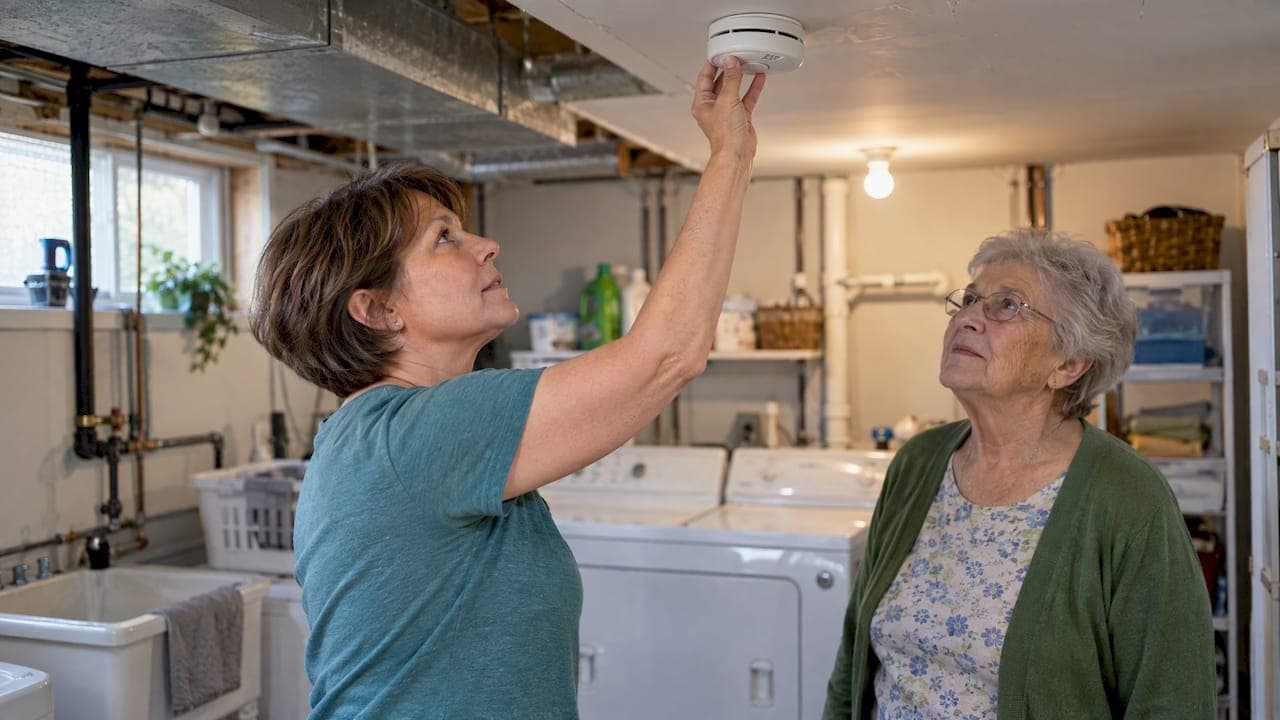
Put a smoke alarm on every level of the home, inside every bedroom, and in the hallway outside each sleeping area. Mount it on the ceiling when you can, keep it away from corners and the stove, and test it monthly. That is the core of it, and you can check most of it in a single quiet afternoon at your parent's house.
If you are the adult child doing the checking, there is a little more to think about. Your mom or dad may sleep with the door closed, hear differently than they used to, or have an alarm that was put up years ago by someone no one remembers. This guide walks through each room, gives the measurements in plain terms, and shows what to add when a parent is older.
TL;DR
- Alarms go on every level, including the basement, inside every bedroom, and outside each separate sleeping area.
- Keep them about 10 feet from the stove, away from corners, and mounted on the ceiling when possible.
- Replace the whole unit at least every 10 years and test monthly.
- If your parent has hearing loss, add a strobe light or bed shaker that goes off with the alarm.
- An alarm is half the plan. Walk through the exit route together.
Table of Contents
- Why placement matters more for an older parent
- The room-by-room map
- Where on the ceiling or wall
- Keeping alarms away from the kitchen and bathroom
- Interconnected alarms: why they help at night
- Extra steps when your parent has hearing loss
- Testing, batteries, and when to replace the whole unit
- An alarm is not an escape plan
- Our perspective: start small, and do it together
- Want a second set of eyes on the whole house?
- A simple walk-through checklist
- FAQ
- Sources
Why placement matters more for an older parent
The U.S. Fire Administration notes that older adults are about twice as likely to be killed or injured in a home fire as the general population. The reasons are ordinary ones: slower reactions, changes in vision or hearing, and mobility that makes getting out harder. None of that means your parent is fragile. It means a few extra minutes of warning count for more.
That is the real job of placement. An alarm in the wrong spot may sound late, or not be heard from the bedroom at night. An alarm in a bad spot near the stove may go off so often that someone takes the battery out. Both problems are fixable, and neither takes special skills.
We also know that this conversation can feel awkward. Walking into a parent's home and counting their alarms can feel like you are inspecting them. It helps to frame it the way you would a favor: "I did this at my own house last week, can I do yours?"

The room-by-room map
The national guidance is consistent across NFPA, the U.S. Consumer Product Safety Commission and the U.S. Fire Administration. Here is how it looks in a typical house.
| Area | What to do |
|---|---|
| Every bedroom | One alarm inside the room, on the ceiling if possible |
| Hallway outside bedrooms | One alarm outside each separate sleeping area |
| Each floor | At least one alarm on every level, including the basement |
| Top and bottom of stairs | Smoke moves up stairwells, so an alarm near the stairs is a sensible spot |
| Living room or den | One in the main living area |
| Kitchen | None directly over the stove; one nearby but at a distance |
| Garage, attic, bathroom | Generally not the place for a standard smoke alarm |
Bedrooms
This is the one people skip, especially in a one-story home where there is "already one in the hall." The guidance calls for an alarm inside each room where someone sleeps. If your parent sleeps with the door shut, which many people do, a hallway alarm may be slower to warn them.
The NFPA escape planning page also points out that a closed door can slow the spread of smoke, heat and fire. So a closed bedroom door is a good habit, as long as there is an alarm inside the room.
Hallways and the area outside sleeping rooms
Put an alarm in the hallway just outside the bedrooms. In a longer hall, local fire guidance often suggests one at each end, and one at the top of each stairwell. Check with your local fire department if you want specifics for your town, since local codes can differ.
Every level, including the basement
A parent who rarely goes downstairs can still have a fire start down there, in a laundry area, a furnace room or a storage space. NFPA says to install alarms on every level, the basement included. If the house has a finished bonus room or a converted garage apartment, treat that as its own level.
Living areas
A main living room or den gets an alarm too. In a ranch-style home, which is common in Central Florida, this is often the room where your parent spends most of the evening, so it is a good second line of notice.
Where on the ceiling or wall
Once you know which rooms, the next question is exact spot. Smoke rises and spreads across the ceiling, so the ceiling is usually the best place.
- Ceiling mount: keep the alarm at least 4 inches from any wall.
- Wall mount: put it 4 to 12 inches below the ceiling. The U.S. Fire Administration lays out both measurements.
- Avoid corners: the same source advises staying at least 2 feet from the corner of a room, because airflow is restricted there and smoke can take longer to reach the alarm.
- Avoid drafts: do not place alarms near windows, vents or other drafty spots, per the Texas Department of Insurance.
- Peaked or vaulted ceilings: read the manufacturer's instructions, as the best spot can differ. If the ceiling is very high and your parent cannot reach it safely, that is a good reason to call in a helper rather than stand on a chair.
Use screws, not tape
Double-sided tape often comes in the box, but it is not a good long-term choice because it can let go when heat or humidity changes. Screw the bracket into the ceiling or wall, then test the alarm before you finish. In Florida's humidity, this matters.
Keeping alarms away from the kitchen and bathroom
The most common reason an older person disables an alarm is nuisance beeping when they cook. The fix is distance, not a dead battery.
NFPA advises placing alarms at least 10 feet from cooking appliances to cut down on false alarms. Some sources give a shorter figure of 5 feet as a minimum, so aim for the longer distance when your floor plan allows it. In a small apartment where that is not possible, choose a model that is listed as resistant to cooking nuisance sources, and put it as far from the stove as the room allows.
Bathrooms are similar. Shower steam can set off some alarms, so keep them at a distance there as well.
A real-life example
Picture a parent whose alarm sits in the hallway six feet from the stove. Every time toast browns too much, it chirps and screeches. After a few weeks she takes the battery out "just for now." Months later no one remembers. Moving that alarm farther along the hall, or swapping it for a model made to resist cooking nuisances, solves the whole thing. This is a common pattern, and it is why your visit should include asking, gently, "Does any alarm ever go off when you cook?"
If kitchen safety is on your list as a whole, our kitchen safety guide for seniors covers the stove habits that cause those alarms in the first place.
Interconnected alarms: why they help at night
When one alarm sounds, interconnected alarms all sound. NFPA recommends them, whether hardwired or wireless. For a parent in a back bedroom, this means a fire in the kitchen or garage triggers the alarm right beside their bed, not just in the room where it started.
If your parent's home is older and not wired for this, wireless sets are available that link to each other by radio. You do not need to rewire anything. Follow the manufacturer's instructions for pairing them.
Extra steps when your parent has hearing loss
A standard alarm may not wake someone who has hearing loss, especially if they take out hearing aids at night. The U.S. Fire Administration checklist for caregivers suggests considering:
- Alarms with low-frequency audible signals
- Strobe or flashing lights that go off when the alarm does
- Bed or pillow shakers that connect to the alarm
The same guidance suggests keeping eyeglasses, hearing aids and a phone within easy reach of the bed. A small basket or tray on the nightstand works. It is the kind of detail that makes a calm exit possible.
If you are unsure which device fits your parent, an audiologist or their regular doctor can tell you what kind of signal they are most likely to notice. We do not give medical advice, but it is worth asking.
Testing, batteries, and when to replace the whole unit
Placement only helps if the alarm works.
- Test monthly. Press the test button on each one. A first-of-the-month reminder on your phone, or on your parent's calendar, keeps this easy.
- Treat chirping as a signal. A chirp means the battery or the unit needs attention right away.
- Check the date. The manufacture date is on the back. Replace the whole alarm at least every 10 years, and if there is no date visible, replace it.
- Keep a list. Write down where each alarm is and the date you installed it. Tape the list inside a kitchen cabinet or put it in your parent's care binder.
If your parent lives in Florida, it is useful to know that state law requires newly installed battery-powered alarms in one- and two-family homes to use a sealed battery that lasts at least 10 years when they are installed or replaced during certain repairs or alterations. Rules vary by state, so check yours.
An alarm is not an escape plan
Fire can spread quickly in modern homes. NFPA notes that residents may have as little as 2 minutes to get out once an alarm sounds. That is not a reason to panic. It is a reason to rehearse once, calmly, so the route is familiar.
Try this on your next visit:
- Stand in your parent's bedroom and ask, "If the alarm went off, how would you get out?"
- Find a second way out, such as a window, and make sure it opens.
- Pick an outside meeting spot, like the mailbox or a neighbor's driveway.
- Decide who helps your parent. If you live far away, that may be a neighbor, a sibling or a nearby friend.
- Walk the route together. A slow practice run tells you if a walker fits through the door or a rug is in the way.
Steady footing matters on that route at night. If your parent is shaky on their feet, our guide to preventing falls at home is a good next read, and this article on balance training for seniors is a helpful outside look at exercises that support steadier movement.
For a fuller plan beyond fire, see our step-by-step emergency plan for aging parents.
Our perspective: start small, and do it together
We have sat at kitchen tables with families doing this exact walk-through. What we see again and again is that the alarm is rarely the real obstacle. The harder part is the feeling that a parent is being managed. When the adult child arrives with a ladder and a plan, a parent can hear "you can't handle this anymore." When the same child says "let's do mine and yours this weekend," it lands differently.

So our advice is to keep it small. Count the alarms. Check the dates. Fix one thing that day, and leave the rest for next time. Parents keep their dignity, and you avoid the overwhelm that makes people put the whole thing off. Fire safety is also one of the two quick wins we suggest families start with, and we wrote about it in our piece on fire safety priorities for seniors.
This is not about taking control. It is about walking alongside your parents, and a smoke alarm check is one of the gentlest ways to begin.
— Mike C.
Want a second set of eyes on the whole house?
Smoke alarms are one item on a longer list. If you would like help seeing the rest, we offer in-home Age-Safe home safety assessments in Central Florida, and virtual home safety consultations for families anywhere else. If you just want to talk it through, the Caregiving Clarity Session is $97 for a one-on-one conversation. For a free starting point, use our elderly home safety checklist.
A simple walk-through checklist
Bring this to your next visit.
- An alarm inside every bedroom
- An alarm in the hallway outside the bedrooms
- An alarm on every level, including the basement
- Nothing within 10 feet of the stove if possible
- Nothing in corners or next to drafty windows or vents
- Manufacture date on each unit is under 10 years old
- Each alarm tested today, and a reminder set for next month
- Screws, not tape, holding each bracket
- Strobe or shaker added if hearing is a concern
- Escape route walked once, with a meeting spot chosen
For a broader view of what else to look at, see making home safer for an elderly parent and our guide on home safety devices for aging parents.
FAQ
How many smoke alarms does a house need?
There is no single number, because it depends on the layout. The rule is one inside every bedroom, one outside each sleeping area, and at least one on every level, including the basement. A two-story house with three bedrooms commonly ends up with six or more.
Should a smoke alarm go on the ceiling or the wall?
The ceiling is usually preferred because smoke rises. If you must use a wall, place the alarm 4 to 12 inches below the ceiling line. Either way, keep it away from corners and drafts.
Can I put a smoke alarm in the kitchen?
Not directly over or beside the stove. Stay about 10 feet from cooking appliances when you can. If space is tight, pick an alarm listed as resistant to cooking nuisance alarms and place it as far from the stove as possible.
What if my parent can't hear the alarm?
Look at alarms with low-frequency sound, flashing strobes or bed shakers that link to the alarm. Ask an audiologist or your parent's doctor what type of signal suits their hearing. Then test that device with your parent in the room so you both know what it feels like.
How often should smoke alarms be replaced?
Replace the entire unit at least every 10 years, and test each one monthly. If the date on the back is missing or unreadable, replace it. A chirping alarm needs attention right away.
Sources
- NFPA: Learn more about smoke alarms
- NFPA: Installing and maintaining smoke alarms
- NFPA: How to make a home fire escape plan
- U.S. Fire Administration: Fire Safety for Older Adults
- U.S. Fire Administration: Fire Safety Checklist for Caregivers of Older Adults
- U.S. Consumer Product Safety Commission: Smoke Alarms, Why, Where, and Which
- Texas Department of Insurance: Smoke alarms, where to put them
- Florida Statutes 553.883: Smoke alarms in one-family and two-family dwellings