
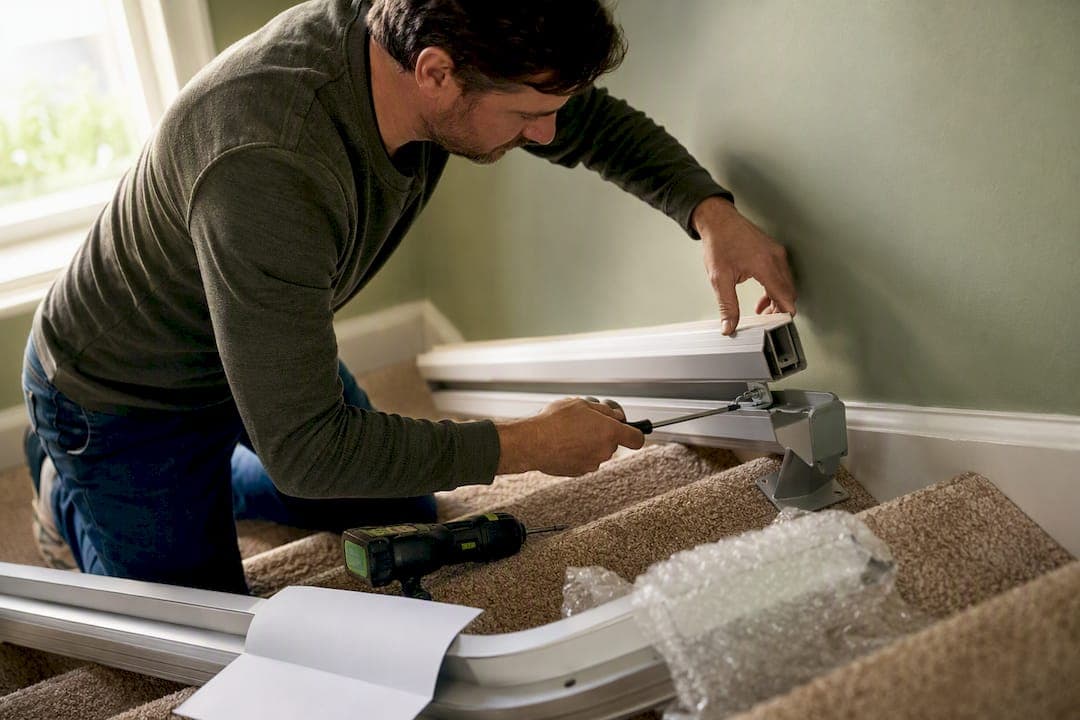
A straight stair lift typically costs $2,000 to $5,000 installed, while a curved stair lift runs $7,000 to $15,000 or more. HomeAdvisor reports a national average around $7,050, with a full range between $2,300 and $24,000 depending on your staircase.
Here's the one thing that determines where you land in that range: how many turns and landings your staircase has. A straight run of stairs is a simple, off-the-shelf job. A staircase that curves, splits, or has a landing partway up requires custom rail fabrication, and that's what pushes prices into five figures.
If you want quick mental anchors: outdoor lifts often add $1,500 to $3,000 over an indoor straight model for weatherproofing, platform (wheelchair) lifts can run $10,000 to $20,000, reconditioned straight units often save 30 to 50 percent off new, and rentals typically run $100 to $300 a month with a minimum term. The fastest way to get a real number for your parent's home is a free, on-site measurement rather than a phone quote.
Key Takeaways
Staircase configuration, not brand or features, is the single biggest factor separating a $2,500 stair lift quote from a $15,000 one.
| Point | Details |
|---|---|
| Straight vs. curved pricing | Straight lifts run $2,000 to $5,000 installed; curved lifts run $7,000 to $15,000 or more. |
| Biggest cost driver | Rail complexity from turns and landings matters more than brand or features. |
| Get it itemized | Ask dealers to separate hardware, rail fabrication, labor, permits, and electrical work. |
| Funding takes research | Medicare typically won't cover it; Medicaid waivers and VA HISA grants vary by state and eligibility. |
| Budget for upkeep | Annual service runs $100 to $300, with battery replacement every two to three years. |
Table of Contents
- How Much Does a Stair Lift Cost by Type?
- What Actually Drives the Price of a Stair Lift?
- What Does Stair Lift Installation Actually Involve?
- Are There Funding Programs to Help Pay for a Stair Lift?
- Should You Buy, Rent, or Go Reconditioned?
- What Does It Cost to Maintain a Stair Lift Over Time?
- How Do You Get an Accurate Stair Lift Quote?
- Is a Stair Lift Cheaper Than the Alternatives?
- What Helping-mom Recommends Before You Call a Dealer
- Ready to Plan Your Parent's Home Safety Budget?
- Why This Topic Deserves More Honesty Than It Gets
- Sources
- FAQ
How Much Does a Stair Lift Cost by Type?
Your staircase shape sets your budget before you even think about features. Here's how the installed price bands break down.
Straight stair lifts are the most affordable option, and installed prices typically fall between $2,000 and $5,000. At the low end, you're getting a basic seated model with manual folding footrest on a single, uninterrupted flight of stairs. At the higher end of that band, you'll often see powered folding rails, swivel seats for safer dismounts, and higher weight capacities.
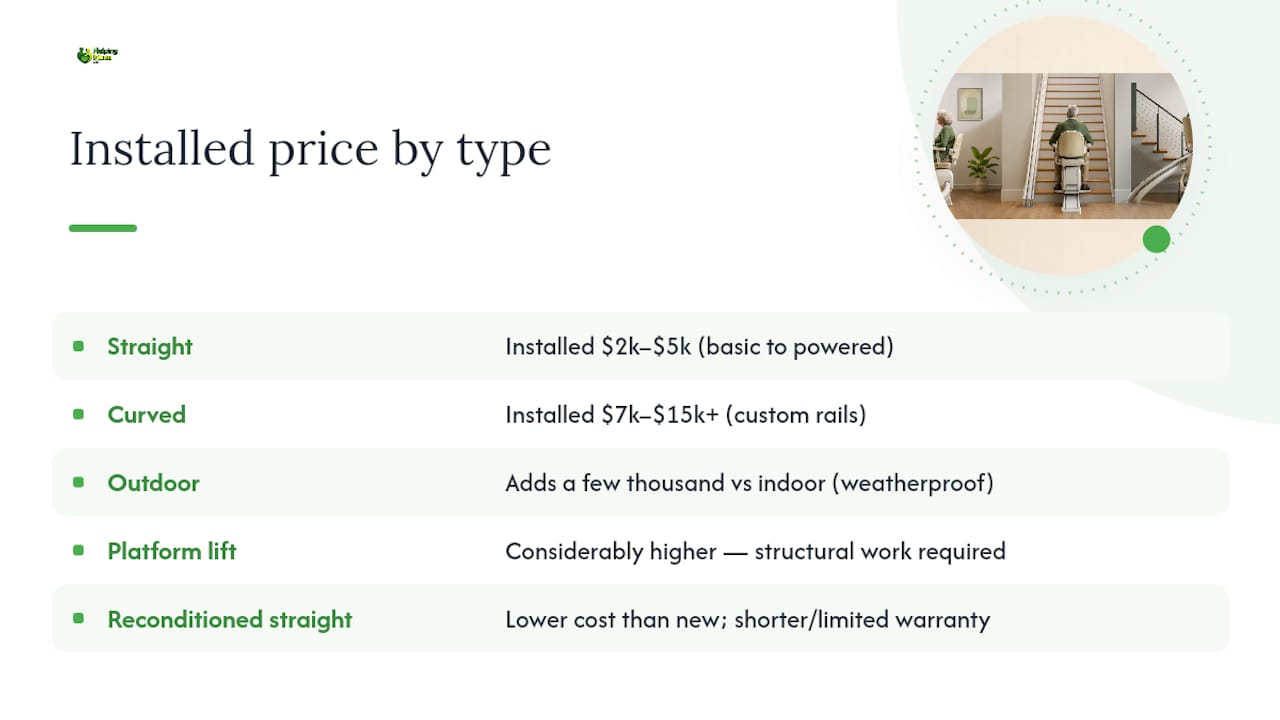
Curved stair lifts cost more because the rail has to be custom built to match your exact staircase, turn by turn. Expect $7,000 to $15,000 or higher for anything with a 90 degree turn, a spiral section, or multiple landings. A staircase with one gentle curve sits at the lower end; a staircase with two turns and a mid-flight landing pushes toward the top, sometimes past it.
Outdoor stair lifts need weather-resistant components, covers, and sometimes a locking mechanism, which typically adds a few thousand dollars over a comparable indoor unit.
Platform (wheelchair) lifts, used when a parent can no longer transfer to a seat safely, run considerably higher than seated stair lifts because of the structural work involved.
Reconditioned straight lifts are worth a look if budget is the main obstacle. They're commonly available for straight staircases at meaningfully lower prices than new, though warranty coverage is usually shorter and more limited than what you'd get buying new.
What Actually Drives the Price of a Stair Lift?
Two staircases that look similar can price out thousands of dollars apart. Here's what dealers are actually charging you for.
- Rail complexity: every turn, landing, or curve adds custom fabrication time and cost. This is the single biggest lever.
- Staircase length: longer rails mean more track, more mounting points, and more labor hours.
- Weight capacity: standard units handle around 300 pounds; heavy-duty models built for higher capacities cost more.
- Powered features: powered swivel seats and folding rails cost more than manual versions but add real safety value for someone with limited grip strength.
- Site prep: uneven stairs, narrow stairwells, or existing damage sometimes require carpentry work before the rail can even go in.
- Electrical work: most lifts run on standard household outlets, but if one needs to be added or moved, that's a separate line item.
- Regional labor rates: installation labor costs vary the same way any home service does, by local market.
Pro Tip: Ask the dealer to walk you through your quote line by line before they leave your parent's house. If they can't explain why a specific number is what it is, that's worth a second opinion.
What Does Stair Lift Installation Actually Involve?
Installation isn't just bolting a rail to the wall. Here's what a professional job typically covers, and how long it takes.
- On-site measurement and staircase assessment, usually done as a free consultation before you commit to anything.
- Rail mounting, which for a straight staircase usually takes a few hours, while curved installs can stretch to one or two full days because of custom-fit sections.
- Electrical connection, typically plugging into an existing outlet, though older homes sometimes need new wiring.
- Seat and carriage installation, followed by calibration to your parent's weight and the staircase angle.
- Safety testing, checking sensors, seatbelt, and emergency stop function.
- User training, showing your parent (and you) how to operate and charge the unit safely.
Labor is often bundled into the total price you're quoted, but not always broken out clearly. Permits, electrician visits, and removal of an old unit are the line items most likely to appear as separate charges, so ask about them upfront rather than after the invoice arrives.
Are There Funding Programs to Help Pay for a Stair Lift?
Money is usually the real obstacle here, not the decision itself. A few programs genuinely help, though none of them are guaranteed or fast.
- Original Medicare generally does not cover stair lifts. Medicare classifies them as a home modification rather than durable medical equipment, so this route is usually a dead end.
- Medicaid HCBS waivers can fund home modifications, including stair lifts, in many states, but rules and waiting lists vary widely by state, so check your parent's state program directly.
- VA HISA grants are one of the more reliable options for eligible veterans, with reimbursement caps around $6,800 for those with a service connection.
- USDA Section 504 and some state-level rural assistance programs offer additional help for qualifying households.
- HELOCs, personal loans, and dealer financing fill the gap for most families who don't qualify for the programs above, and NCOA's guide is a solid starting point for weighing these against grant options.
Should You Buy, Rent, or Go Reconditioned?
Not every situation calls for a brand-new stair lift, and that's worth saying plainly because most articles on this topic skip straight to "buy."
- Renting makes sense for short-term needs, like recovery after surgery or a temporary mobility setback. Monthly costs typically fall in the $100 to $300 range, usually with a minimum rental term attached.
- Reconditioned straight lifts work well when the need is longer-term but the budget is tight, and they're commonly available with real savings off new pricing.
- Curved rails almost never transfer between homes because they're custom-built to one specific staircase. If a dealer tells you a used curved unit will fit your parent's stairs without modification, treat that as a red flag rather than a bargain.
- As a rough rule of thumb, if your parent will need the lift for more than a year, buying (new or reconditioned) usually beats renting on total cost.
What Does It Cost to Maintain a Stair Lift Over Time?
Budget for ongoing costs, not just the installation. Annual servicing typically runs $100 to $300, and batteries usually need replacing every two to three years at $100 to $200 a pop. Extended service plans, often $200 to $400 a year, bundle these together and can be worth it if you'd rather not track appointments yourself. Removal, if you ever need it, is a smaller cost most families don't plan for until it comes up.
How Do You Get an Accurate Stair Lift Quote?
Getting a real number means asking the right questions before anyone shows up with a tape measure. Use this as your script when you call around.
- Ask for itemized pricing: hardware, rail fabrication, installation labor, permits, and electrical work listed separately, not bundled into one number.
- Confirm the quote includes testing and training, not just the physical install.
- Ask what the warranty covers, and specifically whether labor is included or just parts.
- Ask how they handle removal of your old unit, if applicable, and whether that's extra.
- Ask for the in-home measurement to happen before you sign anything. A quote given over the phone without seeing your parent's actual staircase isn't a real quote.
- Ask directly: "What would make this price go up once you're on-site?"
Pro Tip: A dealer who pressures you to sign before doing an on-site visit is optimizing for their close rate, not your parent's staircase. Walk away and call the next name on your list.
Watch for vague bundled pricing with no breakdown, quotes given without ever seeing the stairs, and any claim that a curved rail from another home will "just fit."
Is a Stair Lift Cheaper Than the Alternatives?
A stair lift is almost always the least disruptive and least expensive option compared to the alternatives families consider. A main-floor remodel to create a bedroom and bathroom downstairs often runs well into six figures. A residential elevator costs significantly more than even a complex curved stair lift, and moving your parent to a single-story home brings its own costs and, often, its own emotional toll.
Alternatives make more sense when a parent uses a wheelchair full-time or when the home has other accessibility issues beyond just the stairs. In those cases, a stair safety assessment can help you weigh whether a lift solves the real problem or just one piece of it.
What Helping-mom Recommends Before You Call a Dealer
You don't need to become an expert in stair lift mechanics to make a good decision here. You just need a clear picture of your parent's staircase and a few solid questions ready.
- Walk the staircase yourself and note turns, landings, and any narrow spots.
- Download the elderly home safety checklist before your first dealer call.
- Pair any stair lift decision with a broader look at senior-friendly home setup so you're not solving one hazard while missing others.
- If falls or balance are part of what's driving this decision, a partner resource on balance training for seniors is worth a look alongside the physical modification.
Ready to Plan Your Parent's Home Safety Budget?
Stair lift pricing is only one piece of a bigger home safety picture, and most families we talk to are juggling several decisions at once: grab bars, lighting, bathroom safety, and yes, stairs. If you'd rather not piece this together alone, our practical guide to making a home safer for seniors walks you through prioritizing these projects in the order that actually matters, so you spend money on what protects your parent first. It's the kind of roadmap we wish more families had before the first quote call, not after.
Why This Topic Deserves More Honesty Than It Gets
Most stair lift pricing content reads like it was written to move you toward the "call now for a free quote" button, and that's part of why families end up anxious before they've even measured their own staircase. The real story is simpler than the marketing makes it sound: your staircase shape sets the price range, and everything else is a smaller adjustment on top of that.
Where the conventional advice falls short is funding. Too many guides list Medicare, Medicaid, and VA grants in the same breath as if they're interchangeable options you can just apply for. They're not. Medicare is essentially off the table. Medicaid waivers depend entirely on your parent's state and often involve a wait. VA grants are real but only for veterans with service connection. Treating these as equally accessible sets families up for disappointment right when they can least afford it.
If you take one thing from this guide, make it this: measure the staircase honestly, get two itemized quotes before you get emotionally attached to either dealer, and check funding eligibility before you assume it's available. That order matters more than any single price number.
— Mike C.
This article is general information, not a substitute for advice from a qualified financial advisor. Consult a qualified financial professional about your own circumstances before acting on anything here.
Sources
- How Much Does It Cost to Install a Stair Lift? 2025 Data | HomeAdvisor
- Stair Lift Installation Cost 2026 | Porchlight at Home
- Stair lift costs: a complete guide | NCOA
- How Much Does a Stairlift Cost in 2026? | StairliftResource
FAQ
How much does Medicare pay for a stair lift?
Original Medicare generally does not cover stair lifts because it classifies them as a home modification rather than durable medical equipment. Some Medicare Advantage plans occasionally offer limited supplemental benefits, but this varies by plan and should be confirmed directly with the insurer.
What can seniors do instead of a stair lift?
Alternatives include a main-floor remodel to relocate a bedroom and bathroom downstairs, installing a residential elevator, or moving to a single-story home. Each option costs considerably more than a stair lift and makes sense mainly when a parent needs full wheelchair accessibility rather than just help with stairs.
What are the typical costs of stair lifts in the USA?
Straight stair lifts typically cost $2,000 to $5,000 installed, while curved models run $7,000 to $15,000 or more depending on turns and landings. The national average installed cost is around $7,050, with a full range spanning $2,300 to $24,000.
How much do stair lifts from major dealers cost on average?
Pricing from established dealers generally falls within the same national ranges: $2,000 to $5,000 for straight staircases and $7,000 to $15,000 or higher for curved ones. Getting an on-site, itemized quote is the only reliable way to know where your specific staircase will land.