
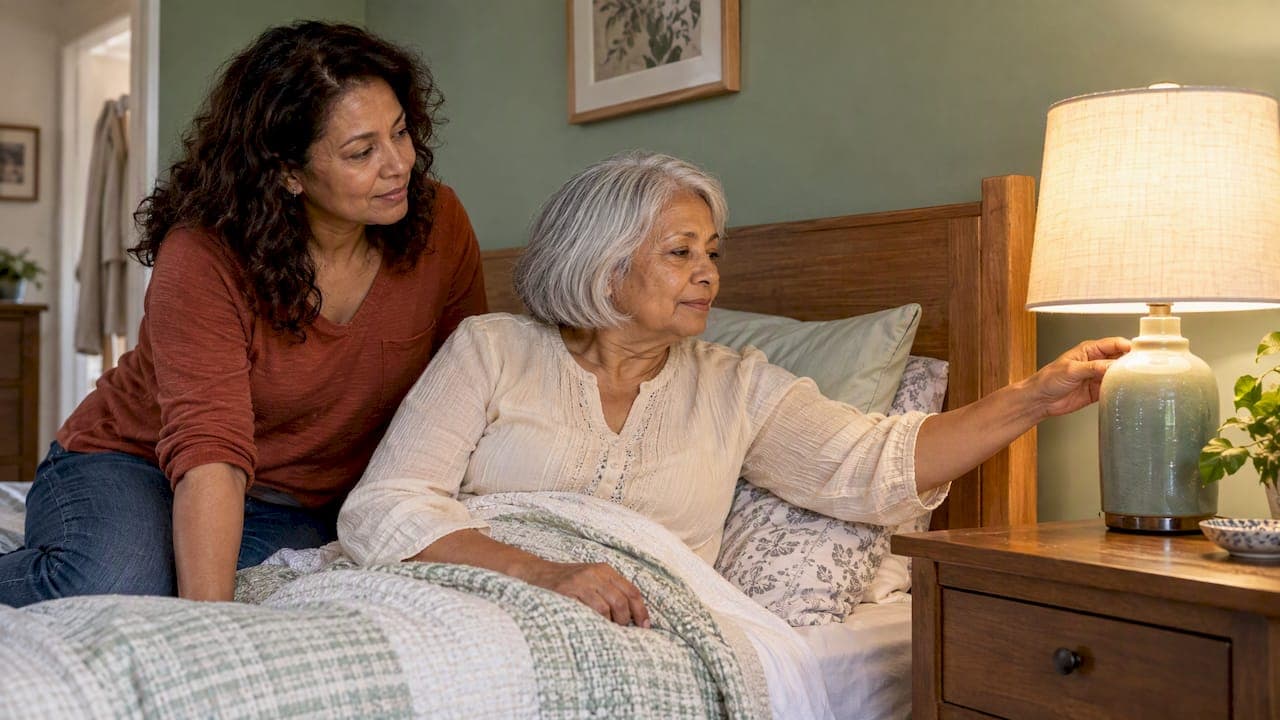
The best bedside lighting for an older adult is a lamp they can switch on without sitting up or reaching, plus a soft light that shows the way to the bathroom. That is the whole idea. The details are in how you choose, place and test those lights, and none of it needs a contractor or a big budget.
If you have ever called your mom at night and heard that she "just walked it in the dark, it was fine," you already know why this matters. The few steps between the bed and the bathroom are where a small change can make the biggest difference. This guide walks through it the way we would at your parent's bedroom door.
TL;DR
- Put a lamp within easy reach of the bed, so your parent never has to stretch, climb or stand up in the dark to get light.
- Add a night light along the route to the bathroom. Motion-activated or automatic models mean nobody has to remember a switch.
- Choose soft, diffuse, glare-free light. Avoid bright pools of light next to dark corners.
- Touch lamps and easy-grip switches help when hands are stiff, but test any lamp with your parent before you buy.
- Walk the path at night yourself, then adjust. A ten-minute test beats any product review.
Table of Contents
- Why the bedside is the place to start
- What aging eyes need from a lamp
- Choosing the right bedside lamp
- Warm or cool light: how we think about color
- The path to the bathroom: night lights that work
- A worked example: one weekend, one bedroom
- Lighting is one piece of the nighttime picture
- How to talk to your parent about it
- Our perspective: watch first, then buy
- Want a second pair of eyes on the bedroom?
- FAQ
- Sources
Why the bedside is the place to start
Most of us think about stairs and bathrooms first when we picture fall risks. The bedside is just as important, because it is where your parent begins every nighttime trip. If the first thing they have to do is fumble for a switch across the room, the rest of the route is already working against them.
Both the National Institute on Aging and the CDC's home fall prevention checklist point to the same two basics for bedrooms: a lamp close to the bed that is easy to reach, and a night light on the path to the bathroom. The CDC checklist adds that some night lights turn on by themselves, which is the kind we like best for a parent who would rather not fuss.
A research team studying a guiding night light between bed and bathroom also found something that matters beyond falls. In one study of older adults, fear-of-falling scores dropped from 5.5 to 3.8 on a 10-point scale after the lights were installed. For many parents, feeling steady at night is half the battle, and it can help them stay confident about living at home.

What aging eyes need from a lamp
You do not need a lighting degree, but a few plain facts explain most buying decisions. According to Oklahoma State University Extension, older adults usually need more light to see than younger people do, and what counts is the quantity, the quality and the location of that light.
In everyday terms, that means:
- Enough light where the eyes are working. A parent reading in bed needs more light than a parent glancing at the clock.
- Light that is gentle, not harsh. Diffuse, glare-free light is easier to live with than a bare bulb shining into the eyes.
- Even light across the room. The goal is uniformity. A bright lamp beside a dark corner can make it hard to judge where the floor is, and can hide the very things you want your parent to see, like a shoe or a cord.
That last point is why a single very bright bedside lamp is not the answer. You want a lamp that is comfortable up close, and a room that does not go suddenly black the moment it is off.
If you have noticed your parent squinting, missing steps or avoiding the dark, our guide to vision changes in older adults covers what to watch for from a safety point of view. Questions about their eyes themselves belong with their eye doctor.
Choosing the right bedside lamp
Here is how we look at a bedside lamp when we are helping a family.
Easy to turn on, in the dark, with one hand
The best lamp is the one your parent can switch on half asleep. Small twist switches on the socket, tiny pull chains and rocker switches hidden behind a shade can all be hard on stiff or arthritic fingers.
Touch lamps are popular for this reason. Tapping the base or body of the lamp replaces the fiddly switch, and many offer several brightness steps. They are also one of the most searched-for options when families look for lamps for elderly parents. A few things to check before you buy one:
- Does it respond reliably? Ask your parent to try it with a dry hand, a lightly moist hand, and a hand in a sleeve. A touch lamp that needs three taps is frustrating at 2 a.m.
- Does it remember its last setting? Some lamps start at the brightest level every time. That is harsh in the middle of the night.
- Is there a low setting? A very dim first step is ideal for the walk to the bathroom.
- Is it stable? A wide, heavy base is better than a tall, narrow one that can tip when someone steadies themselves on the nightstand.
Other good options include a lamp with a large, easy-grip switch, a plug-in smart plug and voice assistant for a parent who is comfortable with that, or a small battery-powered light on the nightstand as a backup. Keep it simple. The best technology is the technology your parent will actually use.
Placement matters as much as the lamp
Put the lamp on the side of the bed where your parent gets up, close enough to reach without leaning. Keep the cord tucked out of the walking path and away from the bed legs. Check that the nightstand is sturdy and has room for the lamp, a phone, glasses and a glass of water. The NCOA bedroom safety guide recommends keeping essentials like your phone and a lamp nearby, and suggests brighter non-glare bulbs, night lights or motion-activated lights.
Shade and bulb
A fabric or frosted shade spreads the light and keeps the bulb itself out of your parent's line of sight. A bare bulb on a gooseneck lamp can be great for reading but is often too sharp for the middle of the night. If your parent likes to read in bed, consider two light levels: a reading lamp for the evening and a very low light for nighttime trips.
Warm or cool light: how we think about color
Light bulbs are labeled with a color temperature in kelvins. Lower numbers look warm and yellow, higher numbers look cool and bluish.
Our practical rule for bedrooms is simple: choose warm-looking light for the bedside and for anything that stays on at night. It feels calmer, it is easy on the eyes, and it is less jarring if your parent wakes up. Cooler, brighter light has its place in a kitchen or at a craft table, where your parent needs to see detail clearly during the day.
This is a comfort guideline from our experience, not medical advice. If your parent has trouble sleeping or has specific eye conditions, their doctor is the right person to ask about lighting and sleep. What we can say is that a light your parent finds soothing is a light they will leave on.
The path to the bathroom: night lights that work
Once the bedside is sorted, look at the route. Think of it as a chain of light, with each link visible from the one before.
Motion sensor or always on?
| Type | Good for | Watch out for |
|---|---|---|
| Motion-activated | Hallways, bathrooms, kitchens: places where you want light only when someone is walking through | Sensors can miss a slow walker if placed poorly; check the angle |
| Dusk-to-dawn (automatic) | Bedroom corners, the bathroom entrance, spots where a soft glow should be constant | Can feel too bright if the light faces the bed |
| Plug-in with adjustable brightness | Any outlet near the floor; lets you dial down the glow | Needs an open outlet near the route |
| Battery-powered, stick-on | Rentals, rooms with few outlets, under a bed frame or along a wall | Batteries need to be checked on a regular schedule |
Consumer Reports notes in its review of indoor motion-sensing lights that adding more lighting is one of the easiest ways to help improve stability at home. Product testers at Yahoo Shopping point out that motion-sensing night lights suit hallways, kitchens and bathrooms, while some models let you adjust color temperature and brightness, which is handy for a bedroom.
Where to put motion sensors
Sensor placement is where most families trip up. Based on the research summarized for us, motion sensors work best when a person walks across the sensor's field of view rather than directly toward it. So in a hallway, mount the light on the side wall instead of at the far end pointing back at your parent. Then walk the route yourself, slowly, and see whether the light comes on before you need it.
A simple placement map
- At the bed: a lamp within easy reach, plus a low night light near the floor on the getting-up side.
- At the bedroom door: a light so your parent can see the threshold and any change in flooring.
- In the hallway: one or two motion-activated lights, placed along the wall.
- At the bathroom door and inside: a light that comes on automatically, so your parent never has to find a switch with a hand on the wall.
If you want to think about the whole hallway, our 3 hallway fixes are all doable without a contractor. For a broader plan that includes every room, our 30-day home lighting plan breaks the work into small weekly steps.
A worked example: one weekend, one bedroom
Here is how this might look for a family we will call the Reyes family (an illustration, not a real client). Their mother lives alone, has a bedside lamp with a tiny twist switch, and uses a wall switch at the door for the hall light.
Saturday morning. Her daughter sits on the bed and asks her mother to show her what she does when she wakes up at night. Mom reaches across to the lamp, fumbles for the switch, gives up, and walks toward the doorway with one hand on the wall. Nothing dramatic, just a quiet sign that the setup is not helping her.
Saturday afternoon. They swap the lamp for a touch lamp with three brightness steps and a sturdy base. They choose a warm bulb. They plug in a night light at floor level on the side of the bed where she gets up, and they move the phone and glasses to the nightstand.
Sunday. They add a motion-sensor light in the hallway, mounted on the side wall, and an automatic light at the bathroom door. The daughter walks the route in the dark. The first light is too bright facing the bed, so they turn it toward the wall.
The next week. A phone call to check in: does it feel right? Is anything glaring? Adjust and repeat.
Total time: a weekend. The point is not the products. It is that the daughter watched the routine before changing it.

Lighting is one piece of the nighttime picture
Good lighting supports your parent's safety, but it works best alongside other small changes. Clear the path, secure loose rugs and keep clutter off the floor. The NCOA bedroom guide puts these together in one short list: clear the way, improve lighting and keep essentials nearby.
Strength and steadiness count too. If you are exploring ways your parent can feel steadier on their feet, this overview of balance training for seniors is a gentle place to begin, and their own doctor or physical therapist can advise on what is right for them.
For a bigger picture, our elderly home safety checklist covers every room, and how to prevent falls at home goes deeper on the practical steps.
If your parent is living with memory loss, lighting can be a more delicate topic. The National Institute on Aging suggests going through the home room by room, first correcting immediate dangers such as poor lighting, in its home safety tips for Alzheimer's caregiving. Keep the changes consistent and avoid rearranging more than you need to.
How to talk to your parent about it
Many parents hear "night light" and think "you think I can't manage." A few ways to ease that:
- Start with your own experience. "I tripped over the cat in the dark at my place, so I put lights everywhere. Can I try some here?"
- Make it about comfort. A soft light at night is a nice thing to have, at any age.
- Let them choose. Show two lamps and ask which looks better in their room.
- Ask what they notice. "Where does it feel darkest when you get up?" gives them the lead.
If conversations like this are hard in your family, we have a guide on talking with aging parents about care.
Our perspective: watch first, then buy
We have walked through many bedrooms, and the same pattern shows up again and again. Families go straight to buying: a fancy lamp, a pack of night lights, a smart system. Then it ends up unused because it did not fit how the parent actually moves at night.
Our approach is the opposite. Observe first. Ask your parent to show you their routine, without correcting it. Notice where they reach, where they pause, what they touch for balance. Then choose the smallest change that solves what you saw.
Helping Mom is built on real caregiving experience and on professional crisis management, and our work is Age Safe® America certified. What that has taught us is that dignity and simplicity beat gadgets nearly every time. A lamp your mom can turn on herself, and a soft glow that shows her the way, are quiet ways of walking alongside her, not taking over.
— Mike C.
Want a second pair of eyes on the bedroom?
Sometimes it helps to have someone look at the whole home with you. If you live far away or just want a calm, practical walkthrough, our virtual home safety consultations let us look at your parent's rooms with you over Zoom. If you are in Central Florida, we also offer in-home Age-Safe assessments. For a broader conversation about what to do first, there is the Caregiving Clarity Session, $97 one time.
FAQ
What is the best night light for an elderly person?
The best one is the one that comes on without anyone doing anything: a motion-activated or automatic night light placed along the route from bed to bathroom. Choose soft, warm, glare-free light, and avoid aiming it at the bed. Test it by walking the route yourself in the dark.
Are touch lamps a good choice for older adults?
Often, yes, because they remove the small switch that is hard on stiff fingers. Look for a stable base, a low first brightness step and reliable response. Have your parent try it before you commit, ideally at night.
How bright should a bedside lamp be?
Bright enough to see comfortably, but not harsh. Older adults usually need more light to see than younger people, so a reading lamp may need to be brighter than you expect. For nighttime trips, a dimmer setting is often better. Dimmable or multi-level lamps give you both.
Where should I put night lights for a parent?
Place one near the floor on the side of the bed where they get up, then one or two along the hallway and one at the bathroom entrance. Aim for a continuous chain of light without dark gaps. Mount motion sensors on the side of the path, not at the end pointing toward your parent.
Should bedside lighting be warm or cool?
We suggest warm light for the bedside and any light that stays on at night, because it feels softer and calmer. Cooler light is more useful for daytime tasks. If sleep or eye comfort is a concern, check with your parent's doctor.
Sources
- Preventing Falls at Home: Room by Room, National Institute on Aging
- Check for Safety: A Home Fall Prevention Checklist for Older Adults, CDC
- A Guiding Nightlight Decreases Fear of Falling, PMC
- Electric Lighting, Vision, and Aging Eyes, Oklahoma State University Extension
- Bedroom Safety for Older Adults, NCOA
- Best Indoor Motion-Sensing Lights, Consumer Reports
- The best night lights of 2026, Yahoo Shopping
- Alzheimer's Caregiving: Home Safety Tips, National Institute on Aging
- Balance Training for Seniors: Safe Exercises to Prevent Falls