
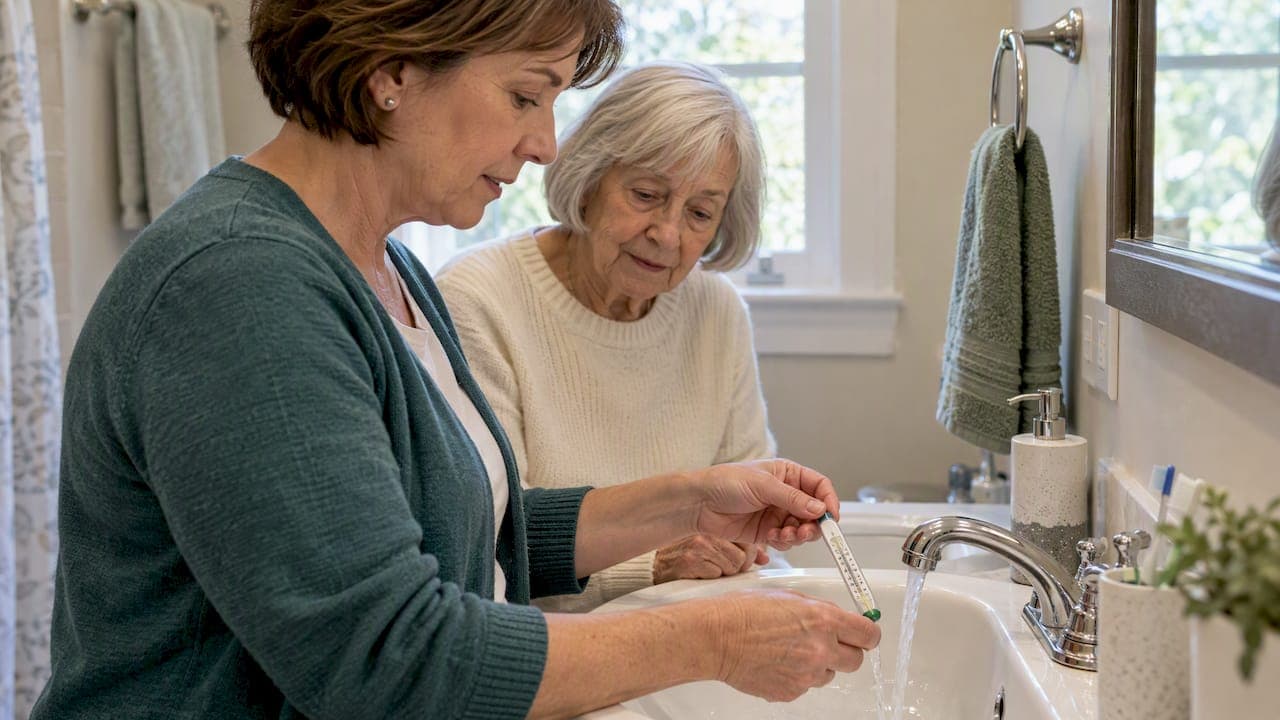
For most homes, and especially a home where an older parent lives, the safest water heater setting is 120°F (49°C). The U.S. Consumer Product Safety Commission urges all users to lower their water heaters to 120 degrees, because most tap water scald injuries and deaths happen to older adults and young children. This guide shows you how to check what your parent's water actually runs at, how to change it, and the one situation where a higher setting makes sense.
If you have never looked at the dial on your mom's or dad's water heater, you are in good company. It is one of the quietest safety items in a home, and one of the easiest to fix in an afternoon.
TL;DR
- Set the water heater to 120°F. At that temperature, it takes about five minutes of contact to cause a serious burn, compared with about 30 seconds at 130°F.
- Do not trust the dial. Measure the water at the tap with a thermometer, because the number on the heater is often not the number at the faucet.
- If a doctor or a plumber recommends a hotter tank (140°F) for health reasons, pair it with anti-scald mixing valves so the water at the tap stays near 120°F.
- Temperature is one layer. Test bath water by hand, add grab bars and a thermostatic shower valve, and make the check a yearly habit.
Table of Contents
- Why 120°F is the number to aim for
- How to find out what temperature the water really is
- How to adjust the setting safely
- The one exception: when a hotter tank can be right
- Why the dial is only the first layer
- If your parent has memory loss
- A real-life way to do this without a fight
- Our perspective: calm, small steps beat big projects
- Where we can help
- A yearly check you can set and forget
- FAQ
- Sources
Why 120°F is the number to aim for
Hot water feels like a comfort until the moment it is not. Skin burns faster than most people expect, and the time it takes drops quickly as the temperature climbs. According to the CPSC's tap water scald publication, water at 120°F takes about five minutes to cause a third-degree burn, while at 130°F it takes about 30 seconds. At higher settings, the time shrinks to a matter of seconds.

Older adults are the people most affected. The Washington State Department of Social and Health Services explains that older adults may have slower reaction times or reduced sensitivity to heat, which means your parent may not pull away from hot water as quickly as you would. Thinner skin, medications, neuropathy and slower movement all play a part, and none of them needs to be dramatic to matter in a bathroom.
There is a practical bonus too. The Department of Energy's home checklist suggests turning the heater down to the warm setting of 120°F to save energy and avoid scalding. Your parent's utility bill may go down a little while the home gets safer.
What 120°F feels like in daily life
Many people worry that 120°F will not be hot enough for showers, dishes or laundry. For nearly all daily use it is. A comfortable shower is usually well below 110°F, and the hot tap simply mixes with cold. If your parent complains that the water now runs out sooner or does not feel hot, check the thermometer reading first. The problem is often a different one, such as an aging heater or a mixing valve that needs attention.
How to find out what temperature the water really is
This is the step most families skip. A heater dial can read "warm" or "B" or show a number, but researchers who checked real homes found that dials are not reliable. In a study of water temperature in homes published through the National Library of Medicine, hot water was unsafe in 41% of homes, and for some gas water heaters the water reached 130°F or more even though the gauge was set well below its maximum.
So measure it. Here is a simple way to do it in about ten minutes.
- Pick the right time. Test first thing in the morning, or at least two hours after anyone has used hot water. The Washington DSHS bulletin recommends this so the tank has reheated to its normal setting.
- Use a real thermometer. A candy or meat thermometer works. Do not guess by feel.
- Run the water, then hold the thermometer under it. Let the hot tap run for two to three minutes, then keep the thermometer in the stream until the reading stops rising.
- Test more than one tap. Check the bathroom sink and the tub or shower, the places your parent is most exposed. A long pipe run or an old valve can change the number.
- Write it down. Put the date and reading on a sticky note inside a cabinet or in your phone. Next year you will know whether anything has drifted.
If the reading is above 120°F, adjust the heater and test again the next day. Give the tank time to settle before you decide the job is done.
How to adjust the setting safely
The details depend on the type of heater.
- Electric water heaters usually have one or two thermostats behind small metal panels on the side of the tank. Turning them off at the breaker before you open the panel is essential, because the wiring inside is live. If that feels like more than you want to take on, this is a good moment to call a licensed plumber or electrician.
- Gas water heaters typically have a dial near the bottom of the tank, often marked with words or letters rather than degrees. Make small changes and retest with your thermometer, since those marks vary from one model to another.
- Newer tank and tankless models may have a digital display. Check the manual for your parent's model, or look up the model number printed on the label.
For any heater, change a little at a time, wait a day, and measure at the tap. If your parent has a rental, ask the landlord or property manager to make the change.
One gentle tip: do the adjusting when your parent is not in the middle of a shower. Tell them what you did and why. People hold on to independence tightly, and "I read that most heaters should be set a bit lower for safety, and it will save you a little on the bill" lands better than a lecture.
The one exception: when a hotter tank can be right
It would be too simple to say 120°F is always the answer. Lower temperatures leave room for Legionella, a bacterium that can grow in water systems and cause a serious lung infection. The CDC explains that keeping a home water heater between 130°F and 140°F can kill germs like Legionella, but also raises the risk of burns. Its guidance for households that go above 120°F is to use valves that mix cold and hot water so the temperature at the tap stays safe.
This matters most if your parent has a weakened immune system or a chronic lung condition. That is a question for their doctor, not for you or for us. Ask the doctor whether a higher tank temperature is advised, and if it is, ask a licensed plumber to install thermostatic mixing valves. The CDC's water system guidance for professionals says to install thermostatic mixing valves as close as possible to the point of use, and to avoid dead legs, which are pipe sections where water sits without flowing.
So the rule of thumb looks like this:
| Situation | Tank setting | What else is needed |
|---|---|---|
| Most homes, no special health concern | 120°F | Test at the tap once a year |
| Doctor advises a hotter tank | Up to 140°F, per the doctor and plumber | Thermostatic mixing valves at the taps, professionally installed |
| Parent has memory loss | 120°F | Anti-scald valves and a bath-water check every time |
| Rental or older home with unknown plumbing | Measure first, then adjust | Ask the landlord or a plumber about the valves |
Why the dial is only the first layer
Turning the heater down is a good first move, but it is not the whole job. Pipes can hold hot water, old mixing valves can fail, and a shower valve can be set incorrectly. The CDC's research on water temperature in homes long after manufacturers adopted a voluntary 120°F pre-setting estimated that tap water scalds cause around 1,500 hospital admissions and 100 deaths per year in the United States. Most of them are preventable with simple steps.
Think of it as a few small layers, each one modest:
- Heater setting at 120°F, confirmed with a thermometer.
- An anti-scald device at the shower or tub, such as a thermostatic or pressure-balancing valve, or a small scald-guard fitting on the faucet. Our guide to home safety devices for aging parents walks through what is available and what is worth buying first.
- A hand or elbow test before every bath or shower, as part of the routine. The Washington DSHS bulletin notes that bathing is one of the most common times scalds happen, and suggests teaching the person you care for to test the water before getting in. If you are helping with bathing, test it before they step in.
- A fixed shower seat, grab bars and a handheld shower head, which make it easier to move away from water that is too hot. Our post on aging in place bathroom upgrades you can phase in shows how to spread those costs over time.
A note on slips and balance
Scalding and falling often happen in the same moment. A person who gets surprised by hot water may jerk away and lose their footing on a wet floor. That is why it helps to look at both risks together. If you are also thinking about steadiness, this article on balance training for seniors and safe exercises to prevent falls is a helpful read, and our own fall risk tests you can do at home are a gentle way to start the conversation.
If your parent has memory loss
When a parent is living with dementia or memory changes, they may not recognize that water is too hot, or may forget that they turned the tap. This is not a medical judgment, just a practical observation many families make: the habits that used to keep them safe may not hold on their own anymore.
In that case, do not rely on reminders. Set the heater to 120°F, install anti-scald valves, and make the water check yours. If a parent bathes alone, consider having the hot-water handle limited by a plumber or a valve with a built-in stop. For conversations about help with bathing, which can be sensitive, our piece on keeping dignity when an elderly parent refuses to bathe offers wording that tends to go over well.
Questions about what is happening with your parent's memory belong with their doctor. What we can do here is make the house quieter and safer while you sort that out.
A real-life way to do this without a fight
The water heater is rarely the thing a parent wants to talk about. Here is an approach that tends to work.
Pick a calm day, not the day after a scare. Say you are doing a quick safety check of your own home and your parent's, because you read that tap water scalds are a common household injury. Then do it together: you hold the thermometer, they run the tap. Seeing the number on the thermometer makes the problem concrete and removes the sense that you are judging how they live.
If the reading is high, you can say, "Let's turn it down a notch and save you a few dollars." If the reading is fine, you have a small win to share, and you have started a habit of checking things together. That habit is worth more than any single fix.
Our perspective: calm, small steps beat big projects
We talk with families who feel they have to fix everything at once. In our experience, the families who feel steadiest are the ones who pick one small, visible thing, do it, and move on to the next. The water heater is a perfect first one. It takes one thermometer, one afternoon and a short conversation, and it removes a risk that is easy to overlook and hard to undo.
We also want to be clear about the limits. We are not plumbers or medical professionals, and we do not give medical advice. If your parent has a health condition that affects what water temperature is wise, that is a conversation for their doctor. If the work involves wiring, gas or valves inside walls, a licensed plumber is the right person. What we can offer is a way to look at the whole home with calm, practical eyes, so you know what to ask and who to ask.
This is not about taking control. It is about walking alongside your parent while the house quietly gets safer.
— Mike C.
Where we can help
If you would like a second set of eyes on the whole house and not only the water heater, we offer a few ways to do that. The Caregiving Clarity Session is a one-time $97 conversation to sort out your next steps. If you would rather have someone look at your parent's home with you, our virtual home safety consultations work over video, and for families in Central Florida we offer in-home Age-Safe safety assessments. An assessment looks at things like water temperature, bathroom setup and trip hazards together, so you are not guessing. You can also start free with our elderly home safety checklist.
A yearly check you can set and forget
Once the heater is at 120°F, keep it simple:
- Pick a date you will remember, like the start of daylight saving time, and test the tap water again.
- Test after any plumbing work, heater replacement or move, since new heaters can arrive with different settings.
- Look at the tank for leaks or rust, and flush it if the manual says to.
- Re-check anything you have changed if your parent's health or mobility changes.
For the rest of the home, our aging in place checklist and senior-friendly home setup guide give you a next step for each room, so you can keep going at a pace that feels manageable.
FAQ
Is 120 too hot for a water heater?
No. 120°F is the setting the CPSC recommends for households, and it is hot enough for normal showers, dishes and laundry. It is also the temperature at which a serious burn takes about five minutes instead of seconds. If it feels too cool, check with a thermometer at the tap before turning it up.
Is 140°F too hot for a water heater?
For a household with an older adult, usually yes, unless there is a specific reason for it. The CDC notes that 130°F to 140°F can kill Legionella but raises burn risk, so it recommends mixing valves if you go above 120°F. Only choose this route after talking with your parent's doctor and a licensed plumber.
What temperature should I set a 40-gallon water heater to?
The same as any other size: 120°F. Tank size changes how much hot water you have, not what temperature is safe. If a 40-gallon tank runs out too quickly, a plumber can look at the heater itself, or you can spread out hot water use during the day.
How do I know my parent's water temperature is safe?
Measure it. Run the hot tap for two to three minutes and hold a candy or meat thermometer in the stream, ideally first thing in the morning. Test the bathroom taps as well as the kitchen, and repeat the check once a year.
Sources
- Tap Water Scalds, CPSC Publication 5098
- Avoiding Tap Water Scalds, CPSC
- How hot is the hot water in your home?, Washington DSHS
- Home Energy Checklist, U.S. Department of Energy
- Still too hot: water temperature and water heater characteristics, PMC
- Preventing Waterborne Germs at Home, CDC
- Controlling Legionella in Potable Water Systems, CDC
- Still too hot: examination of water temperature, CDC Stacks