
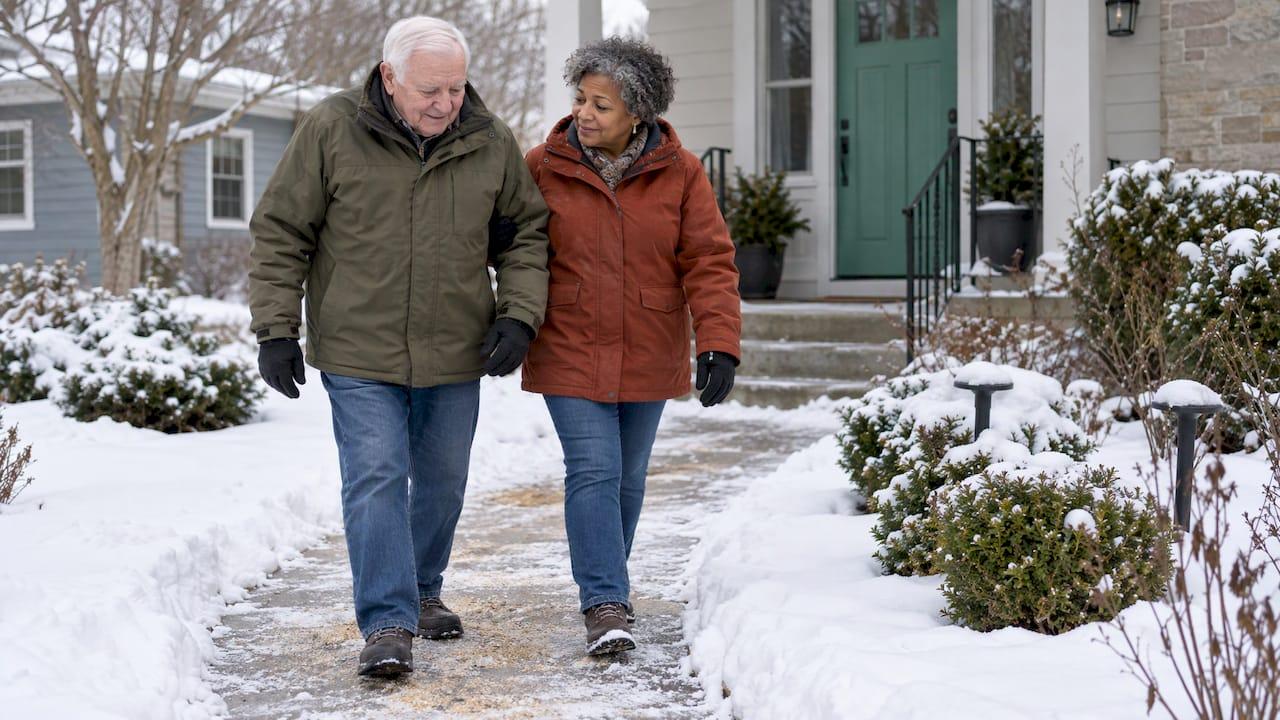
Winter fall prevention comes down to four things: better footwear, safer entrances and walkways, brighter and drier floors indoors, and steady daily movement. None of it needs special equipment or a big project. Most of it can be done in a weekend, before the first real freeze, and in a way that lets your parent stay in charge of their own home.
If you have noticed a subtle sense that your mom or dad moves a little more carefully when the weather turns, you are not imagining it. This guide walks through what to check, what to change, and how to bring it up without making it feel like a takeover.
TL;DR
- Start at the door: clear and treat walkways, add a mat inside, and make sure there is light and something solid to hold.
- Choose nonskid, rubber-soled, low-heeled shoes for every outing, and keep a dry pair by the door for indoors.
- Slow down on ice: short steps, feet slightly out, knees gently bent, hands free.
- Keep moving all winter. Strength and balance fade quickly when people stay in.
- Offer help that protects independence: deliveries, a shoveling plan, and a call to the local Area Agency on Aging at 800-677-1116.
Table of Contents
- Why winter changes the picture
- Start with the shoes
- Walking on snow and ice
- Make the entrance the safest spot in the house
- Inside the house: floors, lighting and warmth
- Keep strength and balance going all winter
- Helping without taking over
- A 30-minute walk-through before the first snow
- When to bring in a health professional
- Our perspective
- Want a second pair of eyes on the house?
- FAQ
- Sources
Why winter changes the picture
Falls happen all year, but winter adds hazards on top of the usual ones. The National Institute on Aging explains that cold-weather risks for older adults include falls on wintry surfaces, along with frostbite and hypothermia. It also notes that aging can make it harder to tell when the body is getting too cold, so a parent may not realize they are chilled and stiff until they are already out in it.
One orthopedic surgeon writing about winter falls describes three recurring causes in older patients: physical factors such as weak muscles or poor balance, hazards inside the home such as loose rugs, clutter and slick bathroom floors, and weather itself. Winter touches all three at once. Days are darker, people move less, and wet boots bring the outdoors inside.

That is useful news. Two of those three categories, the home and the weather, are things you can do something about this weekend.
Start with the shoes
Footwear is the cheapest fix and often the most overlooked. The NIA recommends nonskid, rubber-soled, low-heeled footwear in cold weather. That is a short list, so here is how to use it in real life:
- Check the sole. If it is smooth, worn flat, or hard plastic, it is not a winter sole.
- Look at the heel. Low and wide is steadier than high or narrow.
- Try them on with the thicker socks your parent actually wears in winter. A shoe that fit in July can feel tight or loose in January.
- Keep a pair of dry, supportive indoor shoes or nonskid slippers near the door, so wet boots come off at the entrance instead of walking across the kitchen.
If your parent is attached to a favorite pair of boots, ask to look at the bottoms together. It is easier to say "these look worn, want to find a new pair?" than "these are dangerous." For more on what to look for, our guide on safe footwear features that reduce falls goes through it step by step.
Walking on snow and ice
Even with good shoes, technique matters. The Ohio Department of Aging suggests that on possibly icy surfaces you shorten your stride, point your feet slightly outward, and keep your knees gently bent. The same page advises avoiding walking in more than an inch of snow, since it can hide things you might trip on.
The American Trauma Society's Pennsylvania division calls a similar approach the "penguin walk": arms out a little for balance, small slow steps, toes slightly out, knees slightly bent, and your weight over the front leg. It looks a bit silly, and it works best when nobody feels watched. Try it together in the driveway on a dry day and laugh about it first.
A few other habits are worth passing along:
- Keep hands free. Gloves on, hands out of pockets, and no carrying bags that block the view of the ground. A backpack or a delivery is better than an armful.
- Never rush. Leave ten extra minutes for appointments so there is no pressure to hurry across a parking lot.
- Watch shaded spots and black ice. The ATSPA notes that black ice can be nearly invisible, and that shaded areas melt more slowly.
- Carry traction. The Ohio Department of Aging suggests keeping a small shaker of rock salt, sand or kitty litter in a pocket or purse to sprinkle in front of you on an icy path.
For a quick routine your parent can run before leaving the house, see our three simple checks before every walk.
Make the entrance the safest spot in the house
Most winter slips happen within a few steps of the door, so that is where a small effort goes furthest. Walk the route from the car or the curb to the inside of the house and look at it the way your parent does, carrying groceries in the dark.
Outside
The NIA advises treating outdoor walkways with ice melt or sand, adding non-slip material to outdoor stairs, and keeping porch and deck areas clear of debris. It also suggests considering a grab bar near the front door, which gives your parent something to hold while locking or unlocking. Railings should be solid, because the NIA also recommends using railings on icy stairs and walkways.
Timing counts too. The ATSPA recommends shoveling and applying ice melt or sand as soon as possible after a snowfall, with extra attention to shaded areas.
Good lighting is part of the entrance. The Ohio Department of Aging recommends extra lamps, nightlights and exterior lights, especially around doorways and stairs, plus a flashlight kept near doors and staircases in case the power goes out. Winter outages are common enough that this small step is worth doing.
Just inside
This is where snow melts into puddles. Practical fixes:
- Put a mat that absorbs water just inside the door. The ATSPA suggests floor mats to catch water and snow and wiping up puddles right away.
- Make sure the mat does not slide or curl at the edges.
- Set a bench or sturdy chair by the door so your parent can sit to take off boots rather than balancing on one foot.
- Place a boot tray so melting slush stays in one spot.
We have a short guide to four weekend fixes for home entry safety if you want a simple order of operations.
Inside the house: floors, lighting and warmth
Winter keeps people indoors longer, so the home itself matters more. The Ohio Department of Aging advises clearing any ice and snow tracked indoors, removing wet footwear on entering, and keeping space heaters and their cords out of walkways. If throw rugs are staying, it suggests securing them with tape.
The NIA goes a step further and recommends avoiding throw rugs and small area rugs altogether, fixing carpets firmly in place, and using no-slip strips on tile and wooden floors. For stairs, it recommends secure handrails on both sides, light switches at the top and bottom, and tidy walking areas. Our stair safety guide for caregivers covers the details.
Dark winter evenings are easy to overlook. The Ohio Department of Aging suggests using the highest-wattage bulbs recommended for each fixture and adding nightlights on the path from bedroom to bathroom.
And keep the house warm enough. The NIA suggests setting the heat to at least 68°F. A parent who is cold tends to move stiffly and hurry, neither of which helps balance.
If you want a broader pass through the whole house, our elderly home safety checklist and guide to preventing falls at home work well alongside this winter list.
Keep strength and balance going all winter
The quiet risk of winter is that people stop moving. The Bone Health & Osteoporosis Foundation points out that lack of exercise can cause muscle weakness that raises fall risk, and that tai chi can strengthen the legs and challenge balance.
The Ohio Department of Aging recommends regular physical activity through the winter, asking a doctor or physical therapist about easy indoor exercises, and doing light stretching before going out in the cold. MedlinePlus lists muscle-strengthening moves such as toe stands, knee curls and leg extensions, with strengthening on two or more days a week alongside aerobic activity.
A gentle place to start is the one-leg stand. Kaiser Permanente describes it as a progression that begins holding a sink, counter or chair with both hands and builds at your own pace. Every version of this comes with the same advice: ask a doctor which exercises are safe for you or your parent before starting. If you would like to read more about balance training for seniors, that page covers safe exercise options and the role of an individualized plan.
A good habit is to attach movement to something already in the day: a few counter-supported leg lifts while the kettle heats, or a short indoor walk after lunch.
Helping without taking over
The hardest part is rarely the checklist. It is the conversation. Our approach is to walk alongside your parent, not to take control. A few ways that tends to work:
- Ask first. "I want to get ready for winter. Can we go through the entrance together?" lands better than "I'm worried you'll fall."
- Offer deliveries. The NIA suggests using delivery services for prescriptions, groceries and other necessities when the weather is bad. This reduces risky trips without taking away choices.
- Plan the shoveling. The NIA recommends that older adults avoid shoveling snow themselves when possible, since beyond the fall risk there is a risk of heart attack. Line up a neighbor, a grandchild or a local service before the first storm, so nobody has to improvise while snow is falling.
- Find local help. The NIA notes that many state and local governments offer fall prevention education or home modification programs. You can check the local health department, use the Eldercare Locator, or call 800-677-1116 to reach your Area Agency on Aging.
- Keep it light. Frame changes as making the house easier, not as a sign of decline. Our guide to talking with aging parents about care has gentle language you can borrow.
A 30-minute walk-through before the first snow
Here is a simple order you can follow with your parent, ideally on a dry afternoon:
- Walk from the curb to the door. Note uneven spots, loose rails, and dark patches.
- Test the handrails. They should not wiggle.
- Stock the ice melt or sand where it is easy to reach, and check that the shovel is not the only plan.
- Check bulbs at the door, in the hall and on the stairs. Add nightlights.
- Place the entry mat, bench and boot tray.
- Look at the shoes together, and set aside a dry indoor pair.
- Remove or secure rugs, and move cords and space heaters out of the path.
- Put a flashlight near the door and at the top of the stairs.
- Save the delivery services and the snow-removal contact in the phone.
That is usually enough for one visit. Stop after this and have a cup of tea. You can do the rest another day.
When to bring in a health professional
Everything above is about the home and the weather. Balance changes themselves are a conversation for a doctor. The Bone Health & Osteoporosis Foundation advises telling a healthcare provider right away about a fall, a fear of falling, or feeling unsteady. It also notes that some medications can cause dizziness or slowed reflexes that raise fall risk, so a medication review is a reasonable question for your parent's doctor or pharmacist.
The CDC's STEADI materials note that a guideline recommends yearly fall-risk screening for older adults. The same plan describes strength and balance programs, occupational therapy referrals to improve home safety, and eye specialist referrals among the ways clinicians reduce risk. If your parent hasn't had a fall-risk conversation in the past year, winter is a natural time to schedule one.
Our perspective
Winter fall prevention is not about wrapping a parent in caution. It is about removing the small surprises: the dark step, the wet mat, the worn sole, the rug that curls.
We built Helping Mom on real family caregiving experience and on professional crisis management, and we hold Age Safe® America certification. What we see again and again is that the families who feel calmest are the ones who made a few quiet changes before there was an emergency, and who made them with their parent, not for them.
That is why we focus on simple, non-medical, practical steps and on dignity. A home that is well lit, uncluttered and easy to enter lets a parent keep doing what they have always done, with more confidence. If you would like another set of eyes on your parent's home, whether in person in Central Florida or over video from anywhere, we are glad to walk through it with you.
Mike C.
Want a second pair of eyes on the house?
If you would rather not do this alone, we can help in a few ways. Our virtual home safety consultations let you show us the entrance, stairs and key rooms by video, and we talk through practical changes with you. In Central Florida, our in-home Age-Safe assessments bring that walk-through to your parent's door. If you mainly need to sort out where to begin and how to talk with the family, the Caregiving Clarity Session is $97.
FAQ
What is the best way to walk on ice?
Go slowly, take short steps, point your feet slightly outward, and keep your knees gently bent. Keep your hands out of your pockets and free for balance. The Ohio Department of Aging also suggests skipping walks through more than an inch of snow, since it can hide hazards.
What kind of shoes help prevent winter falls?
The NIA recommends nonskid, rubber-soled, low-heeled footwear. Check the soles for wear, try them with winter socks, and keep a dry pair for indoors so wet boots stay at the door.
Should my parent shovel their own snow?
It is better to avoid it when possible. The NIA notes that besides the fall risk, shoveling carries a risk of heart attack for older adults. Arrange a neighbor, family member or local service before the first storm.
How do I find local help with home modifications?
The NIA suggests checking with your local health department, searching the Eldercare Locator, or calling 800-677-1116 to reach your Area Agency on Aging. Many state and local programs offer fall prevention education or home modification help.
Should I tell the doctor about a near-miss?
Yes. Tell your parent's healthcare provider about any fall, any worry about falling, or any unsteadiness. The Bone Health & Osteoporosis Foundation advises doing this right away, and it is also a good moment to ask about medications.
Sources
- Cold Weather Safety for Older Adults, National Institute on Aging
- Preventing Falls at Home: Room by Room, National Institute on Aging
- Falls Prevention in Every Season, Ohio Department of Aging
- Preventing Winter Slips, Trips, and Falls, American Trauma Society PA Division
- Practical steps to prevent fall-related fractures this winter, UT Southwestern Medical Center
- Preventing Falls: Exercises for Strength and Balance, Kaiser Permanente
- Exercises to help prevent falls, MedlinePlus
- Preventing Falls and Broken Bones, Bone Health & Osteoporosis Foundation
- Coordinated Care Plan to Prevent Older Adult Falls, CDC STEADI