
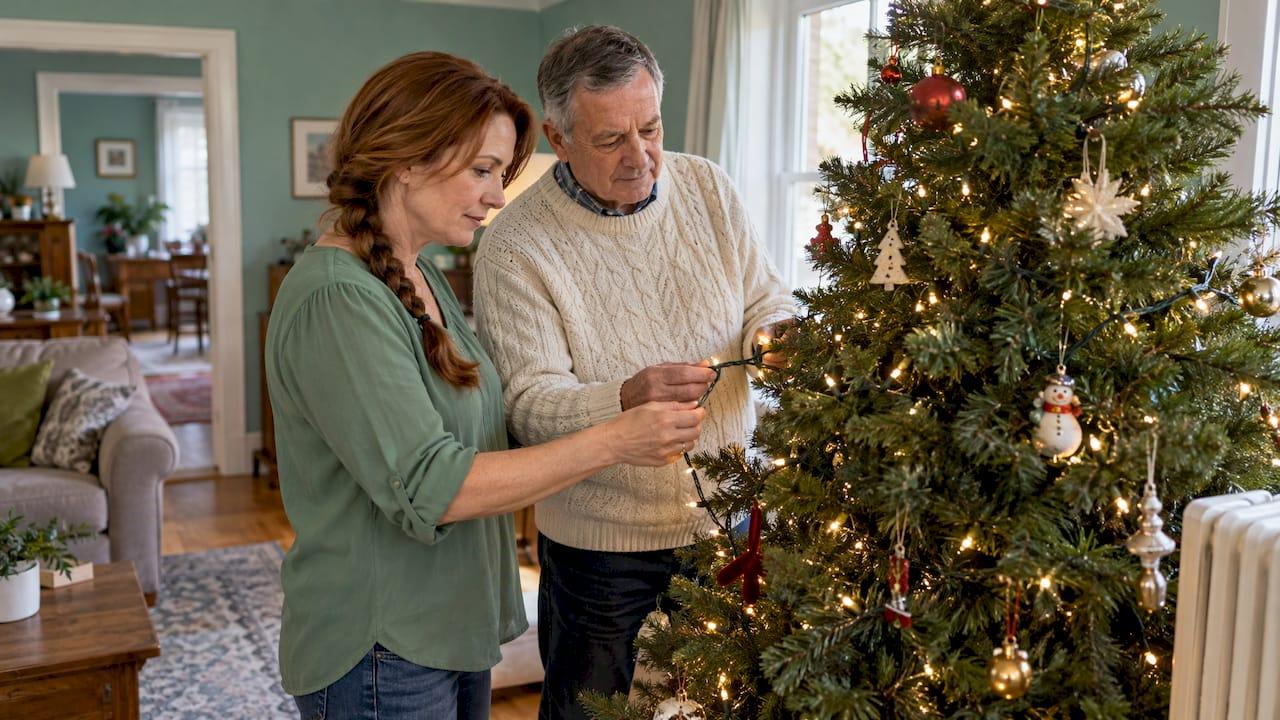
Holiday safety for seniors comes down to a few quiet decisions made before the guests arrive. Check the lights, trade real candles for flameless ones, clear the paths your parent walks every day, keep the kitchen supervised, and shape the gathering around your parent's normal rhythm. None of it takes special equipment. Most of it takes one unhurried walk through the house with your parent, ideally before the decorations come out of the attic.
If you are an adult child helping a mom or dad, this season can feel like one more thing on a long list. It does not have to. This guide goes through the house, the table and the gathering in the order you will actually meet them.
TL;DR
- Walk the house first, with your parent, and look at alarms, lighting, walking paths and anything you plan to add.
- Swap lit candles for battery-operated flameless ones, and inspect every string of lights before it goes up.
- Keep cords, gifts, rugs and garlands out of the paths your parent uses, and treat entryways in winter weather as the highest-risk spot.
- Keep the meal near your parent's usual time, keep the guest list small, and give them a quiet place to step away.
- Decide in advance who stays in the kitchen, who checks on your parent, and when the day ends.
Table of Contents
- Start with a walk-through, not a to-do list
- Lights, trees and candles
- Preventing falls around holiday clutter and winter weather
- Holiday cooking and meals
- Gatherings that feel good, not overwhelming
- Our perspective
- Get a second pair of eyes before the holidays
- FAQ
- Sources
Start with a walk-through, not a to-do list
Before you buy a single decoration, do a short walk-through of your parent's home. The goal is not to find fault. It is to see the house the way it will look once the tree is up and six extra people are in it.
The Consumer Product Safety Commission has a home-safety checklist for older consumers. It recommends smoke and carbon monoxide alarms, an emergency escape plan, a fire extinguisher in the kitchen, good indoor and outdoor lighting, and flat, slip-resistant walking surfaces. It also suggests having a helper arranged in advance if your parent would need assistance getting out. It adds that fuel-burning appliances and chimneys should be inspected by a professional each year.
Here is a simple order for the walk-through:
- Alarms. Press the test button on each smoke and carbon monoxide alarm. If you cannot remember when they were last replaced, put it on your list.
- Exits. Stand at the front door and picture the tree, boxes or furniture that might end up near it. Exits should stay clear.
- Lighting. Check that hallways, stairs and entryways are bright, and that switches are easy to reach. Holiday evenings are dark early.
- Floors. Look for loose rugs, cords and clutter. You will see more of this in December than any other month.
- Heat sources. Note where the fireplace, space heater and stove are, and what sits near them.
If you want a fuller version, our room-by-room senior home safety checklist covers every room, and the elderly home safety checklist is a printable-friendly place to start.
A gentle tip on tone: invite your parent to walk it with you. "Help me think through where everyone will sit" lands much better than "I'm worried about your house." This is about walking alongside them, not taking over.
Lights, trees and candles
Holiday fires are mostly ordinary and preventable, and a few habits cover most of the risk.
Lights and the tree
The U.S. Fire Administration says to inspect holiday lights every year before hanging them and discard strands with frayed or pinched wires. It also says to follow the manufacturer's limit on how many strands can be connected. If you have a real tree, the same page advises watering it daily, keeping it at least three feet from heat sources, making sure it does not block an exit, and getting rid of it after Christmas or when it dries out.
The Red Cross adds a habit worth building: unplug lights before leaving the house or going to sleep. A power strip with a switch, or a plug-in timer, makes this easy for a parent who tires by evening.
If your parent has memory loss, the Alzheimer's Association suggests avoiding blinking lights and decorations that look like food, since both can be confusing. Steady white lights and decorations that are clearly not edible are a calm choice for any home.
Candles: why flameless is the easy answer
Candles are lovely, and they are also where a quiet evening can turn. The National Fire Protection Association looked at 2014 to 2018 and found an average of 7,610 home candle fires a year, with December the peak month. The same report found that 36% of the people who died in candle fires were 65 or older, and that 16% of candle fires involved candles that were unattended or abandoned.

That is why the U.S. Fire Administration's first suggestion is to consider battery-operated flameless candles. They give the same glow on the windowsill and the mantel with nothing to knock over or forget.
If your parent loves the real thing and you decide to keep a few, use these ground rules from the same source: keep lit candles at least 12 inches from anything that can burn, use stable holders, and place them where they are hard to knock down. USFA also says to keep lit candles out of bedrooms, bathrooms and sleeping areas, and to put them out when leaving a room or going to bed. The CPSC checklist makes the same point about keeping candles away from curtains, furniture and blankets and never leaving them unattended.
A practical way to make this stick: replace the candles with flameless ones before you arrive, so there is no conversation to have. If there is a power outage, USFA recommends flashlights instead of candles, so put a flashlight where your parent can find it in the dark.
Fireplaces
If there is a fireplace, the Red Cross recommends keeping wrapping paper, rugs and clothing at least three feet from the flames, using a fire screen, and making sure embers are out before bed. Wrapping paper is the one people forget. Bag it and carry it out as you go.
Preventing falls around holiday clutter and winter weather
Holidays change the floor plan. A tree takes a corner, gifts pile up, extension cords cross the room, and there are more people and more shoes. Falls are the quiet risk in all of that.
Clear the paths your parent actually uses
The CDC's "Check for Safety" checklist is plain about it. It says to clear furniture and objects out of walking paths, remove or secure throw rugs, and coil or tape cords beside the walls. The Agency for Healthcare Research and Quality's checklist agrees that cords should stay out of walking paths and from under carpets.
In practice:
- Put the tree where nobody has to walk around it to reach the bathroom, kitchen or bed.
- Run light cords along the wall nearest an outlet, and keep them off the floor where people walk.
- Keep gifts in one spot, not scattered. A laundry basket or a corner of the dining room works.
- Skip floor-level decorations such as trains, garlands and floor candles in hallways.
- Rugs deserve a second look. Our rug safety guide for caregivers explains how to decide which to secure and which to remove.
Stairs, lighting and small changes
Holiday visitors often mean extra trips up and down stairs with arms full. The CDC checklist says to keep stairs free of objects, repair uneven steps, have lights and switches at both ends, secure or remove loose stair carpeting, and keep handrails on both sides. Our stair safety guide walks through the same ideas in a family-friendly way.
The same CDC checklist says to keep frequently used kitchen items about waist-high and never use a chair as a step stool. That matters at the holidays, when the good platter lives on the top shelf. Fetch it yourself before the day. Hanging decorations is also the moment ladders come out, and the Red Cross advises to keep your body centered, avoid overreaching and never stand on the top step. A simple family rule: your parent directs, someone else climbs.
If you are also thinking about longer-term changes to cut fall and fracture risk, these clinic-backed fall and fracture actions are a good companion read for the home modifications you are already considering.
Entryways in winter weather
Wet boots, ice and darkness make the front door the most slippery place in the house. The Red Cross suggests salting driveways and sidewalks on icy days, and AHRQ's checklist says to clear winter ice and snow and use salt or an ice-melting product. Put a nonslip mat inside the door for wet shoes, and give guests a spot for coats and boots that is not the hallway floor. Our guide to outdoor fall prevention for seniors has a quick routine for checking the walk to the mailbox or car.
If your parent does fall, the Red Cross notes that a medical evaluation is often advisable after a fall, especially for older adults or anyone who hit their head, and that emergency help is needed if the person is unresponsive or has altered consciousness. Call 911 in that case, and otherwise call your parent's doctor the same day.
For a deeper look, see how to prevent falls at home for aging parents, or try the three quick screening tests we describe for noticing changes in balance.
Holiday cooking and meals
Kitchen fire safety
Holiday cooking is busy, and busy kitchens are where attention drifts. The NFPA says cooking is the leading cause of U.S. home fires and injuries, with 49% of reported home fires involving cooking equipment. It also says 29% of home cooking fires start with unattended cooking.
The habits it recommends are simple: stay in the kitchen when boiling, frying, grilling or broiling, use a timer when simmering or baking, keep anything that can burn away from the stovetop, and turn the stove off when you leave the room, even briefly.
At a family gathering, the practical version is a plan for who is "on the stove." If your parent loves to cook, give them a role that is safe and satisfying: seasoning, mixing, rolling dough at the table. Our guidance for aging in place leans on the idea that a role keeps dignity intact while the risk goes down.

Food safety for the big meal
The Academy of Nutrition and Dietetics has a handy holiday food-safety page. Its key points:
| What to do | Guideline |
|---|---|
| Refrigerator and freezer | Keep the fridge at 40°F or below and the freezer at 0°F or below |
| Hand washing | Soap and water for 20 seconds |
| Food left out | Discard perishables left at room temperature over two hours, or over one hour above 90°F |
| Leftovers | Use refrigerated leftovers within three to four days, reheated to 165°F |
| Raw and ready-to-eat | Keep raw meat, poultry and seafood separate, with separate cutting boards |
The source is the Academy's holiday food safety guide. A food thermometer and shallow containers make the leftovers part easier. If you are sending a plate home with your parent, label it with the date so no one has to guess.
Making the meal comfortable
For a parent with memory loss, Dementia Friendly America suggests keeping the meal close to the person's usual mealtime, offering easy-to-eat, non-messy food, lightweight easy-grip cutlery, and smaller portions if helpful. It also suggests seating them near a care partner or supportive person and turning down background music during the meal. These small changes help any older guest who tires easily or struggles to follow table conversation.
Gatherings that feel good, not overwhelming
Safety is not only about hazards. A loud, crowded, late afternoon can be tiring and confusing, and that is a safety issue too, because tired people stumble and stressed people forget.
Shape the day around your parent
Dementia Friendly America suggests planning around the person's normal rhythms, keeping the gathering to a meal and one or two activities, and staying flexible if they need to arrive late or leave early. A relatively small guest list helps.
The Alzheimer's Association says to discuss plans and caregiving limits with family in advance, consider smaller or more casual gatherings, and celebrate earlier in the day if evening confusion is a concern. It also suggests keeping routines as normal as possible, inviting your parent into safe tasks they enjoy, and dropping activities that feel overwhelming or risky. A lunch can be as meaningful as a dinner.
Prepare visitors and create a quiet corner
The American Speech-Language-Hearing Association's 2025 guidance suggests telling visitors what to expect, preparing the person with conversations, labeled photos and a simple schedule, and reducing background noise. A short text to relatives a few days ahead does a lot: "Mom is best in the morning, so we're eating at noon. Please say your name when you greet her."
Dementia Friendly America also recommends a quiet area with soft lighting, a comfortable chair, blankets or pillows, and optional headphones, along with clear labels on key rooms and high-contrast name tags. Even without memory loss, a place to step away helps. Choose a room away from the kitchen and the television, and tell your parent it is theirs whenever they want it.

Use the visit to notice, gently
Holiday visits are often the one time of year that distant relatives see a parent in person. If someone says, "Dad seems different," try to hear it as information rather than criticism. A few things worth quietly noticing: unopened mail, spoiled food in the fridge, new bruises, or more difficulty on the stairs. Write it down privately afterward. Our guide to signs your aging parent may need help can help you sort what is a passing thing from what deserves a conversation, and talking with aging parents about care gives you words for raising it kindly. A relative visiting for a weekend is not a substitute for the routines that already support your parent, so keep those in place.
Our perspective
In our experience, holiday safety goes wrong when families treat it as a lecture instead of a project. Your parent has run this home for decades. If the first thing a visiting child does is take down their candles and rearrange the furniture, the message they hear is "you can't manage."
We take a different approach, and it is the one we built Helping Mom around: calm, non-medical and practical. Walk through the house together. Pick two or three changes that make the biggest difference, such as flameless candles, cords off the floor and a bright, mat-lined entry. Then let your parent keep their traditions and their role.
When a family wants a second set of eyes, that is what our home safety assessments and virtual consultations are designed for. We look at the home through the lens of dignity and simplicity, and we help you decide what matters now and what can wait. Small, manageable steps beat a perfect plan that never happens.
Mike C.
Get a second pair of eyes before the holidays
If you would like help deciding what to change, we offer a few ways to get it. In Central Florida, our in-home Age-Safe home safety assessments bring a trained eye to your parent's actual rooms. If you live elsewhere, a virtual home safety consultation lets us walk through the home with you over Zoom. And if the bigger question is how to coordinate family, care and holiday expectations, the Caregiving Clarity Session is a one-time $97 conversation focused on getting you a clear next step.
FAQ
What is the biggest holiday safety risk for seniors at home?
For most families, it is a mix of falls and fire. Clutter, cords and winter entryways raise the chance of a fall, while candles, cooking and dry trees raise the chance of a fire. Start with the walking paths and the candles, since both are quick to fix.
Are flameless candles really a good replacement?
Yes. The U.S. Fire Administration lists battery-operated flameless candles as the first thing to consider, and they give the same warm look without a flame to knock over or forget. If you keep any real candles, keep them at least 12 inches from anything that can burn and put them out before leaving the room or going to bed.
How do I keep holiday gatherings from overwhelming a parent with memory loss?
Keep the guest list small, plan the day around their usual routine, and stick to a meal and one or two activities. Provide a quiet room, turn down background noise, and tell visitors ahead of time what to expect. If evenings are harder, celebrate at lunch.
Should I decorate my parent's home for them?
It helps to decorate together, with your parent in charge of the design and someone else on the ladder. Choose steady lights and unbreakable ornaments, keep decorations off the floor in walkways, and keep cords along the walls. That way they keep the tradition and the home stays easy to move through.
When should I get outside help with home safety?
If the walk-through turns up several things you are unsure about, or you live far away and cannot check in person, a professional home safety assessment can give you a clear, prioritized list. For a fall, call 911 if your parent is unresponsive or confused, and see a doctor promptly after any fall with a head strike.
Sources
- Consumer Product Safety Commission: Safety for Older Consumers home safety checklist
- U.S. Fire Administration: Holiday Fire Safety
- U.S. Fire Administration: Candles
- American Red Cross: Holiday Safety Tips
- American Red Cross: Tips to Avoid and Treat Common Holiday Injuries
- NFPA: Home Candle Fires
- NFPA: Cook and use candles with caution
- CDC: Check for Safety, a home fall prevention checklist
- AHRQ: Reducing Falls, a safety checklist
- Dementia Friendly America: Holiday Guide
- Alzheimer's Association: The Holidays and Alzheimer's
- ASHA: Home for the Holidays
- Academy of Nutrition and Dietetics: Holiday Food Safety
- Bone Health Sacramento: fall and fracture risk actions