
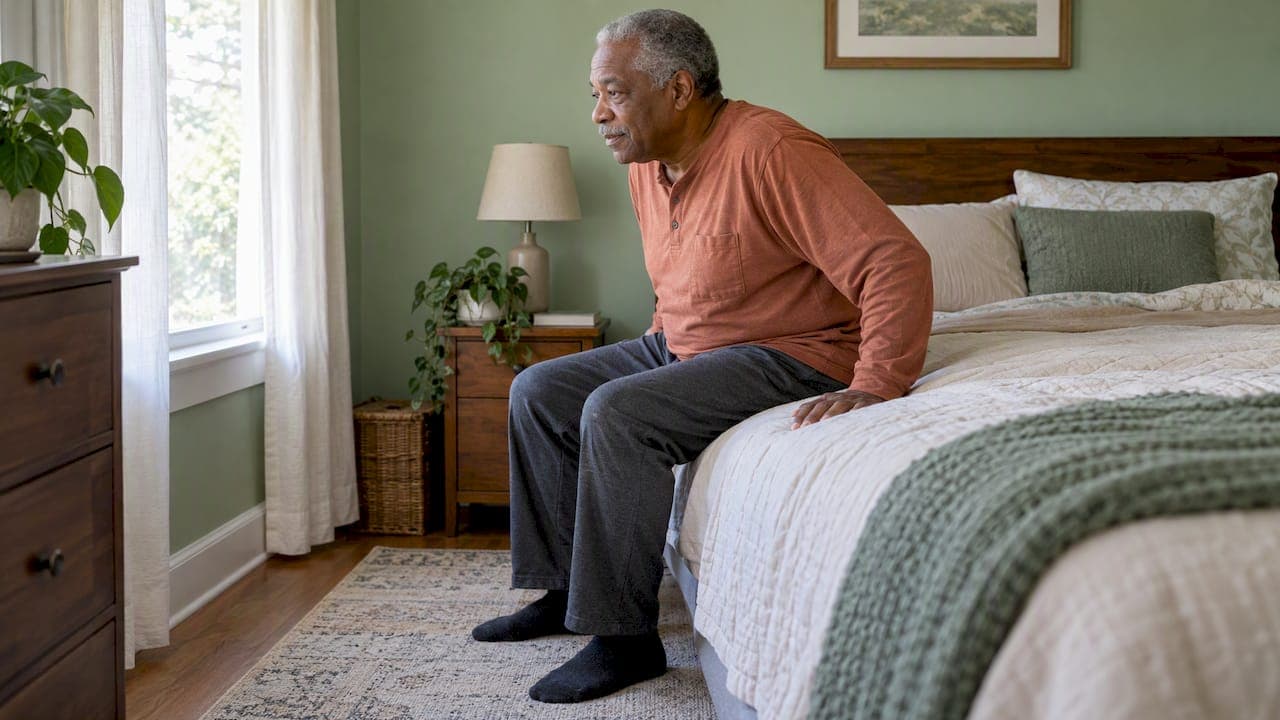
A safer bedroom for an older parent comes down to a few things you can mostly do in one afternoon: light the path from bed to bathroom, clear the floor, set the bed at a height where their feet rest on the floor, and keep the essentials within arm's reach. None of it requires a contractor or a big purchase, and most of it starts with simply standing in the room and noticing how your parent moves through it, especially at night.
If you have a subtle sense that something has shifted, maybe a stumble in the dark or a parent who now hesitates at the edge of the bed, this guide is for you. It is non-medical and meant to walk you through practical changes, not to alarm you.
TL;DR
- Put lights, night-lights, and a phone within reach of the bed, and make the route to the bathroom easy to see.
- Remove loose rugs and cords, and keep the walking paths clear of furniture.
- Check bed height: when your parent sits on the edge, their feet should touch the floor.
- Talk with a health-care provider or therapist before adding bed rails or other equipment, and after any fall or near-fall.
- Start with the nighttime route, since that is where most families find the quickest wins.
Table of Contents
- Why the bedroom deserves its own look
- Start with a quiet walk-through
- Lighting: the biggest easy win
- Clear the floor and the paths
- Bed height: how to check it
- Getting in and out of bed more safely
- Keep essentials within reach
- Our perspective: change a little, together
- When to bring in a professional
- A one-afternoon bedroom plan
- Frequently asked questions
- Sources
Why the bedroom deserves its own look
The bedroom is where your parent is most tired, most likely to be half awake, and least likely to turn on every light. Getting up at night to use the bathroom means moving through the dark, often in socks or slippers, often a little stiff after lying still. That combination is why the National Institute on Aging includes the bedroom in its room-by-room guide to preventing falls at home.
A bedroom is also deeply personal. It holds a lifetime of furniture, photographs, and habits. So the goal is not to turn it into a clinical space. It is to keep what your parent loves and quietly remove the few things that get in the way.
Here is a real-life picture. A daughter we might imagine visits her father on a Sunday and notices the small rug beside his bed has a curled corner, the lamp is across the room on a dresser, and his phone charges in the kitchen. Nothing looks dangerous in daylight. At 3 a.m., every one of those things matters. The fixes take minutes, and that is the spirit of this whole guide.
Start with a quiet walk-through
Before you buy or move anything, spend ten minutes doing this:
- Stand at the bedroom door in the evening with the overhead light off, the way it would be at night.
- Walk the path from the bed to the bathroom slowly. Notice where it is dark, where your foot meets something, and where you would want to reach out for support.
- Sit on the edge of the bed. Notice how it feels to stand up from there.
- Lie down and see what you can reach without sitting up: a light, a phone, water, glasses.
Write down what you notice. If you would like a more structured way to do this, our elderly home safety checklist covers the whole house, and our fall risk screening guide describes three simple tests you can try with your parent.
Invite your parent to walk it with you. This is not about taking control, it is about walking alongside them. A parent who helps choose the changes is far more likely to keep using them.
Lighting: the biggest easy win
If you only do one thing, improve the lighting. The NIA advises keeping night-lights and light switches close to the bed, a flashlight by the bed in case the power goes out, and a landline or well-charged phone nearby.
Other official guidance adds useful detail:
- A bedside lamp that is easy to reach, plus a night-light, appears in Kaiser Permanente's home-fall checklist.
- MedlinePlus recommends good lighting along the route from the bedroom to the bathroom.
- The Agency for Healthcare Research and Quality suggests easy-access switches, direct task lighting, glare-reducing shades or bulbs, and motion-detector lights, along with a night-light and an easily lit route from bed to bathroom.
- New York City's health department says that if the bed-to-bathroom path is dark, you can use a night-light or glow-in-the-dark tape and clear trip hazards.
- The Parkinson's Foundation recommends bedroom lighting that can be operated without walking in the dark, and a bright night-light that fully lights the way to the bathroom.
A simple lighting setup
| Spot | What to try | Why it helps |
|---|---|---|
| Bedside | A lamp with an easy switch, or a touch lamp | Light before the feet touch the floor |
| Floor level | Plug-in night-lights that turn on automatically | No switch to find in the dark |
| Doorway and hall | Motion-detector light | Hands stay free |
| Nightstand | A flashlight | Backup if the power goes out |
For a deeper plan, see our bedside lighting guide and the 30-day home lighting plan.
One gentle tip: choose warm, soft light for night-lights. Bright enough to see the floor, soft enough that your parent can fall back asleep.
Clear the floor and the paths
The NIA names loose or small rugs, cords in walking paths, and furniture or other objects in the way as fall hazards. Its Alzheimer's home safety checklist also advises removing scatter and throw rugs. MedlinePlus adds fixing uneven flooring and reorganizing belongings so they are easier to reach.
Here is what that looks like in practice:
- Rugs. Remove small throw rugs by the bed. If your parent loves a particular rug, talk it through before you take it away. Our rug safety guide covers options.
- Cords. Lamp, phone charger, and heating pad cords tend to stretch across the floor beside the bed. Move the outlet side of the setup or reposition the furniture so cords run along the wall, not through the walking path.
- Furniture. Leave a clear lane from bed to door and from door to bathroom. A chair piled with clothes or a basket on the floor is a common culprit. Give those things a new home.
- Clutter by the bed. A tidy nightstand with only what is used nightly beats a crowded one. If you want help with decluttering gently, balance training for seniors can also pair well with clearing trip hazards, since a steadier body and a clearer floor work together.
- Footwear. Slippers with a slippery sole are as much a hazard as a rug. See our guide to safe footwear features.
A good rule: if you have to step over it or around it in the dark, it does not belong in the path.
Bed height: how to check it
Bed height is one of the most searched bedroom questions, and the answer is refreshingly simple. MedlinePlus advises using a low bed so that the person's feet touch the floor when seated on the edge. The Parkinson's Foundation's safety checklist says the same.
There is no single magic number, because it depends on your parent's legs and the mattress. So test it:
- Have your parent sit on the edge of the bed with shoes or slippers on.
- Check that both feet rest flat on the floor.
- Check that their knees are roughly level with, or just below, their hips, so standing up does not feel like a climb or a drop. (This is our practical rule of thumb, not an official measurement.)
- Ask how it feels: do they need to push hard, scoot, or grab something to stand?
If getting in or out is hard, Kaiser Permanente suggests adjusting the bed height, for example with a thinner mattress or a shorter frame. If the bed is too low, that can be tough too, which is why the feet-on-the-floor test is more useful than any chart. An adjustable bed is an option some families choose, but it is a bigger purchase, so try the simpler fixes first.
If you are also thinking about the nightstand, its height matters because it should be reachable from a seated or lying position. A bedside table height guide can help you match it to the mattress top.
Getting in and out of bed more safely
Even a well-set-up bed can feel tricky if the movement is rushed. The Parkinson's Foundation describes a calm sequence for getting out: roll onto the side, let the legs move off the bed, and push up to sit. Then sit at the bedside for a moment before standing, and take your time.

That pause is something you can encourage in your own words: "Sit a minute, there's no rush." It sounds small, and it is the habit families tell us is easiest to adopt.
The same Parkinson's Foundation resource notes that a physical or occupational therapist can help identify tools such as adjustable beds, bed rails or poles, bed ladders, and slide sheets. We are not clinicians, so this is where we hand the question to the right professional.
About bed rails
Bed rails come up in nearly every search about this topic, and they deserve care. The Parkinson's Foundation cautions families to consult the care team before using bed rails, and says that lowering the bed or adding padding beside it may reduce the risk of injury from falling out of bed. The NIA lists bed rails among transfer and mobility aids to consider as abilities change. So the practical path is: ask first, choose second.
Keep essentials within reach
A lot of nighttime risk comes from reaching or getting up for something small. Set up the bedside so your parent does not have to leave the bed for the basics:
- A phone, charged, within reach. The NIA suggests a landline or well-charged phone nearby, and the Parkinson's Foundation adds a clock on the nightstand.
- A flashlight.
- Glasses, hearing aids if used, and a glass of water.
- Tissues and any items your parent's care team has told them to keep nearby.
In the closet and dresser, move everyday clothes to waist-to-shoulder height so there is no stretching or bending. MedlinePlus lists reorganizing belongings so they are easier to reach as a simple fall-prevention step.
If your parent lives alone or you worry about nights you cannot be there, the NIA's Alzheimer's checklist mentions considering a monitoring device that can alert a caregiver to a nighttime fall or need for help. Talk with your parent first. Some people welcome that peace of mind, others feel watched, and the conversation matters as much as the device. Our guide to talking with aging parents about care can help you start.
Our perspective: change a little, together
We have sat in a lot of bedrooms, as family members and as professionals, and the pattern is consistent. Families rarely need a long list. They need the first three changes, made with their parent's agreement, and a way to keep from feeling overwhelmed.
Our approach, shaped by personal caregiving experience and our Age Safe® America certification, is to begin at night. We look at how a parent actually moves from bed to bathroom, then adjust light, floor, and reach before anything else. Equipment comes last, and only after a conversation with the right professional.
We also believe the emotional side counts. A parent who hears "your room is a hazard" will resist. A parent who hears "I want you to feel steady and keep your independence" will often say yes. Dignity and simplicity are the point.
— Mike C.
When to bring in a professional
Some situations call for a health-care professional, not a DIY fix. MedlinePlus advises contacting a health-care provider after a fall or near-fall, if eyesight has worsened, or to ask about medicines that may cause dizziness, and asking about a physical therapist if getting up is difficult.
Please keep in mind that we offer non-medical, safety-focused guidance. If your parent has fallen, is newly unsteady, or seems confused at night, call their doctor. The changes in this article support that care, they do not replace it.
For the home itself, you may want a second set of eyes. Our home safety assessments are available in person in Central Florida, and our virtual home safety consultations work from anywhere. If you are not sure where to start, the Caregiving Clarity Session is a one-time $97 conversation to sort out priorities and next steps. For a broader picture beyond the bedroom, read our guide to home safety for aging parents or the senior-friendly home setup guide.
A one-afternoon bedroom plan
If you would like a simple order of operations, try this:
- First 15 minutes: Plug in night-lights between the bed and the bathroom. Put a flashlight and charged phone on the nightstand.
- Next 30 minutes: Remove throw rugs and tuck away cords. Clear the path of baskets, shoes, and extra furniture.
- Next 30 minutes: Test the bed height with your parent sitting on the edge. Note what you see, and make a list of questions for their doctor or therapist.
- Next 30 minutes: Reorganize the nightstand and the most-used clothing so everything is easy to reach.
- One week later: Ask your parent how the nights have felt. Adjust one thing at a time.
This kind of small, steady progress is what keeps caregiving manageable. If you are carrying a lot yourself, our caregiver well-being resources are here too.
Frequently asked questions
What is the best bed height for an elderly person?
The most widely given guidance is that their feet should touch the floor when they sit on the edge of the bed. MedlinePlus and the Parkinson's Foundation both say so. If getting in or out is hard, a thinner mattress or shorter frame may help. A therapist can tailor this to your parent.
Are bed rails a good idea for seniors?
They can help some people roll and get up, but they are not right for everyone. The Parkinson's Foundation advises talking with the care team first. Lowering the bed or adding padding beside it may also reduce injury risk from falling out of bed.
What is the first thing to fix in a senior's bedroom?
Start with the lighting from bed to bathroom. Night-lights, an easy-to-reach lamp, and a flashlight make the biggest difference for the least effort. Then remove loose rugs and cords from the walking path.
How can I help my parent get out of bed safely?
Encourage them to roll onto their side, let their legs move off the bed, and push up to sit. Then they can rest at the bedside for a moment before standing. If it is still difficult, ask their doctor about a physical or occupational therapist.
Should I involve my parent in changing their bedroom?
Yes, whenever possible. Walk through the room together and let them choose which changes to try first. Changes they helped pick are the ones they tend to keep using.
Sources
- Preventing Falls at Home: Room by Room, National Institute on Aging
- Home Safety Checklist for Alzheimer's Disease, National Institute on Aging
- Alzheimer's Caregiving: Home Safety Tips, National Institute on Aging
- Preventing falls, MedlinePlus Medical Encyclopedia
- Reducing Falls: A Safety Checklist, AHRQ
- How To Prevent Falls: A Home Safety Checklist, NYC Health Department
- Home Safety, Parkinson's Foundation
- Safety Considerations, Parkinson's Foundation
- Sleep & Moving in Bed, Parkinson's Foundation
- Checklist for Preventing Falls at Home, Kaiser Permanente