
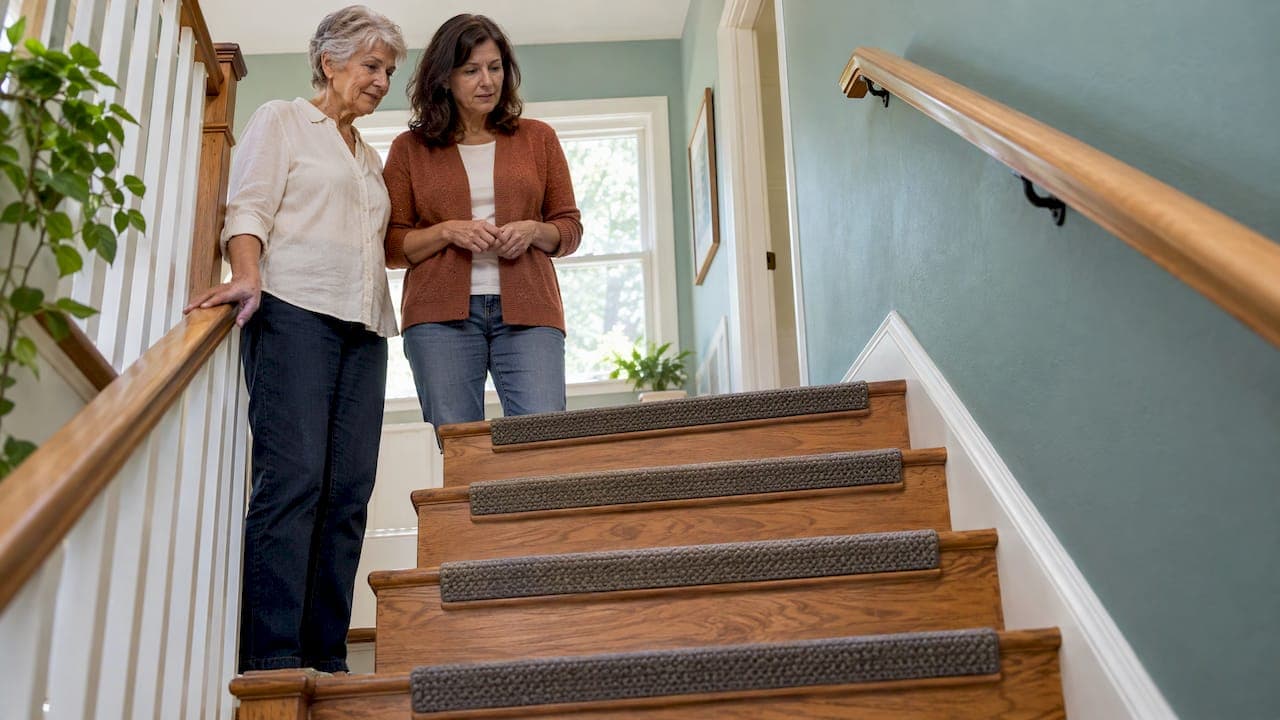
The best non-slip stair treads for an aging parent are the ones that match the stairs you have. Bare wood or tile steps usually do well with adhesive strips or firmly fixed rubber treads. Carpeted steps need carpet that is tightly attached. Outdoor steps need a rough, weather-ready surface. Treads work best as part of a short stair check that also covers lighting, handrails and clutter.
If you are reading this because a parent has started to hold the wall on the way down, or because you feel a quiet worry every time they carry laundry upstairs, you are in good company. Stairs are one of the most common places families decide to make a change. The good news is that most of the useful changes are small, affordable and doable in a weekend. This guide walks you through them in a calm order.
TL;DR
- Look at the whole staircase first: lighting, handrails, loose carpet, clutter and damaged steps. Treads help most when those basics are in place.
- Match the tread to the surface. Bare wood or tile usually calls for non-slip strips or rubber treads, carpet must be firmly attached, and outdoor steps need non-slip material made for weather.
- Thin, tightly attached treads with no lifting edges are the goal. A tread that curls or cracks at the edge becomes its own trip hazard.
- Handrails on both sides, running the full length of the stairs, are a simple upgrade that pairs well with treads.
- If stairs are becoming truly difficult, treads are one step among several. Planning for one-level living can come later, without pressure.
Table of Contents
- Why treads are worth the weekend
- Start with a calm look at the stairs
- Choosing the right tread for your stairs
- Indoor versus outdoor steps
- Installing treads without creating a new trip hazard
- Handrails: the partner to every tread
- Light, clutter and what's underfoot
- Strength and balance matter too
- When treads are a step, not the whole answer
- Want a second pair of eyes on the stairs?
- FAQ
- Sources
Why treads are worth the weekend
The idea behind a non-slip tread is simple: it gives a shoe or a sock more grip on the part of the step where feet land. That matters most on smooth surfaces such as bare wood, painted boards or tile.
Several trusted organizations point to the same basics. The National Institute on Aging suggests no-slip strips on tile and wooden floors and non-slip material on outdoor stairways, alongside secure handrails on both sides, good lighting and clear stairs. The American Academy of Orthopaedic Surgeons recommends nonslip treads on bare-wood steps in its home checklist. AARP's HomeFit guidance also calls for nonslip adhesive strips on uncarpeted steps.
Notice what these have in common. Treads appear in a list, not on a pedestal. They sit beside lighting, rails and clutter. That is how we think about them too, and it is why we start with a walk through the stairs before anyone clicks "add to cart."
Start with a calm look at the stairs
Before you buy anything, spend ten minutes on the staircase with your parent, ideally in daylight and again in the evening. You are not inspecting. You are observing how the stairs feel to use.
The CDC's home fall prevention checklist is a handy guide. It asks you to look for objects on the stairs, broken or uneven steps, missing lighting or switches at the top and bottom, loose or torn carpet, and loose or broken handrails or a rail on only one side.
Here is a simple way to run it:
- Stand at the bottom and look up. Can you clearly see the edge of every step? Dark, patterned or thick carpet can hide edges. The AAOS advises avoiding patterned, dark or thick carpeting that obscures step edges.
- Run your hand along the rail. Is it firm? Is it on both sides? Does it run the whole way?
- Check the lights. Can your parent turn one on at the top and at the bottom without crossing the dark stairs? The CDC advises having an electrician install an overhead light and switches at both ends when they are missing, as noted in the same checklist.
- Look for wear. Are any treads bent, loose, cracked or uneven? A 2024 NIOSH stairway checklist, written for workplaces, notes that bent or unlevel treads can cause uneven risers and slips, and recommends repairing or replacing them. The same logic holds at home.
- Clear the steps. Shoes, mail, laundry baskets and pet toys all belong somewhere else.
If you want a fuller walkthrough of the whole house, our no-drama home safety walkthrough and elderly home safety checklist keep it gentle and organized. For stairs specifically, our practical stair safety guide for caregivers goes deeper.
Choosing the right tread for your stairs
The right tread depends mostly on what is under it. Here is how we think through the common situations.
| Your stairs | What usually fits | What to watch |
|---|---|---|
| Bare wood, indoors | Adhesive non-slip strips, or rubber or carpet treads that attach firmly | Edges that lift, and treads that slide on the surface |
| Tile or other smooth indoor steps | No-slip strips | Moisture from wet shoes near an entry |
| Carpeted stairs | Carpet fixed firmly to every step, or removed and replaced with non-slip rubber treads | Loose, worn or thick carpet that hides step edges |
| Outdoor steps | Non-slip material made for outdoor use | Wet leaves, debris, ice and snow |
This lines up with what the CDC recommends for carpet: attach it firmly to every step, or remove it and attach non-slip rubber treads.
Strips, mats, rubber and carpet treads
You will see a handful of styles in stores and online:
- Adhesive strips or grit tape. Thin, low-profile and designed for uncarpeted steps. This is the style AARP's HomeFit guidance names for uncarpeted steps.
- Rubber treads. A sturdier cover for the full step, often used on outdoor stairs or entryways.
- Carpet-style peel-and-stick treads. Softer underfoot and popular on wood stairs. They look homey, but they depend entirely on how well they stay attached.
- Outdoor-rated treads. Made for rain, moss and snow. Look for products that say clearly they are intended for outdoor use.
What to compare before you buy
You do not need a spreadsheet. A handful of questions will get you most of the way:
- Is it thin? Guidance from Canada's housing agency says tread coverings should be thin and tightly affixed, and that soft treads with short coverage and large rounded nosings should be avoided.
- Does it cover the edge well? The nosing, the front edge of the step, is where feet often land on the way down. A tread that stops short of it leaves a slick strip right where it counts.
- Is the surface rough where it gets wet? The same guidance recommends a slip-resistant, rough finish on treads that get wet.
- Can you see the edge? Solid-color coverings show step edges more clearly, according to the AAOS. A contrasting color on the front edge can help your parent see where each step ends.
- Will it last? Look at the adhesive and the material. If the product is meant to be checked and replaced over time, plan for that.
- Is it easy to clean? Dust, grit and leaves reduce grip and tread depth, so a surface you can sweep or wipe quickly stays safer.
If your parent uses a cane or walker on any steps, or has a pet that dashes up and down, mention it to yourself as you shop. Those details change which tread feels steadier in real life.
Indoor versus outdoor steps
Indoor and outdoor stairs fail in different ways, so they deserve different thinking.

Indoors, the usual culprits are smooth surfaces, worn carpet and poor light. Socks on wood are a notoriously slippery pairing. A tread helps, and so does a conversation about footwear. Our guide to safe footwear features that reduce falls is a gentle way to bring that up.
Outdoors, the issue is weather. The NIA suggests keeping outdoor areas clear of debris and treating winter walkways with ice melt or sand, on top of using non-slip material on outdoor stairways. A tread is not a substitute for clearing wet leaves or snow. It is the grip that remains once you have done that.
If the front steps are where your parent comes and goes every day, you may also like our ideas for weekend fixes for home entry safety.
Installing treads without creating a new trip hazard
This is the part many people skip, and it matters. A tread that lifts, curls or sits crooked can cause the very stumble you are trying to prevent. The Canadian stair guidance notes that resilient safety coverings need careful installation and maintenance, because cracking at the nosing can create a hazard.
A calm installation routine looks like this:
- Fix the steps first. Repair loose boards or damaged edges before covering them. A tread on a wobbly step is still a wobbly step.
- Clean the surface. Remove dust, wax and grime so adhesive can hold. Let the surface dry fully.
- Measure each step. Do not assume they are identical. Older homes in particular can have steps that vary.
- Dry-fit before peeling. Lay the tread in place, check the edges and confirm it sits flat.
- Press firmly from one side to the other. Push out air bubbles and make sure corners are down.
- Walk it with your parent. Have them go up and down once, holding the rail, and ask how it feels. Their comfort matters as much as the product.
Keep every step the same
One quiet detail: stairs feel safest when every step behaves the same way. The NIOSH checklist says tread depth should be uniform from the first step through the last, and that debris building up and shrinking the usable depth should be removed. If you add treads to some steps but not others, or use different thicknesses, your parent's feet may find an unexpected difference. Cover them all, or cover none.
Check them now and then
The same NIOSH checklist recommends routinely examining and maintaining stair treads, and repairing or replacing damaged ones. At home, that can be a quick look every few months. Run a hand over each edge. Look for peeling corners, worn patches and dirt that has built up. Treat it like changing the batteries in a smoke detector: a small habit that keeps things reliable.
Handrails: the partner to every tread
Treads give feet grip. Handrails give hands something steady to hold. Together they do more than either does alone.
The CDC recommends fixing loose handrails or installing new ones, with handrails on both sides and as long as the stairs. If your parent's stairs have a rail on one side only, a second rail is often one of the most meaningful upgrades you can make.
What about rail extensions?
A rail extension is the stretch of handrail that continues past the top and bottom step, so a person can grab it before stepping onto the stairs and hold it until they are fully off. Public buildings covered by the ADA have rules for this. On stairs that fall under those standards, the Access Board explains that handrails are required on both sides and must be continuous within each flight, with top and bottom extensions that return to walls, guards or floors. The same guidance says rails should offer a usable gripping surface with rounded edges and nothing sharp or abrasive.
A few things are good to know for a private home:
- The ADA stair rules apply to stairs that are part of a required means of egress. Stairs that are not do not have to meet the standards, according to the Access Board. A single-family home is generally outside that scope, so treat the ADA as a useful model rather than a requirement.
- Mind protrusion. The Access Board notes that wall-mounted rails with leading edges higher than 27 inches may not protrude more than 4½ inches into circulation paths under the standard it describes. An extension that sticks out into a hallway can catch a sleeve or a hip.
- Local code can still matter. Residential codes cover things like tread depth and stair width. The 2021 International Residential Code, in a visual interpretation, shows a 10-inch minimum tread depth, a 7¾-inch maximum riser and no more than a ⅜-inch variation in tread depths within a flight. Your city or county decides which edition applies, and a new rail or structural change may call for a permit, so ask your local building department before you build.
For most families, the practical move is to have a handyman or a qualified installer fit sturdy rails anchored into solid framing, with ends that turn back toward the wall rather than sticking out.
Light, clutter and what's underfoot
Treads are only one layer. Two simple ones sit alongside them.
Lighting. Aim for light across the whole staircase, with switches at both ends. AARP's HomeFit guidance and the NIA both describe lighting for the full staircase with switches at the top and bottom as part of a safe setup.
Clear steps. The staircase is not storage. If your family has a "take it up later" pile, give it a home on the main level, perhaps a basket by the door that gets emptied on a schedule.
Our hallway fixes that need no contractor can help with the approach to the stairs too.
Strength and balance matter too
The safest staircase still depends on the person using it. Some families find that gentle movement, such as walking, tai chi or a beginner-friendly class, helps parents feel steadier. This list of gentle exercise options for adults is a good place to look for ideas that suit different comfort levels. If your parent has osteoporosis or has fallen before, this overview of fall and fracture prevention actions covers traction and handrails among other steps, and it pairs well with a talk with their doctor.
And if your parent has fallen, the NIA says their doctor might suggest an occupational therapist, physical therapist or nurse to assess the home's safety and advise on changes. That kind of clinical question is one for their care team, not for a product page, and not for us.
When treads are a step, not the whole answer
Sometimes the staircase is the real question. If your parent is avoiding the stairs, using furniture to steady themselves or only going up once a day, treads may not be enough.
AARP's HomeFit guidance suggests combining low-cost changes (nonslip strips, lighting, clear stairs and two-sided rails) with broader planning, such as a step-free entrance or arranging essential living spaces on one level, if stairs become unsafe. That is a longer conversation, and it does not need to happen this week. If you want to ease into it, our guide on talking with aging parents about care offers gentle starting points, and our aging in place resource hub lays out the bigger picture.
For a way to look at how your parent is moving without making it a test, see our three safe fall risk tests for an aging parent.
Our perspective
When families come to us about stairs, the first question is nearly always "which tread should I buy?" We understand why. It feels like a concrete thing you can fix this afternoon.
What we have learned from our own caregiving experience and from our work as an Age Safe® America certified team is that the tread is rarely the whole story. A good tread on a dim staircase with one wobbly rail still leaves your parent working harder than they should. So we look at the staircase as a system: light, rails, surface, clutter and how your parent actually moves.
This is also why we value a second set of eyes. It is hard to see a home you have walked through for decades, and harder when the home is your parent's. An in-home assessment or a virtual home safety consultation gives you a calm, specific plan, with no scare tactics and no jargon, so you can decide what to do first and what can wait.
Above all, this journey is not about taking control. It is about walking alongside your parents so that home keeps feeling like theirs.
Mike C.
Want a second pair of eyes on the stairs?
If you would rather not guess, we can help. Our virtual home safety consultations let you walk us through your parent's stairs over video, and our in-home age-safe assessments are available locally in Central Florida. If you are still sorting out the bigger picture of caregiving, the Caregiving Clarity Session is a one-time $97 conversation to help you decide what to tackle first. Prefer to start on your own? Our free elder care checklist is a gentle place to begin.
FAQ
Are non-slip stair treads enough to make stairs safe for an elderly parent?
They are a helpful layer, not the whole plan. Trusted guidance pairs treads with handrails on both sides, good lighting, clear steps and secure carpet. Checking all of these together gives your parent the most support.
Should I put treads on carpeted stairs?
Only if the carpet is already firmly attached to every step. The CDC advises fixing carpet firmly or removing it and attaching non-slip rubber treads. Loose, worn or thick carpet is worth addressing first.
Do I need handrails on both sides of the stairs?
Both sides is what the CDC, NIA, AARP and AAOS guidance all recommend for older adults. If your stairs have one rail, adding a second is often a worthwhile upgrade. Have it installed securely into solid framing, and check local building rules first.
How often should I check the treads?
A quick look every few months works for most homes. Run a hand along each edge, check for peeling corners or worn spots and clear built-up dirt. Replace any tread that is damaged or no longer lies flat.
Sources
- Preventing Falls at Home: Room by Room, National Institute on Aging
- Home Safety Checklist, Preventing Falls, OrthoInfo (AAOS)
- AARP HomeFit Worksheets Collection
- Check for Safety: A Home Fall Prevention Checklist for Older Adults, CDC
- ErgoMine 2.0: Stairway Checklist, NIOSH
- Preventing Falls on Stairs, CMHC
- Chapter 5: Stairways, U.S. Access Board
- 2021 International Residential Code Visual Interpretation