
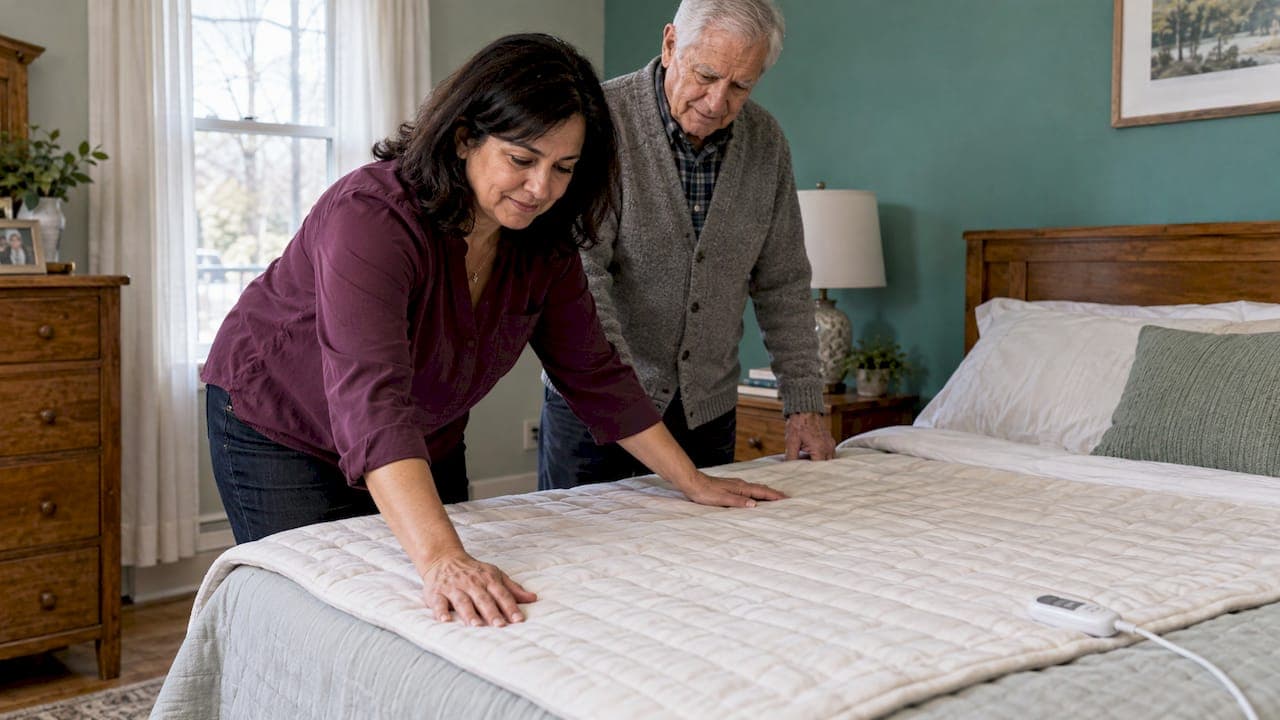
If your mom or dad is always cold, an electric blanket can look like the easy answer. For some older adults it can work, but it takes more care than it does for a younger person. Thinner skin and reduced feeling in the hands and feet make burns easier to miss, and a worn blanket can become a fire risk. The safest approach is to decide whether a blanket suits your parent at all, then use it in a way that keeps the heat on only when someone is awake to notice it.
This guide walks you through that decision and the daily habits that go with it. It is practical guidance for families, not medical advice. For anything involving a health condition, your parent's doctor is the right person to ask.
TL;DR
- Experts at UAB advise against electric blankets for elderly people because thinning skin and reduced sensation raise the risk of burns.
- Diabetes, circulation problems, incontinence and dementia are all reasons to pause and talk with a doctor or monitor use closely.
- If you do use one: warm the bed first, then switch the blanket off and unplug it before your parent lies down to sleep.
- Never fold it, cover it, or layer it with a heating pad, and retire any blanket that is old or damaged.
- Flannel sheets, a down comforter, warm socks and a draft-free room can give much of the same comfort with no wiring.
Table of Contents
- Why the question matters more for older adults
- Who should skip an electric blanket, or use extra care
- If you decide to use one: a safer setup
- The "warm it up, then turn it off" routine
- A quick monthly check of the blanket itself
- Dementia, memory loss and limited mobility
- Warm without the wiring
- Look at the whole room, not just the blanket
- How to raise it with your parent
- Want a second set of eyes on the bedroom?
- FAQ
- Sources
Why the question matters more for older adults
Most of us feel heat and pull away before it hurts. With age, that early warning can fade. Medical News Today notes that older adults may have altered temperature receptors, so a setting that feels pleasantly warm may be hotter than it seems. UAB's guidance adds that thinning skin and nerve changes in the extremities increase burn risk.
Fire is the other half of the picture. The CDC and U.S. Fire Administration's Fire Safe Seniors guide reports that people over 65 are three times more likely to die in a residential fire than people younger than 65. It also lists physical or mental impairments and medication or alcohol use as added vulnerability factors.
None of this means your parent can never be warm. It means a heated blanket belongs in the "use thoughtfully" category, not the "set it and forget it" one.
Who should skip an electric blanket, or use extra care
Before you buy, look at your parent's situation honestly. A few situations come up again and again in official guidance.
Diabetes. The Maine State Fire Marshal says people with diabetes should not sleep with an electric blanket on. Medical News Today says people with diabetes or circulation issues should check with a doctor first.
Incontinence or moisture. The same fire marshal guidance says people who are incontinent should not use an electric blanket, because moisture can cause the wiring to malfunction. UAB points to the same hazard for open weeping wounds, and for water bottles in the bed.
Dementia or memory changes. The Alzheimer's Association says to closely monitor an electric blanket, heater or heating pad for someone living with dementia to prevent burns or other injuries. We cover this in its own section below.
Limited mobility. If your parent cannot easily move off a hot spot, shift position, or reach the controls, a heated blanket removes a safety margin they may not have to spare.
An old or secondhand blanket. The Maine guidance says to replace very old or damaged blankets. A blanket that has lived in a closet for fifteen years is not a good candidate for a comeback.
If one of these fits your parent, that is a good moment for a gentle conversation with their doctor. You are not taking something away. You are asking which kind of warmth is right for them.

If you decide to use one: a safer setup
When the doctor is comfortable with it and your parent can manage the controls, these habits make the biggest difference. They come from UL, UAB, the Maine State Fire Marshal and the Electrical Safety Foundation International.
Choose the blanket carefully
- Buy a blanket approved by a nationally recognized testing agency, from a reputable brand. UL's guidance and UAB's both say this. Look for the testing mark on the label.
- Pick one with simple controls your parent can read and use without fumbling. Large numbers, a clear off position and a cord long enough to avoid stretching are worth more than extra features.
- Keep the manufacturer's instructions. Tape them inside a drawer or write the key points on an index card.
Use it flat and uncovered
ESFI says never to fold an electric blanket while it is operating and never to place anything on top of it, because folding or covering can cause overheating and fire. That includes extra comforters, pillows, pets and stuffed animals. UL also says not to use one together with a heating pad, and UAB advises against layering with other heating products.
Store it with care
UAB suggests rolling a blanket rather than folding it when you put it away. Rolled loosely in a dry spot, the internal wires are less likely to kink.
Mind the cord
Keep the cord clear of rugs, furniture legs and any spot where it can get pinched. A cord running across a bedroom floor also becomes a tripping hazard in the dark. The Alzheimer's Association specifically mentions removing tripping hazards such as extension cords.
The "warm it up, then turn it off" routine
This is the habit most families do not know about, and it answers the common question of whether an electric blanket is safe to use every night.
UL recommends using an electric blanket to warm the bed, then turning it off before sleep and unplugging it when you are done. A burn specialist quoted by UL suggests switching it on about 30 minutes before bedtime and switching it off before getting into bed. UAB likewise advises unplugging before sleep or when not in use.
In practice, it can look like this:
- About 30 minutes before bed, switch the blanket on to a low or medium setting.
- When your parent is ready to lie down, switch it off.
- Unplug it at the wall, or at the connector, so it cannot be turned on by accident.
- Slide into a bed that is already warm, with regular blankets on top.
For a parent who lives alone, you can make this easier. A phone reminder, a note on the nightstand, or a call at the same time each evening can turn the routine into something automatic. If your parent will probably forget a step, that is useful information about whether a blanket is the right choice yet.
A quick monthly check of the blanket itself
UAB recommends checking cords and heating elements regularly. UL and the U.S. Fire Administration both say to discard or replace damaged items. Here is a simple checklist you can run through when you visit, ideally at the start of each cold season and again midwinter.
| What to check | What you are looking for | What to do |
|---|---|---|
| The blanket surface | Scorch marks, dark spots, thin or stiff patches | Stop using it and replace it |
| The cord and plug | Fraying, cracks, a plug that feels hot or loose | Stop using it and replace it |
| The controller | Warm to the touch when off, sticky buttons, flickering light | Replace the blanket |
| The fabric | Bunching, folds, wire that feels bent or lumpy | Lay it flat, or retire it |
| The bed | Anything on top, tucked tightly, or a heating pad underneath | Remove it and keep the blanket flat |
| The outlet | Overloaded power strip, loose fit, warm cover plate | Use a wall outlet on its own |
The U.S. Fire Administration also recommends replacing cracked, damaged or loose electrical cords and avoiding overloaded circuits. If a breaker trips often or fuses blow, it advises having a licensed electrician look at it. Do not treat those as nuisances to reset and forget.
Dementia, memory loss and limited mobility
This is where families feel the most uncertainty, so here is a plain way to think about it.
The Alzheimer's Association explains that dementia can make it hard to tell hot from cold. Your parent may not report that the blanket is too warm, or may not understand why it is uncomfortable. Add the chance that they turn the dial up, tuck the blanket in, or forget to switch it off, and the margin gets thin.
The Alzheimer's Association guidance is to monitor closely. That is a good rule of thumb:
- If someone is there to set up the blanket, watch it, and switch it off, it may be workable.
- If your parent is alone through the night and cannot reliably follow the steps, it is wise to look at other ways to keep them warm.
- If you are not sure, ask their doctor, and consider a home safety review so a second set of eyes can look at the whole bedroom.
One real-life example: a daughter we might meet at a kitchen table says her father keeps turning the heat to the highest setting "because it feels nice at first." That pattern is common, and it tells you the controls are a problem, not him. Swapping to a pre-warmed bed with flannel sheets removes the decision altogether.
Warm without the wiring
If your parent is cold, the goal is comfort, not a specific product. The Maine State Fire Marshal suggests a down comforter, flannel sheets or warm socks. Medical News Today adds socks and head coverings, brushed sheets, layered duvets or thick blankets, and reducing drafts. It also lists a hot-water bottle or heat pad, though those carry burn risks of their own, so use them with the same caution and ask the doctor first if your parent has reduced feeling.
What tends to work well:
- Flannel or brushed sheets. They feel warm the moment you lie down, with no cord and no timer.
- Layers that can be added or removed. A light wool or fleece throw under a duvet is easier to adjust than one heavy blanket.
- Warm socks and a soft hat for sleeping. Simple, and often surprisingly effective.
- A draft check. A door sweep, a thermal curtain, or sealing a gap by the window can change how a room feels. Walk the bedroom with your hand held out and notice where the cold air comes from.
- A warm bedtime ritual. A warm drink and some time in a comfortable room before bed can help a parent settle in a cozy bed.
If you are also rethinking the bed itself, for example moving to an adjustable base for easier getting in and out, it helps to know where the motor should sit relative to where your parent's head rests.
Warm clothing and a warmer bed also help with something people overlook. When a parent is cold at night, they are more likely to get up, shuffle to the thermostat, and walk around in the dark. Steadiness matters there, and balance training for seniors is a topic worth exploring with their doctor or physical therapist.
Look at the whole room, not just the blanket
A parent who keeps asking for more heat may be telling you something about the house. Is the furnace working well? Is the bedroom the coldest room? Is there a space heater parked next to the bed?
The U.S. Fire Administration recommends space heaters with automatic shutoff, placed on a level surface rather than on furniture, and keeping combustible items at least 3 feet from space heaters, radiators, fireplaces, wood stoves and furnaces. It also recommends a professional heating-system inspection each year and says never to use an oven, stovetop or grill to heat a home. Working smoke alarms matter too: the CDC and USFA suggest independently tested alarms and, when possible, long-life lithium-battery models.

If a space heater is already in the picture, our guide to making space heaters safer for seniors walks through eight quick checks. For a broader look at fire risks, read two fire safety priorities to fix this week.
The bedroom is also a good place to think about other temperature hazards. Many older adults who feel cold take long, hot baths or showers, so it is worth reading about the safe water heater temperature and anti-scald valves. For a wider view, see our overview of home safety devices for aging parents.
How to raise it with your parent
If you have found the blanket is not a good fit, the conversation matters as much as the facts. A parent who has used one for twenty winters may hear "it's not safe" as "you can't manage."
Try starting from their comfort:
- "I noticed you're still cold at night. Let's find what keeps you warmest."
- "I read that some blankets need a bit more attention as we get older. Can we look at yours together?"
- "What if we try flannel sheets for a couple of weeks and see how you sleep?"
Offering a trial and a choice usually goes further than a rule. Our guide to talking with aging parents about care has more ways to open these conversations without a standoff.
Our perspective
We have sat in a lot of bedrooms with families, and the electric blanket is rarely the real issue. It is the first thing someone notices in a larger picture: a parent who is cold, a house that has not kept up with how they live now, and a family trying to guess which risks are worth worrying about.
We do not believe in handing a parent a list of "don'ts." We believe in walking the room together, looking at the bed, the cords, the heat source, the path to the bathroom, and the smoke alarm, then choosing a few changes that keep your parent warm and independent. Sometimes that means a carefully used blanket. Often it means flannel sheets, a pre-warmed bed and a draft stopped at the window.
That is why we offer a home safety review, either in person in Central Florida or by video, and why we built our guidance around calm, small steps. A second set of eyes is often all a family needs to feel confident again. This journey is not about taking control, it is about walking alongside your parents.
Mike C.
Want a second set of eyes on the bedroom?
If you would like help sorting out what to change and what to leave alone, a Caregiving Clarity Session is $97 and gives you a calm, one-on-one conversation about your parent's situation. For a closer look at the home itself, our virtual home safety consultations let you walk us through the rooms by video, and our in-home Age-Safe assessments cover homes in Central Florida. You can also start with the free elder care checklist or our guide to where to start with home safety.
FAQ
Are electric blankets safe for elderly people?
They can carry more risk than for younger adults. UAB experts advise against them for elderly people because thin skin and reduced sensation in the extremities raise burn risk. If your parent already uses one, choose a tested model, keep it flat and uncovered, and switch it off and unplug it before sleep. Ask their doctor first if they have diabetes, circulation problems or memory changes.
Who should not use an electric blanket?
Official guidance flags people with diabetes, who the Maine State Fire Marshal says should not sleep with one on, and people with incontinence, because moisture can cause the wiring to malfunction. Caution also applies to anyone with open weeping wounds, and caregivers should monitor use closely for someone with dementia. Very old or damaged blankets should be replaced no matter who uses them.
Is it safe to leave an electric blanket on all night?
The guidance we found says no. UL recommends warming the bed with the blanket, then turning it off before sleep and unplugging it. A pre-warmed bed with regular blankets on top keeps your parent cozy without leaving a heating element running while they sleep.
What can I use instead of an electric blanket for my parent?
Flannel sheets, a down comforter, layered blankets, warm socks, a soft sleep hat and a draft-free room are all suggested by the Maine State Fire Marshal and Medical News Today. If you are tempted by a hot-water bottle or heat pad, treat those with the same burn caution and check with your parent's doctor if they have reduced feeling.
How do I know when to replace an electric blanket?
Replace it if you see scorch marks, fraying, a damaged cord or plug, or a controller that gets warm when it should be off. Replace it as well if it is very old. When in doubt, retire it and swap in layers.
Sources
- Cold weather safety: Is your space heater more harmful than helpful? (UAB)
- Guidelines for Using Electric Blankets Safely (Maine State Fire Marshal)
- Are electric blankets safe? How to use safely (Medical News Today)
- Electric Blankets Are Cozy, But Are They Safe? (UL Solutions)
- Electric Blanket Fire Prevention (ESFI)
- Fire Safety for Older Adults (U.S. Fire Administration)
- Fire Safe Seniors Implementation Guide (CDC and U.S. Fire Administration)
- Home Safety (Alzheimer's Association)